
BUSINESS GUIDE
How to start a chiropractic practice in 2026
Every step from getting licensed to opening your doors and filling your schedule — plus the one thing most new chiropractors skip that decides whether the phone rings. Written for busy owners, not designers.
Free to build · No credit card · Pay when you publish
$18B+U.S. chiropractic market
$50–$200typical visit rate
~$10Kto start lean
No codeto get online
See it in action
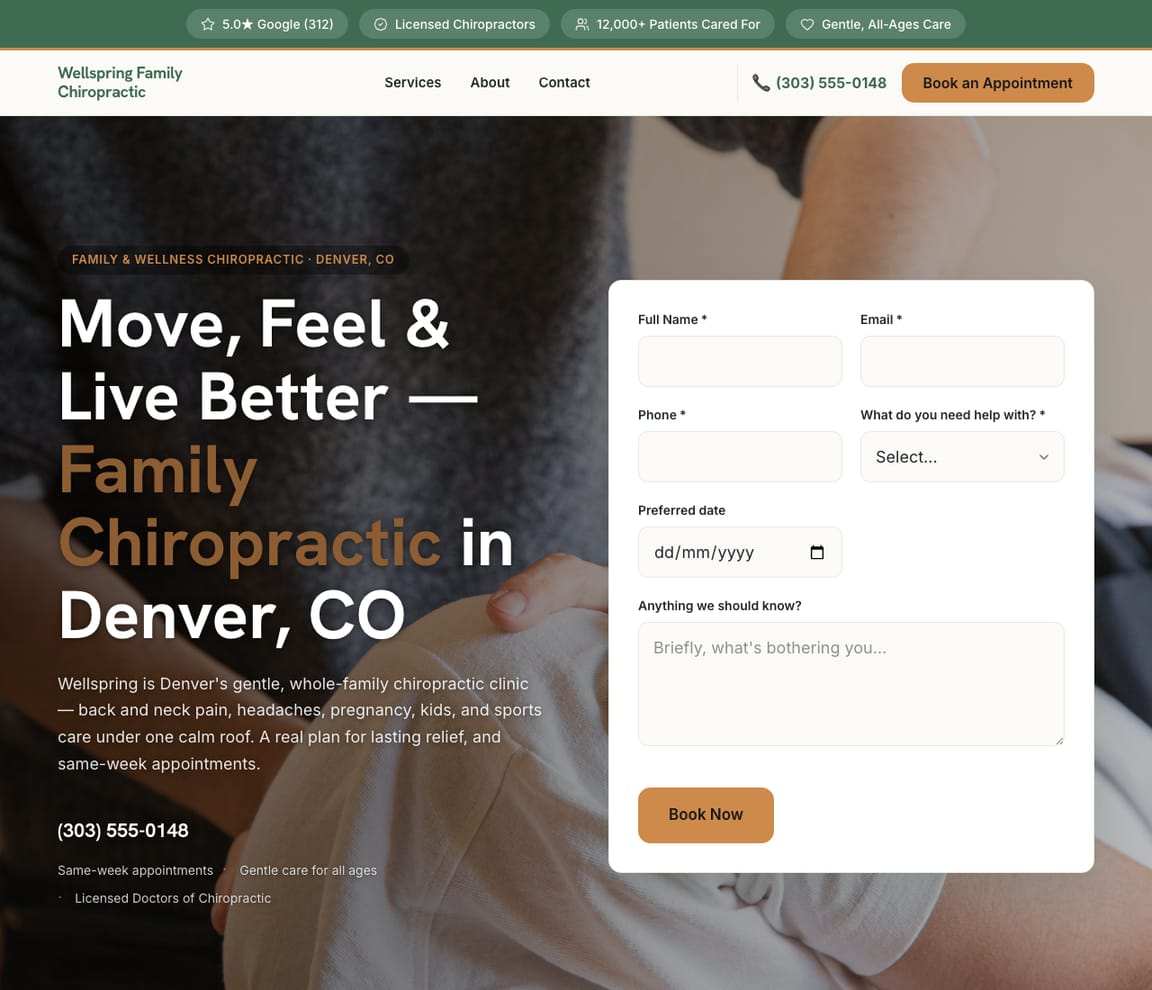
See what your chiropractic website could look like
Describe your practice and you get a professional site in about a minute — your services, the conditions you treat, an appointment form, and room for reviews, all mobile-ready and SEO-optimized from the start.
- Professional design — not a generic template
- Looks great on desktop and mobile
- Content written for your industry
Is a chiropractic practice worth starting?
For the right person, yes — but go in clear-eyed. Chiropractic is a licensed healthcare profession, not a side hustle: it takes a four-year Doctor of Chiropractic (D.C.) degree, national board exams, and a state license before you treat a single patient. That's a serious investment of time and money.
The upside is just as real. Demand for drug-free, hands-on pain relief keeps growing, patients come back for years rather than once, and malpractice costs are low compared with most healthcare fields. Once your schedule fills, you own a stable, respected local practice with strong margins.
The honest trade-offs: high upfront costs for equipment, space, and insurance credentialing; a slow first year while you build a patient base; and the reality that you're running a small business as much as a clinic — marketing, billing, and online reviews all included.
Starting a chiropractic practice, in plain English
Here's how it actually goes, once you're licensed.
First, decide who you'll focus on. General family care is the broadest start, but a niche helps you stand out and command higher rates: sports and performance, prenatal and pediatric, auto-accident recovery, spinal decompression, or wellness memberships. Most chiropractors start general and lean into a specialty as they find their footing.
Next, set up your space and equipment. You don't have to build out a full clinic on day one — many new chiropractors sublease a room in an existing practice or share space to keep costs down. You'll need an adjustment table, an activator and basic diagnostic tools, and HIPAA-compliant practice software for scheduling, notes, and billing.
Then get your first patients the fastest way there is: tell everyone you know, and start building referral relationships with local gyms, personal trainers, massage therapists, and physicians. Message your friends, family, and network and ask them to spread the word — offer a free first consultation to anyone they send. Something like:
“Hi! I've just opened [Practice Name], a chiropractic clinic here in [your town]. If you — or anyone you know — is dealing with back or neck pain, headaches, or recovering from an injury, I'd love to help. I'm offering a complimentary consultation and exam for anyone you refer this month.”
Copy that, make it yours, and send it to everyone in your phone.
Now decide how you'll charge. You can run a cash practice (per-visit fees and prepaid care plans — simpler, no insurance paperwork), bill insurance (a wider patient pool, but credentialing and claims), or blend both. Typical visits run $50–$200; call a few local clinics as a “new patient” to hear what your area actually pays, then price your exams, adjustments, and packages accordingly.
Finally — and this is the part that compounds — give every patient a great first visit, then ask for two things: a review on your Google Business Profile and a referral. A steady stream of 5-star reviews is exactly what makes Google show your clinic to the next person searching “chiropractor near me.” Do that on repeat and your schedule fills itself.
THE STARTER KIT
What you need to get started
Your license
A Doctor of Chiropractic (D.C.) degree, passing scores on the NBCE board exams, and an active state chiropractic license — plus an NPI number and malpractice insurance before you touch a patient.
Clinical equipment
An adjustment table (Hi-Lo, drop, or flexion-distraction), an activator, and basic diagnostic gear — reflex hammer, goniometer, and posture and exam tools.
A treatment space
A clinic — or a room you sublease inside an existing practice — with a reception area, one or two treatment rooms, and space for any therapy equipment.
Practice software
HIPAA-compliant chiropractic EHR and practice-management software for scheduling, SOAP notes, insurance billing, and patient records — day one.
A niche
Sports and performance, prenatal and pediatric, wellness memberships, auto-accident recovery, or spinal decompression — a focus lets you stand out and charge premium rates.
A way to get found
A professional website and a Google Business Profile — the two things that turn “chiropractor near me” searches into booked appointments (covered below).
THE STEPS
How to start your chiropractic practice (step by step)
Four steps from licensed graduate to a clinic with a full schedule.
01
Get licensed and insured
Chiropractic is a licensed profession, so this comes first: earn your Doctor of Chiropractic (D.C.) degree, pass the National Board of Chiropractic Examiners (NBCE) exams, and get your state chiropractic license. Then get your NPI number, professional-liability (malpractice) insurance, and form an LLC or PLLC to protect your personal assets and add credibility.
License is required02
Set up your practice
Choose your focus and location — lease a clinic or sublease a treatment room in an existing practice to start lean. Buy your core equipment (adjustment table, activator, and diagnostic and therapy tools), set up HIPAA-compliant EHR and scheduling software, and if you'll accept insurance, start credentialing with payers early — it can take months.
Sublease to start lean03
Price your care and land your first patients
Decide between a cash practice, insurance billing, or a blend, then set your exam, adjustment, and care-plan prices to your local market. Fill your schedule by telling your network, partnering with local gyms, trainers, and physicians, offering intro exams, and asking every happy patient for a referral — it's the #1 growth engine in this business.
$50–$200 per visit04
Get found online
To get a chiropractic practice found online, you need two things: a professional website and a Google Business Profile. The website should list your services, the conditions you treat, your team, patient reviews, and a “book an appointment” button; the Google Business Profile puts your clinic on Google Maps for “chiropractor near me” searches. The fastest way to set up both is an AI website builder like Zarla, which creates a professional chiropractic website free in about a minute and connects it to your Google Business Profile.
Set up free belowTHE COSTS
How much does it cost to start a chiropractic practice?
Chiropractic is capital-heavier than most home services — here's where the money actually goes.
$5K–$25KTables & clinical equipment
$1K–$3KMalpractice insurance (year 1)
$0Website with Zarlavs $3,000+ for a designer
$50K–$150KRealistic total to launchor ~$10K subleasing to start lean
WHAT WE'VE LEARNED
What actually gets a chiropractic practice found
We've built websites for thousands of local businesses, and the same three things decide which clinics show up on Google and Google Maps — and which stay invisible. Do all three and you'll get found; skip one and you won't.
A fast, findable website
Quick-loading, with real patient photos and reviews, plus a dedicated page for every service and condition you treat and every area you serve.
A connected Google Business Profile
Properly set up and linked to your website, so your clinic shows in Google Maps and the local “chiropractor near me” pack.
A steady stream of reviews
The signal Google trusts most for local clinics. Ask every patient who leaves feeling better for one — they add up faster than you'd think.
SEE IT WORK
Chiropractic website designs you can start from
Every one is a real Zarla template you can make yours in about a minute — just add your practice name, services, and the conditions you treat.



GET FOUND
Get found by local patients
A website plus a Google Business Profile is how nearby patients find and choose a chiropractor. Zarla sets up both and wires them together.
“Chiropractor near me”
Show up in local Google searches the moment someone needs an adjustment or pain relief in your area — the highest-intent leads there are.
Google Business Profile
Your clinic hours, services, patient reviews, and photos right in Google Maps, so a new patient can call or book an appointment in one tap.
Reviews that win the patient
Collect and show off 5-star reviews — the deciding factor when someone chooses between your clinic and the one down the street.
Google Search
Aanchorchiropractic.com
Anchor Chiropractic — Trusted chiropractor in Your AreaLicensed chiropractor available for residential and commercial work. Same-day response.← Your Zarla siteCcitychiropractorservices.com
City chiropractor ServicesGoogle Maps
1
Anchor Chiropractic
← You2
Metro chiropractor Co.
3
Quick chiropractor Services
AI assistants (ChatGPT / Perplexity)
For chiropractor services in your area: Anchor Chiropractic — 4.9★ across 200+ Google reviews, same-day response, licensed and insured.
YOUR LAUNCH PLAN
Your chiropractic practice launch checklist
Everything above, boiled down to the concrete steps — work through them in order and you'll be open for business and findable on Google.
- Get licensed — earn your D.C. degree, pass the NBCE boards, and hold an active state chiropractic license.
- Form your business — set up an LLC or PLLC, get your NPI number, and buy malpractice insurance.
- Choose your focus and space — pick a niche and lease or sublease a treatment room to start.
- Buy your core equipment — an adjustment table, an activator, and diagnostic and therapy tools.
- Set up practice software — HIPAA-compliant EHR for scheduling, SOAP notes, and billing.
- Decide cash vs insurance — set your prices and credential with payers if you'll bill insurance.
- Build your website and connect a Google Business Profile — free with Zarla.
- Do great work, then ask for a Google review after every patient's first visit.
REAL CUSTOMERS
Practice owners who got online with Zarla
Verified reviews from real Zarla customers.
“Quickly built my website from scratch. No hiccups. Would highly recommend Zarla for someone with no experience who wants to start a polished business website.”
“I had no idea how to set up a website for my business. Thanks to Zarla, they've helped me a lot.”
“Great professional website in less than a minute, with the use of AI and a few descriptive prompts. This has saved me bundles of time and research on web developers.”
“Optimized for local service-based businesses. Easiest website build I've experienced. The AI-based build is the way to go instead of clunky theme-based websites. Get the site built and get out of the weeds with Zarla!”
“Very reliable, professional, and fast results. I was able to get my business online in no time, and the ease of access made it so simple.”
Free to build
Ready to get your chiropractic practice online?
Describe your practice and Zarla builds your website in about a minute — your services, the conditions you treat, an appointment form, and room for reviews, all connected to Google.
Free to build and preview — no code, no credit card.
Frequently asked questions
Do you need a license to start a chiropractic practice?
Yes — chiropractic is a licensed healthcare profession. You must earn a Doctor of Chiropractic (D.C.) degree from an accredited program, pass the National Board of Chiropractic Examiners (NBCE) exams, and hold an active license from your state chiropractic board. You'll also need an NPI number, a general business license, and malpractice insurance before you treat patients.
How much does it cost to start a chiropractic practice?
A full new (de novo) practice typically costs $50,000–$150,000 once you factor in equipment, office build-out, software, insurance, and a few months of operating expenses. You can start much leaner — around $10,000–$30,000 — by subleasing a treatment room in an existing clinic, buying used equipment, and running a cash-based practice while you grow.
How long does it take to become a chiropractor?
Plan on around seven to eight years: three to four years of undergraduate coursework followed by a four-year Doctor of Chiropractic program (roughly 3,500+ hours of study and clinical training). After graduation you pass the NBCE board exams and apply for your state license before you can open your doors.
How do chiropractors get their first patients?
Referrals and local search. Tell your personal network, build relationships with local gyms, trainers, massage therapists, and physicians, and offer a free first consultation. Then make sure you're findable online — a website with your services and reviews plus a Google Business Profile is what turns “chiropractor near me” searches into booked appointments.
Should I run a cash or insurance-based chiropractic practice?
Both work. Cash practices (per-visit fees and prepaid care plans) are simpler — no credentialing, faster payment, and predictable pricing — but a smaller patient pool. Insurance-based practices reach more patients but require credentialing with each payer and more billing paperwork. Many chiropractors blend the two: accept a few major insurers and offer cash wellness plans on top.
How do I get my chiropractic practice found on Google?
Two things do most of the work: a professional website and a Google Business Profile. Your website should list your services, the conditions you treat, your team, patient reviews, and an appointment-booking button; your Google Business Profile puts your clinic on Google Maps for “chiropractor near me” searches. Then collect Google reviews from happy patients — they're the strongest signal Google uses to rank local clinics. An AI builder like Zarla creates the website free in about a minute and connects it to your Google Business Profile.
Can I start a chiropractic practice with no money?
Not entirely — the degree, license, and insurance are non-negotiable costs. But you can open with very little capital by working as an associate first to save up, subleasing space instead of building out a clinic, buying used equipment, and running cash-only to start. Keep overhead low: build a professional website free with Zarla and list on Google Business Profile at no cost, then reinvest your first patients' fees into growth.