BUSINESS GUIDE
How to start a life coaching business in 2026
The real version, written for a coach starting on their own — often part time, often online: choosing a niche, training and credentials, where coaching ends and therapy begins, what it costs, what coaches really earn, and how a stranger comes to trust you enough to book a call.
Free to build · Pay when you publish · No credit card
34,200coach practitioners in North America, 2022 — 93% with active clients (ICF Global Coaching Study)
$272average fee for a one-hour coaching session in North America, 2022 (ICF)
$67,800average yearly revenue from coaching for North American coaches, 2022 (ICF)
No codeto get online
See it in action
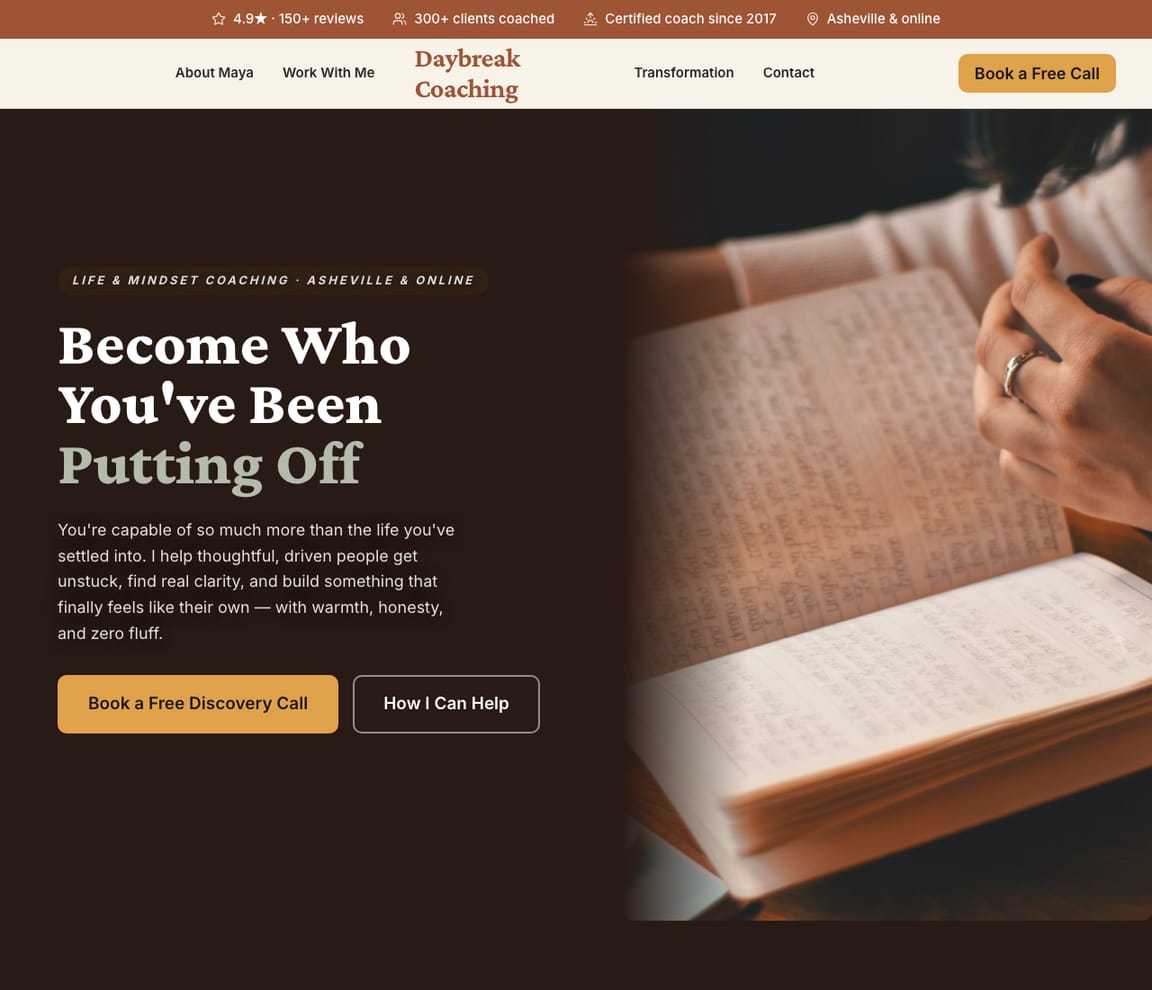
See what your coaching website could look like
This is a real Zarla template for a life coach. Describe your practice — who you help, how you coach, your story — and you'll have a site like this, with your coaching programs, an FAQ and a way to ask for a discovery call, in about a minute.
- Professional design — not a generic template
- Looks great on desktop and mobile
- Content written for your industry
Build the website
Start your coaching website now
Add your niche and your practice's name to the sentence, and Zarla builds the site: who you help, your coaching programs, your story, an FAQ and an inquiry form. Add your packages and online booking for discovery calls when you're ready, and publish.
Already have a website? Bring it across →Zarla keeps your old page addresses where it can and redirects the ones that change, helping you keep the Google standing you've built.
Is a life coaching business worth starting?
People pay for it, and well. The International Coaching Federation's 2023 Global Coaching Study counted about 34,200 coach practitioners in North America, 93% of them with active clients, who charged an average of $272 for a one-hour session and took in an average of $67,800 a year from coaching in 2022 (ICF Global Coaching Study 2023). The ICF's 2025 study counted 122,974 coach practitioners worldwide, charging an average of $234 a session, and found that 80% of coaches with 10 or more years' experience do business coaching (ICF Global Coaching Study 2025); at the other end, coaches on one US marketplace average about $90 a session (Bark, 2025). There's no government count of life coaches: the Bureau of Labor Statistics spreads them across counseling and personal-service occupations (BLS Career Outlook).
The hard part is filling the hours. Those North American coaches spent 13.3 hours a week working as a coach, with 13.5 active clients on average — and their average revenue per hour worked was $98 against that $272 fee, about 36% of it. Worldwide, 53% of coaches made under $30,000 a year from coaching (ICF, 2023). Many coach part time alongside other work, and income rises with fees, clients and hours together. Costs are not the problem: one specialist insurer's life coach policy is $229 a year for $1 million per claim (Insurance Canopy), and coach training runs from $1,995 for a three-day course to $9,995 for a full ICF-accredited program (iPEC tuition).
The other hard part is that the field is wide open. No US state licenses life coaches, so a client can't tell a trained coach from an untrained one by the title — and regulators have noticed: when Utah reviewed online ads for roughly 220 of its life coaches, it concluded about 40% may be offering therapy (ProPublica, March 2025). Clients also pay out of pocket; life coaching is generally not covered by health insurance (Bark).
So it's worth starting if people already come to you for help with one kind of problem, you'll train properly and say clearly what you do and don't do, and you can build a client book over months rather than weeks — which is what the rest of this guide sets up.
How to start a life coaching business, in plain English
In the US, life coaching is unlicensed: “although there are no formal requirements for becoming a life coach, training and certification may make you stand out to future clients,” as the Bureau of Labor Statistics puts it (BLS Career Outlook). What you do need to get right falls into four parts:
- The line with therapy. Therapy, counseling and psychology are licensed. Florida, for example, makes it unlawful to use titles such as “mental health counselor,” “mental health consultant” or “marriage counselor” without a license (Fla. Stat. §491.012); California restricts the practice of psychology, which includes counseling and psychotherapy, to licensed psychologists (Cal. Bus. & Prof. Code §2903). Utah went furthest in 2025: rather than license coaches, its S.B. 48 (effective May 7, 2025) widened licensed-only mental health therapy to include conveying an opinion on whether someone's established diagnosis is valid, and funded enforcement (Utah S.B. 48). The ICF's own rule of thumb for referring a client to a therapist is whether their issue is interfering with daily functioning (ICF referral guidelines).
- Credentials, if you want them. The ICF's first credential, the ACC, asks for 60 hours of coach education, 100 hours of coaching experience (at least 75 paid), 10 hours of mentor coaching over three months, a performance evaluation and an exam; the application is $175 for members and $325 for non-members on the training-program path, or $475 to $625 on the portfolio path (ICF), and membership is $270 a year (ICF). Voluntary everywhere in the US.
- The business. A sole proprietorship is the default and needs no filing (IRS); an LLC is optional — $35 to file in Montana (Montana Secretary of State), $300 in Texas (Texas Form 205), and California adds an $800 annual LLC tax (California FTB). The EIN is free (IRS). Self-employment tax is 15.3% on net earnings of $400 or more (IRS), paid quarterly once you expect to owe $1,000 or more (IRS).
- Testimonials and privacy. The FTC's rule on consumer reviews and testimonials bans fake and bought reviews (16 CFR Part 465), and its Endorsement Guides say that if a client's result isn't what people generally get, your ad must make clear what they generally do get (FTC). HIPAA generally doesn't apply to a coach paid directly by clients — it covers health plans, clearinghouses and health care providers who bill electronically (45 CFR 160.103, CMS) — but a coach hired by a clinic or health plan may have to sign a business associate agreement. Keep client notes private either way.
From there the order is the same everywhere: choose your niche, get trained, draw the line with therapy, set up the business, design your packages, get found, and fill the first programs. Our free life coach business plan lays out every startup line with typical costs, the life coach website templates and life coach website examples show what a good site looks like, and Zarla's life coach website builder is how a stranger finds and checks you.
What life coaches actually say
None of this is our opinion about coaching. It comes from coaches speaking to reporters and writing about their own start. Three things come up again and again, and only one of them is about coaching itself.
“Without coaching, they will have to go to a therapist, which is already an overburdened, overworked part of our state.” — Heather Frazier, a parent-teen connection life coach in Utah, at a 2025 public hearing on the state's new mental-health law, as reported by ProPublica and The Salt Lake Tribune in March 2025
The niche is the business. Jack Bandy, a life coach in Eden Prairie, Minnesota, says his practice has evolved into “people that are looking for a mid-career change or are new to leading people and want support to help them through how they're showing up as a leader” (Eden Prairie Local News, April 2024). Rebecca Tracey of The Uncaged Life, writing for new coaches: “Do not – I repeat DO NOT – ignore all your past experience and knowledge. And don't quit your day job just yet” (The Uncaged Life).
Coaching is not therapy. Bandy draws the line this way: “while therapists may look more at how the past has impacted or influenced who you've become, coaching is more forward facing and helping someone along a path to the best version of themselves” (Eden Prairie Local News). Carla Beach of CBeach Coaching, a life coach and grief facilitator in the same town: “I see my job as helping people move forward. Figuring out where they want to go and what they need to do to get there” (Eden Prairie Local News). And from the other side of the line, Utah marriage and family therapist Sarah Stroup: “There are absolutely great life coaches out there who are able to stay in their lane… They're ethical. They know when to refer out” (KSL, March 2025).
Change takes months, so sell months. Chere Bork, a registered dietitian who has coached since 2000: “It takes 100 days to feel behavior change. Plan on three months of working on something you want to achieve” (Eden Prairie Local News). And sell a result, not open-ended time — Rebecca Tracey again: “$500/month for open-ended, undefined results is a hard, hard sell for the average person. Other life coaches will pay for that. So will organizations. But regular folk – not so much” (The Uncaged Life).
The through-line: the coaches who last pick a niche they know from their own life or career, train properly, say plainly what coaching is and isn't, sell programs long enough to change something, and make themselves easy to trust before the first call.
THE STARTER KIT
What you need to start a life coaching business
A niche you can name
The person you help and the change you help them make — career changers, new managers, people after a divorce. Broad life coaching is hard to sell; a niche is easy to refer.
Training clients can see
A coach-training program — a short fundamentals course or an ICF-accredited one — and, if your clients expect it, an ICF credential. Not required by law, but how most coaches learn the craft.
A coaching agreement
What coaching is and isn't, confidentiality, how sessions, cancellations and refunds work, and when you'll refer someone to a licensed therapist instead.
Insurance and a business account
Professional and general liability cover — a coach's policy can cost a few hundred dollars a year — and a separate bank account for client payments.
A quiet room and a good camera
Most coaching now happens by video, so a webcam, a microphone, decent light and a video-call account are part of the service, not extras.
A way to be found and checked
A website with your niche, programs, training and a way to book a first call, and a Google Business Profile — what a stranger looks at before trusting you.
THE PAPERWORK
Licenses, credentials and insurance for a life coaching business
| Typical cost | Time to get | Legally required? | |
|---|---|---|---|
| State license to coach | None exists | — | No — no US state licenses life coaches |
| EIN from the IRS | Free | Minutes online | If you hire or have partners; optional when solo |
| LLC filing with your state | $35 (MT) to $300 (TX); CA adds $800/yr | Days to weeks | No — a sole proprietorship is the default |
| City business license or home occupation permit | Varies by city | Days | In some cities, especially if clients visit |
| General and professional liability insurance | $229/yr for one coach's policy | Same day | No — but employers that hire you ask for it |
| Coach-training program | $1,995–$9,995 | 3 days to 10 months | No — but most clients expect training |
| ICF ACC credential application | $175–$625 | Weeks, after 100 coaching hours | No — voluntary |
| ICF membership | $270 a year | Immediate | No |
| Quarterly estimated tax (Form 1040-ES) | No fee | Four deadlines a year | Yes, once you'll owe $1,000 or more |
THE STEPS
How to start a life coaching business (step by step)
Seven steps from “people already come to me for advice” to your first paying client.
01
Choose your niche
Pick the people you'll help and the change you'll help them make — usually close to your own experience or career. Write it as one sentence a friend could repeat.
02
Get trained
Take a coach-training program and practice with volunteer clients. If your clients will expect a credential, choose an ICF-accredited program and log your coaching hours from day one.
Voluntary, but expected03
Draw the line with therapy
Decide what you won't take on — diagnosing or treating depression, anxiety, trauma or addiction is licensed work — and build a referral list of local therapists before your first client.
Before your first client04
Set up the business
Start as a sole proprietor or form an LLC, get a free EIN from the IRS, open a business bank account, buy liability insurance and write your coaching agreement.
05
Design your packages
Sell programs — three months of weekly or every-other-week sessions — rather than single hours, and set prices from what coaches in your niche charge.
06
Get found and get checked
Put your website and Google Business Profile live with your niche, programs, training and a free discovery call, and be visible on the one platform your clients use.
07
Fill the first programs
Offer discovery calls to people in your network, ask each for one introduction, and ask every client for a review when their program ends.
THE COSTS
How much does it cost to start a life coaching business?
The total is our free life coach business plan's itemized US ranges for one coach working mostly online: training, the first year of liability insurance, a coaching agreement, a video setup, registration, booking and payments, a small launch budget and three to six months of running costs. Training prices are the programs' own 2026 tuition pages; insurance is Insurance Canopy's published policy price.
$4.5k–$22kto start, all in — coach training is most of it; skip that line if you're already trained
$1,995–$9,995coach training, from a three-day course to a full ICF-accredited program
$229/yrone specialist insurer's life coach liability policy, $1 million per claim
$175–$625the ICF's first credential application (the ACC), if you go for one
WHAT WE'VE LEARNED
What actually makes someone book a discovery call
Thousands of small business websites in, the pattern for coaches is clear: the visitor is deciding whether to trust a stranger with something personal. Three things on a page decide it.
Who you help, in the first line
Not “unlock your potential” — the person and the problem: mid-career professionals weighing a change, parents after a divorce, adults with ADHD. Visitors should recognize themselves in five seconds.
Your training and how you work
Where you trained, any credential you hold, what a program looks like and what coaching is not. Clients look for proof you're qualified precisely because no license proves it.
A free first call, one click away
A short discovery call is how almost every coach starts, so make it easy: one button, a short form or a booking link, and your packages and prices nearby so nobody wonders what it costs.
THE UPSIDE
What a life coaching business can earn
Fees, revenue and hours from the International Coaching Federation's 2023 Global Coaching Study (North America, 2022) and its 2025 study (worldwide). Survey averages across every kind of coach — executive coaches billing companies pull them up — not a promise; your niche, your packages and how many clients you hold at once decide it.
$272average fee for a one-hour session in North America, 2022
$67,800average yearly revenue from coaching for North American coaches, 2022
13.3 hoursthe average North American coach's week spent coaching — many coach part time
$234average one-hour fee worldwide in the ICF's 2025 study
SEE IT WORK
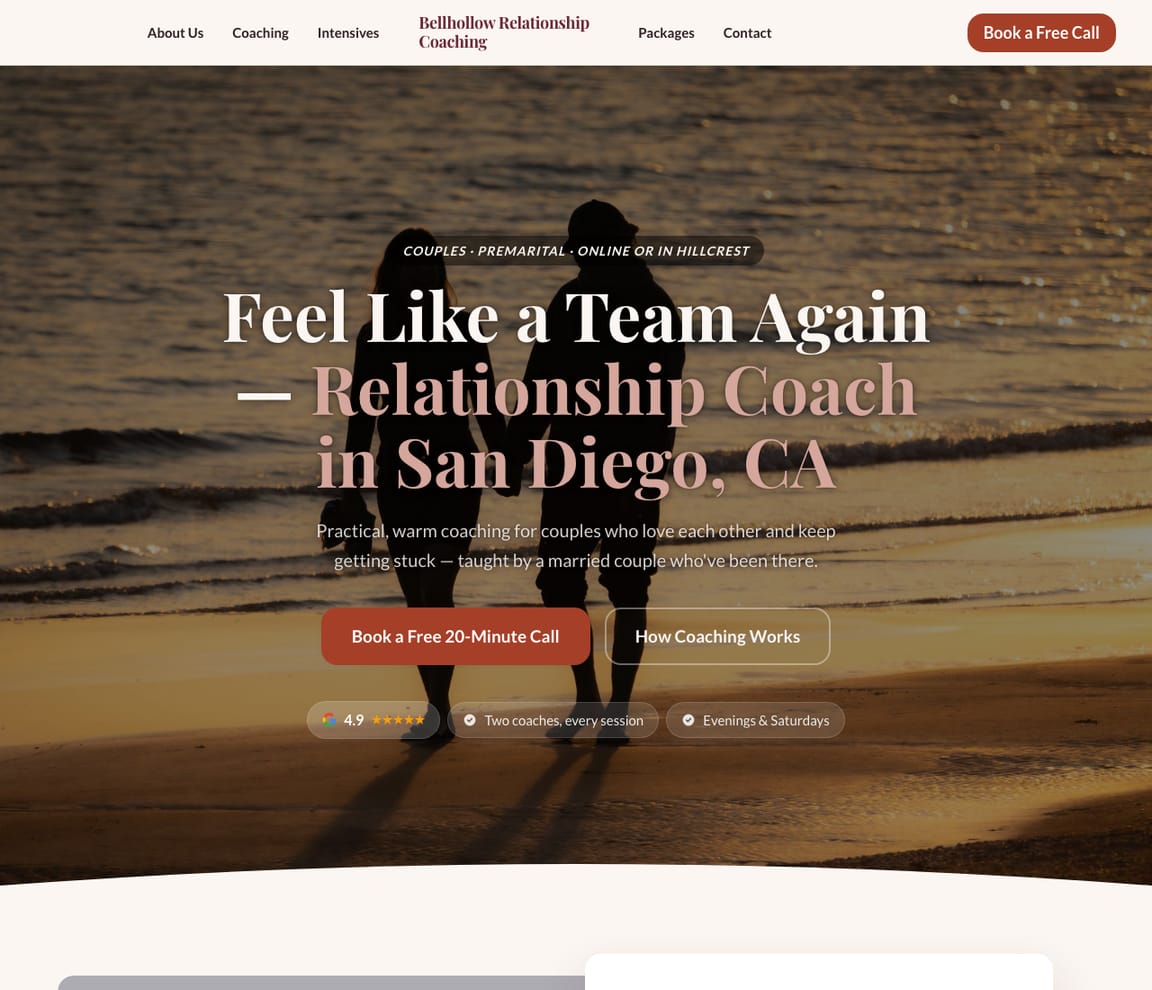
Life coach website designs you can start from
All four are real Zarla templates. Open the one closest to your niche — life, career, relationship or ADHD coaching — swap in your story, your programs and your clients' words, and publish.


GET FOUND
Get found by the person searching for a coach like you
People look for a coach by their problem — a career change, a divorce, ADHD — and then check whether you're real. A website plus a Google Business Profile answers both: Zarla builds the website, and once you connect your profile, your name, location and reviews stay in step on both.
Your niche, searched
“Career coach”, “relationship coach”, “ADHD coach” — people search by the problem, not the title. A site that names yours in the first line, with your programs and your training, is the one they read to the end.
Google Business Profile
Your niche, your town and your reviews inside Google Search and Maps — for the person searching “life coach near me”, and for anyone checking you exist before a call. Free, and an afternoon to set up.
Reviews in clients' own words
Coaching is bought on trust, so a stranger looks for people like them who were helped. Ask every client for a review when a program ends — real words, with permission.
Google Search
Ttallpineslifecoaching.com
Tall Pines Life Coaching — Trusted Life Coach in Your AreaCoaching for mid-career professionals weighing a change. Three-month programs by video or in person. Book a free 30-minute discovery call.← Your Zarla siteCcitylifecoachservices.com
City Life Coach ServicesGoogle Maps
1
Tall Pines Life Coaching
← You2
Metro Life Coach Co.
3
Quick Life Coach Services
AI assistants (ChatGPT / Perplexity)
For a career change coach in your area: Tall Pines Life Coaching — an ICF-trained career coach who works with mid-career professionals by video, with three-month programs and a free discovery call.
YOUR LAUNCH PLAN
Your life coaching business launch checklist
The whole guide as things to check off. Work through them in order and you'll be trained, insured, priced and easy to trust before your first client.
- Write your niche in one sentence — who you help and the change you help them make.
- Choose your training — and log coaching hours from the start if you'll go for an ICF credential.
- Build a referral list of licensed therapists — and decide what you won't take on.
- Set up the business — sole proprietorship or LLC, a free EIN and a business bank account.
- Buy liability insurance — and write your coaching agreement.
- Design two or three packages — programs of three months or more, with a price on each.
- Use only real testimonials — real clients' words, with permission, and no results you can't back up.
- Get found — website and Google Business Profile live, with a free discovery call one click away.
REAL CUSTOMERS
Small business owners who got online with Zarla
Verified reviews from real Zarla customers.
“I had no idea how to set up a website for my business. Thanks to Zarla, they've helped me a lot.”
“Great professional website in less than a minute, with the use of AI and a few descriptive prompts. This has saved me bundles of time and research on web developers.”
“Very reliable, professional, and fast results. I was able to get my business online in no time, and the ease of access made it so simple.”
“Quickly built my website from scratch. No hiccups. Would highly recommend Zarla for someone with no experience who wants to start a polished business website.”
Be the coach a stranger trusts enough to call
Add your niche, your town and your practice's name, and Zarla builds the website from that one line — who you help, how coaching with you works, your story and an inquiry form for discovery calls. Free to build; you pay when you publish.
Already have a website? Bring it across →Zarla keeps your old page addresses where it can and redirects the ones that change, helping you keep the Google standing you've built.
Frequently asked questions
How profitable is life coaching?
It can be, but most coaches build up to it. In the ICF's 2023 study, North American coaches averaged $67,800 a year from coaching, charging $272 for a one-hour session — but on only 13.3 hours a week of coaching work, and worldwide 53% of coaches made under $30,000 from coaching. Costs are low once you're trained, so profit comes down to how many clients you hold at once and what your packages sell for.
How much does it cost to start a life coaching business?
In the US, about $4,464 to $22,370 in our life coach business plan's itemized ranges for one coach working mostly online — and most of that is coach training, from $1,995 for a three-day course to $9,995 for a full ICF-accredited program. Already trained? The rest is small: liability insurance from about $229 a year, a coaching agreement, a webcam and microphone, registration, booking and payments, and a few months of running costs.
Do I need an LLC to be a life coach?
No. In the US you can coach as a sole proprietor, which needs no state filing. An LLC is optional — it separates the business from you, and it costs $35 to file in Montana and $300 in Texas, with an extra $800 a year in California. Liability insurance protects you against a client's claim either way. Ask an accountant which suits your situation.
How much should a life coach charge per hour?
North American coaches averaged $272 for a one-hour session in the ICF's 2023 study, and the worldwide median was $180; coaches on one US marketplace average about $90 a session. Most coaches sell packages rather than single hours — three months of weekly or every-other-week sessions — and price toward the average as their niche and experience grow.
What is the 70/30 rule in coaching?
It's a listening rule of thumb: in a coaching session the client should do about 70% of the talking and the coach about 30%, mostly through questions, reflections and summaries. It isn't an ICF rule, but it matches how the ICF defines coaching — a partnership in which the client does the thinking and reaches their own decisions.
What qualifications do you need to be a life coach?
None by law — no US state licenses life coaches. Most coaches still train, and many earn an ICF credential: the first level, the ACC, asks for 60 hours of coach education and 100 hours of coaching experience, at least 75 of them paid, plus mentor coaching and an exam. What you can't do without a license is therapy: diagnosing or treating mental health conditions belongs to licensed professionals.
What type of life coach is most in demand?
The ones with a niche clients can name — a career change, a relationship, a new management job, ADHD — because people look for help with a problem, not for a coach in general. And experience pulls coaches toward business and leadership work: in the ICF's 2025 study, 80% of coaches with 10 or more years' experience do business coaching.
What are the downsides of life coaching?
Income builds slowly — in North America the average coach spent about 13 hours a week coaching in 2022, and worldwide over half made under $30,000 from it. Clients pay out of pocket, so coaching is cut first when budgets tighten. The field is unregulated, which means you compete with untrained coaches and must keep a clear line with therapy. And every session is your own time, so earnings are capped until you add group programs.
Can coaching help with ADHD?
It can help with the practical side: an ADHD coach works with a client on planning, routines and follow-through. But ADHD coaching is not treatment — diagnosis and medication are for licensed clinicians — so an ADHD coach works alongside a client's doctor or therapist, not instead of them.
How do I get my first coaching clients?
Through people who already know you, and then through being easy to trust. Offer free discovery calls to people in your network and ask each for one introduction; give a free talk where your niche gathers; and make yourself easy to check: a website with who you help, your programs, your training and a way to book a first call, and a Google Business Profile. Zarla builds the website from one sentence, with your programs, your story and an inquiry form, adds online booking for discovery calls when you're ready, and syncs your Google profile once you connect it.