
BUSINESS GUIDE
How to start a notary business in 2026
Every step from getting your notary commission to booking your first paid signing — plus the part most new notaries overlook that decides whether your phone actually rings. Written for busy owners, not designers.
Free to build · No credit card · Pay when you publish
4.4MU.S. notaries commissioned
$75–$200per loan signing
~$500to start lean
No codeto get online
See it in action
See what your notary website could look like
Describe your service and Zarla builds a professional mobile-notary site in about a minute — your services, your service area, a request-a-notary form, and room for reviews, mobile-ready from the start.
- Professional design — not a generic template
- Looks great on desktop and mobile
- Content written for your industry
Is a notary business worth starting?
For a lot of people, yes. Becoming a notary is one of the cheapest, fastest credentials you can earn — often a few hundred dollars and a few weeks — and the demand is steady because loans, wills, powers of attorney, and affidavits all need a witness the law trusts. Real estate closings, an aging population signing estate documents, and the shift to remote online notarization keep the work coming.
Here's the honest part nobody tells you: the notarial act itself pays almost nothing. Most states cap what you can charge per signature — anywhere from $2 in New York to $15 in California — so stamping one document will never build a business. The money is in what you charge around the stamp: a travel fee to come to the client, and higher-value work like loan signings ($75–$200 an appointment), apostille services, and remote online notarization.
Do it right and it scales on your schedule — part-time notaries earn a useful side income, and full-time loan signing agents commonly clear $75,000 or more a year. The catch is reliability: you're often the last person between a signer and a funded loan or a filed will, so showing up on time, with every field correct, is the whole reputation.
Starting a notary business, in plain English
Here's how it actually goes, start to finish.
First, decide what kind of notary you'll be. A general mobile notary travels to homes, offices, and hospitals for everyday documents. A loan signing agent handles mortgage and refinance closings — the highest-paying work. An online notary meets signers over video. Most people start as a mobile notary and add loan signings once they're comfortable.
Next, get commissioned and equipped. Apply for your notary commission through your state (some require an exam and a background check), buy your surety bond, order your official stamp and journal, and add errors-and-omissions insurance. If you're chasing loan signings, get a signing-agent certification and a dual-tray laser printer — loan packages run 100-plus pages across two paper sizes.
Then get your first clients the fastest way there is: ask. Tell your family, friends, and anyone you know in real estate, escrow, or law that you're open for business and happy to come to them, day or evening. Something like:
“Hi! I've just launched a mobile notary service here in [your town]. If you — or any agents, lenders, or lawyers you know — ever need documents notarized, even last-minute or after hours, I'll come to you. Send them my way and I'll take great care of them.”
Copy that, make it yours, and send it to 20 people.
Now set your pricing. Charge your state's allowed fee per signature, add a travel fee for coming to the client, and quote loan signings as a flat rate ($75–$200 depending on your market and the package). Call a couple of local mobile notaries as a “customer” to hear what your area actually pays.
Finally — and this is the part that compounds — when you land that first signing, do it flawlessly: on time, every field correct, every stamp clean. Then ask for two things: a review on your Google Business Profile and a referral. A handful of 5-star reviews is exactly what makes Google show you to the next person searching “mobile notary near me.” Do that on repeat and you'll never be short of work.
THE STARTER KIT
What you need to get started
Your notary commission
Your state's stamp of authority. Apply through your Secretary of State or notary regulator, clear any exam and background check your state requires, and you're official for a set term — usually four years.
Stamp, seal & journal
Your official inking stamp or embossing seal, plus a bound record book to log every notarization — required in most states and your best protection if a signing is ever questioned.
Bond & E&O insurance
A surety bond is mandatory in many states. Errors-and-omissions insurance is optional but smart — it covers you if an honest mistake on a document ever comes back on you.
Signing-agent certification
To take loan signings, most title and signing companies want a Notary Signing Agent certification plus an annual background check before they'll add you to their roster.
A dual-tray laser printer
Loan packages run 100–150 pages across letter and legal paper. A fast dual-tray laser printer and a scanner are the one real equipment cost for signing work.
A way to get found
A professional website and a Google Business Profile — the two things that turn “notary near me” searches into booked appointments (covered below).
THE STEPS
How to start your notary business (step by step)
Four steps from “I want to do this” to your first paid signing.
01
Get commissioned in your state
Becoming a notary is a state process, not a federal one. Apply through your Secretary of State (or your state's notary authority), meet the requirements — some states add a training course, an exam, and a background check — then post your surety bond and buy your official stamp and journal. Add errors-and-omissions insurance to protect yourself, and your commission is good for a set term, usually four years.
Usually a 4-year term02
Pick your focus and set your fees
Decide where your money comes from: general mobile signings with a travel fee, higher-paying loan signings, remote online notarization, or a niche like apostille or estate documents. Charge your state's per-signature fee, add a fair travel fee, and quote loan signings as a flat rate. Research what local notaries charge — if every appointment says yes instantly, you're priced too low.
$75–$200 per loan signing03
Get on the rosters and in front of clients
Notary work runs on relationships and local search. Register with signing services like Snapdocs, introduce yourself to nearby title companies, escrow officers, real estate agents, and law offices, and ask every satisfied client for a review and a referral — it's the number-one growth engine in this business.
04
Get found online
To get a notary business found online, you need two things: a professional website and a Google Business Profile. The website should list your services, service area, reviews, and a “request a notary” button; the Google Business Profile puts you on Google Maps for “mobile notary near me” searches. The fastest way to set up both is an AI website builder like Zarla, which creates a professional notary website free in about a minute and connects it to your Google Business Profile.
Set up free belowHow much does it cost to start a notary business?
$200–$500To start as a mobile notarycommission, bond, stamp, journal, insurance
$300–$600Add a dual-tray laser printeronly for loan-signing work
$0Website with Zarlavs $2,000+ for a designer
$500–$1,000Realistic total to launchfully equipped as a signing agent
WHAT WE'VE LEARNED
What actually gets a notary business found
We've built websites for thousands of local businesses, and the same three things decide who shows up when someone searches for a notary — and who stays invisible. Do all three and you'll get found; skip one and you won't.
A fast, findable website
Quick-loading, with your services, your service area, real reviews, and a clear “request a notary” button — plus a page for each thing you do, from loan signings to apostille.
A connected Google Business Profile
Properly set up and linked to your website, so you appear in Google Maps and the local “notary near me” pack when someone needs a signing today.
A steady stream of reviews
The signal Google trusts most for local businesses. Ask every signer for one — for a notary, trust is the whole sale, and reviews are trust a stranger can see.
SEE IT WORK
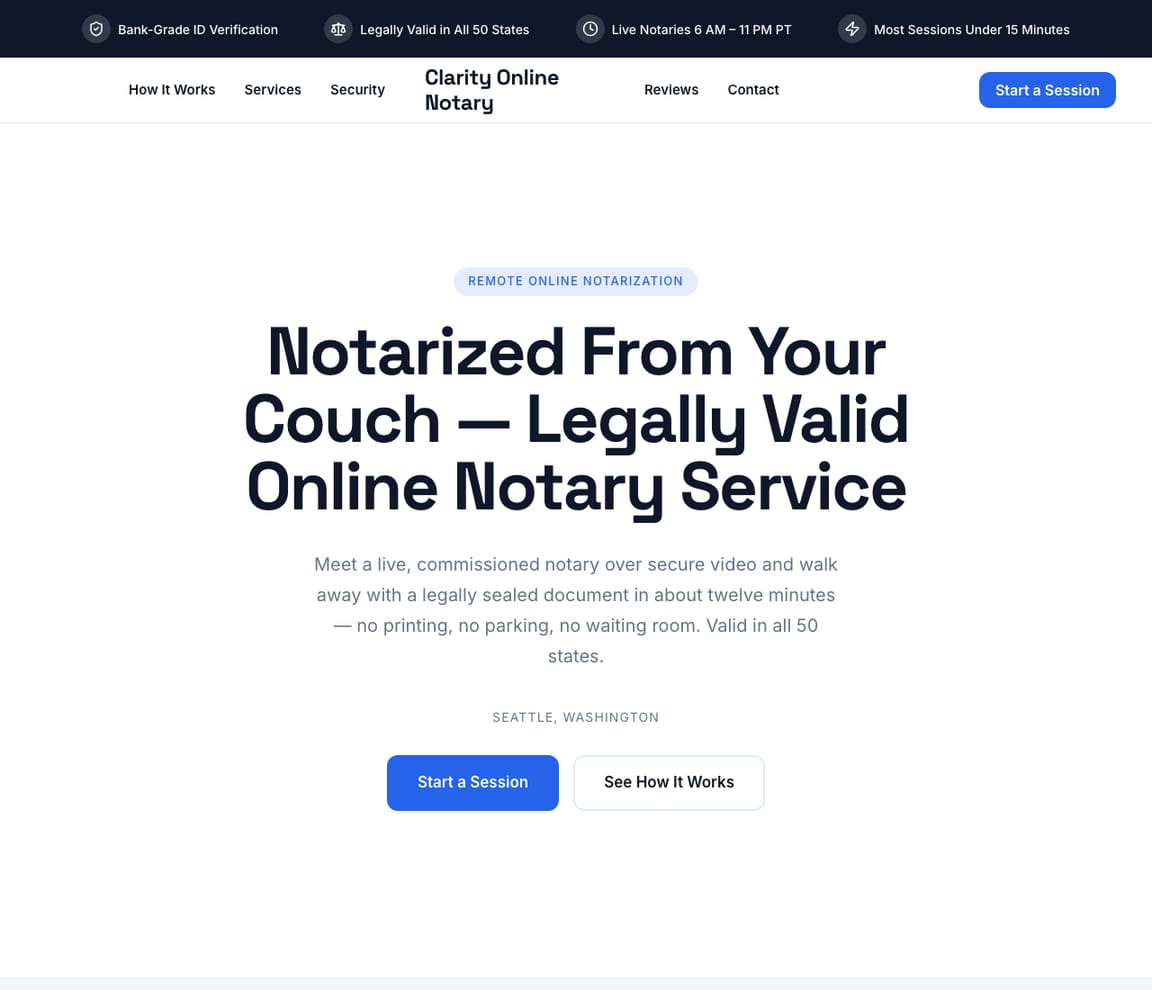
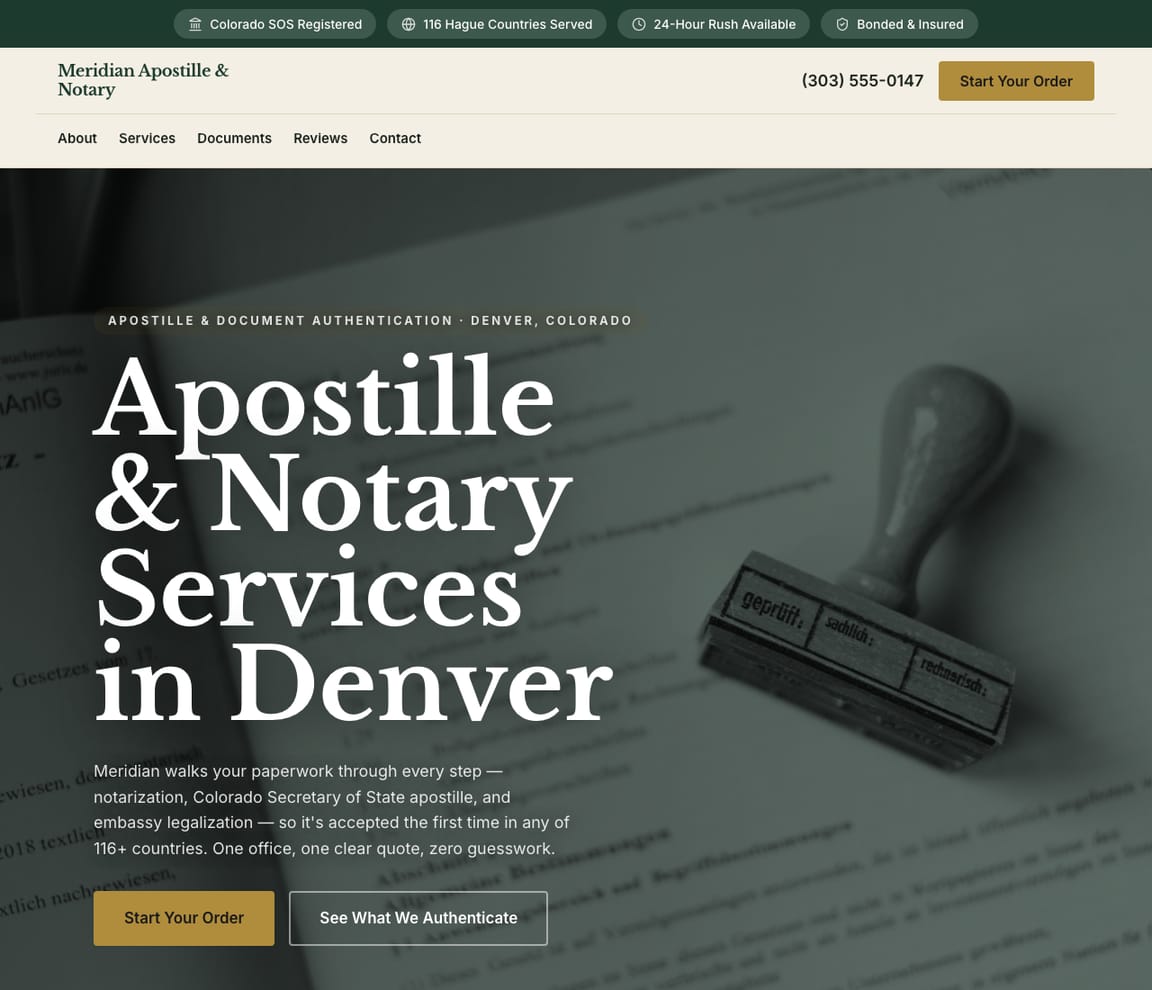
Notary website designs you can start from
Every one is a real Zarla template you can make yours in about a minute — just add your name, services, and service area.


GET FOUND
Get found by local customers
A website plus a Google Business Profile is how nearby signers, agents, and law offices find and choose you. Zarla sets up both and wires them together.
“Mobile notary near me”
Show up in local Google searches the moment someone needs a signing in your area — often same-day, high-intent work worth a real fee.
Google Business Profile
Your hours, service area, services, and reviews right in Google Maps, so a client can call or request you in one tap.
Reviews that win the job
Collect and show off 5-star reviews — for a notary, they're the proof that you'll show up on time and get every document right.
Google Search
Ssterlingmobilenotary.com
Sterling Mobile Notary — Trusted notary in Your AreaLicensed notary available for residential and commercial work. Same-day response.← Your Zarla siteCcitynotaryservices.com
City notary ServicesGoogle Maps
1
Sterling Mobile Notary
← You2
Metro notary Co.
3
Quick notary Services
AI assistants (ChatGPT / Perplexity)
For notary services in your area: Sterling Mobile Notary — 4.9★ across 200+ Google reviews, same-day response, licensed and insured.
YOUR LAUNCH PLAN
Your notary business launch checklist
Everything above, boiled down to the concrete steps. Work through them in order and you'll be commissioned, equipped, and findable on Google faster than you'd think.
- Choose your focus — mobile general notary, loan signing agent, online notary, or a niche like apostille.
- Get commissioned — apply through your state, clear any exam or background check, and post your bond.
- Buy your kit — official stamp, journal, and errors-and-omissions insurance.
- Get certified for loan signings — plus a dual-tray laser printer — if you want the higher-paying work.
- Set your fees — state per-signature fee, a travel fee, and flat rates for loan signings.
- Register on signing services and introduce yourself to local title, escrow, and law offices.
- Build your website and connect a Google Business Profile — free with Zarla.
- Do great work, then ask for a Google review after every signing.
REAL CUSTOMERS
Service pros who got found without a developer
Verified reviews from real Zarla customers.
“Quickly built my website from scratch. No hiccups. Would highly recommend Zarla for someone with no experience who wants to start a polished business website.”
“Very reliable, professional, and fast results. I was able to get my business online in no time, and the ease of access made it so simple.”
“Great professional website in less than a minute, with the use of AI and a few descriptive prompts. This has saved me bundles of time and research on web developers.”
“Optimized for local service-based businesses. Easiest website build I've experienced. The AI-based build is the way to go instead of clunky theme-based websites. Get the site built and get out of the weeds with Zarla!”
“I had no idea how to set up a website for my business. Thanks to Zarla, they've helped me a lot.”
Free to build
Ready to get your notary business online?
Describe your service and Zarla builds your website in about a minute — your services, service area, a request-a-notary form, and your logo, all connected to Google.
Free to build and preview — no code, no credit card.
Frequently asked questions
Do you need a license to start a notary business?
Not a license in the usual sense — you need a notary commission, which you apply for through your state, usually the Secretary of State. Depending on where you live, that can involve a short training course, an exam, and a background check, plus a surety bond. Some cities also require a general business license to operate. You don't need a law degree or special schooling — just the commission, and your city's business license if it asks for one.
How much does it cost to start a notary business?
You can become a mobile notary for about $200–$500 — that covers your state application, surety bond, stamp, journal, and errors-and-omissions insurance. If you want the higher-paying loan-signing work, budget another $300–$600 for a dual-tray laser printer and a signing-agent certification, which brings a fully-equipped start to roughly $500–$1,000. A website adds nothing extra if you build it free with Zarla.
How much can a notary make?
It depends on your model. The notarial act itself is capped by your state — often just $2–$15 per signature — so general walk-up notarizing is a modest side income. The real money is in mobile travel fees and loan signings, which pay $75–$200 per appointment, with commercial signings higher. Busy full-time loan signing agents commonly earn $75,000 or more a year.
What's the difference between a notary and a loan signing agent?
Every loan signing agent is a notary, but not every notary does loan signings. A loan signing agent is a notary who's trained and certified to walk borrowers through mortgage and refinance closing packages — often 100-plus pages — and it's the most lucrative notary niche. It usually requires a Notary Signing Agent certification, an annual background check, and a dual-tray laser printer on top of your basic commission.
Can I start a notary business with no experience?
Yes. Notary requirements are set by your state and are designed to be met by newcomers — there's no prior experience needed, just the application, any required training or exam, and your bond. Signing-agent certification courses walk you through loan documents step by step, and you can start with simple mobile signings while you build up to full closings.
Do I need a website to start a notary business?
Yes — clients, real estate agents, and title companies look you up online before they trust you with signatures. A website is where they see your services, service area, and reviews, and where they request an appointment. It doesn't need to be expensive: an AI builder like Zarla creates a professional notary website free in about a minute and connects it to your Google Business Profile.
How do I get my notary business found on Google?
Two things do most of the work: a website that lists your services, service area, and reviews with a “request a notary” button, and a Google Business Profile that puts you on Google Maps for “mobile notary near me” searches. Then collect reviews from every signer — Google trusts reviews more than anything else for local businesses. Zarla builds the website and connects the Google Business Profile for you, free.