BUSINESS GUIDE
How to start a pest control business in 2026
Every step from passing your license exam to landing your first recurring customers — plus the one thing most new operators skip that decides whether the phone rings. Written for busy owners, not designers.
Free to build · No credit card · Pay when you publish
$26BU.S. pest control industry
$150+typical treatment
~$5Kto start lean
No codeto get online
See it in action
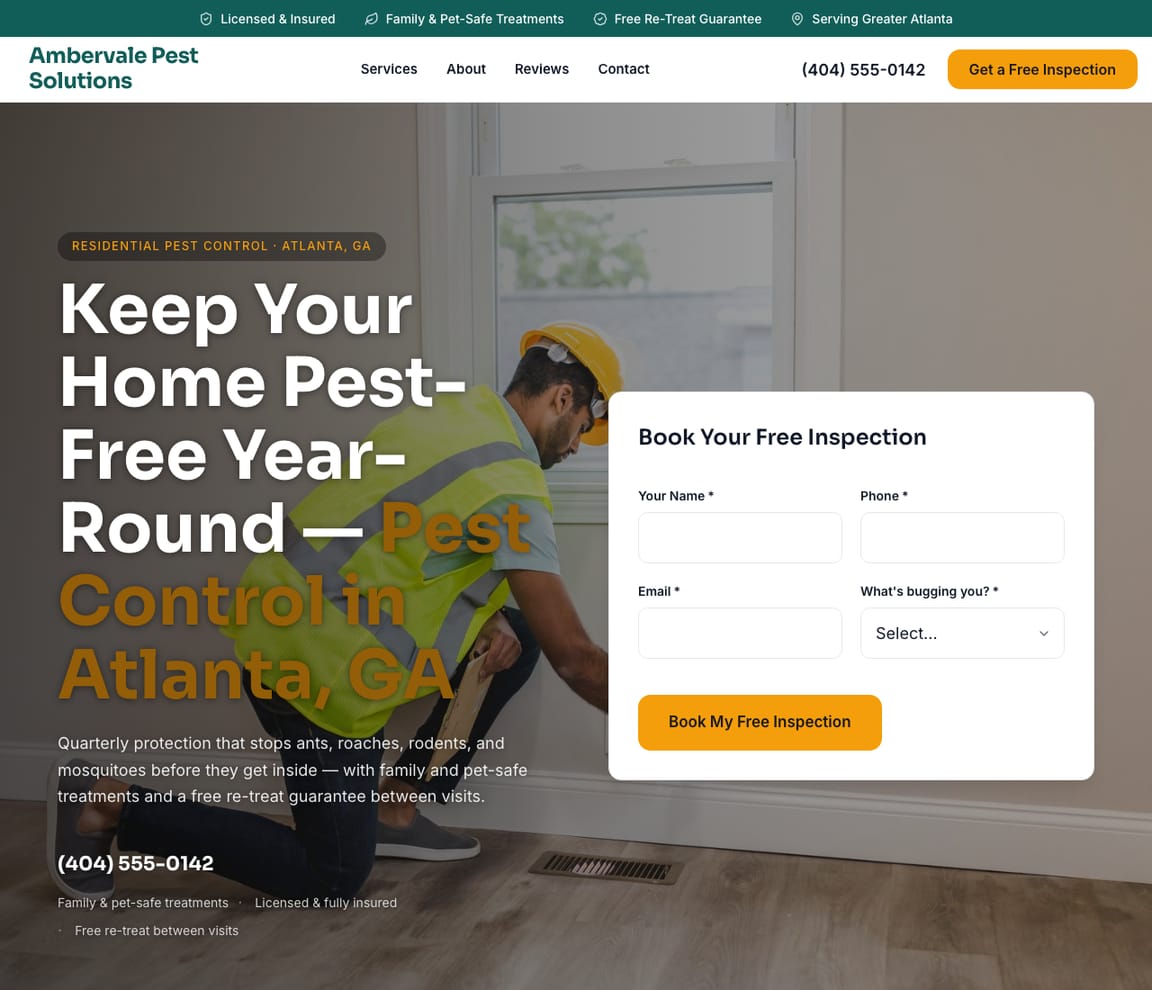
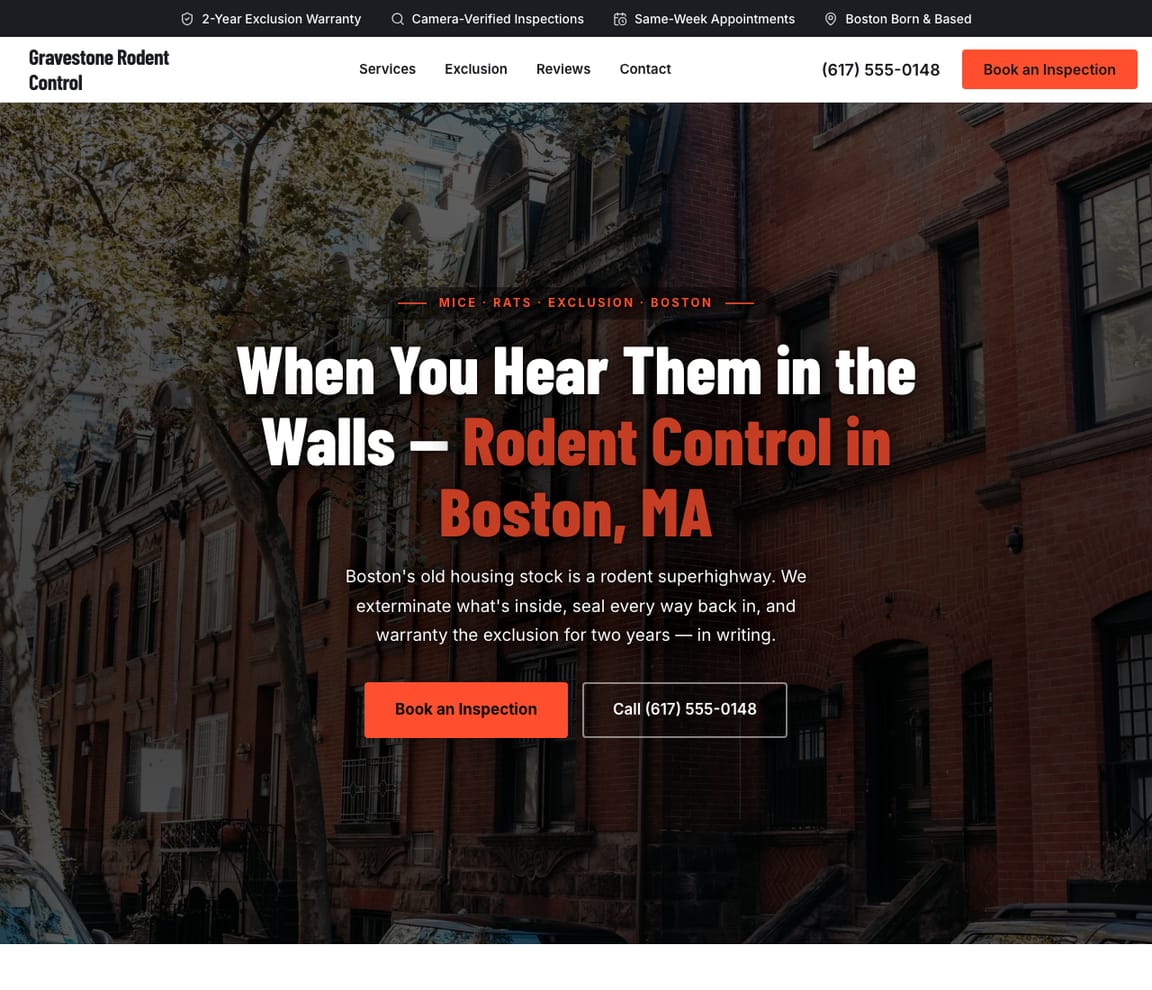
See what your pest control website could look like
This is a real Zarla template — describe your business and you get a site like this in about a minute, with your services, a request-an-inspection form, and room for reviews.
- Professional design — not a generic template
- Looks great on desktop and mobile
- Content written for your industry
Is a pest control business worth starting?
For the right person, yes. Pest control is a $26-billion U.S. industry with something most trades don't have: recurring revenue. Homeowners don't buy a one-time spray and disappear — they sign up for quarterly or bi-monthly protection plans, so every customer you win keeps paying visit after visit. Demand is steady too; ants, roaches, and rodents don't take a year off, and no app makes them go away.
It's also a real business, not a Saturday side hustle. Pest control is a licensed, regulated trade — you handle EPA-registered chemicals inside people's homes, which means exams, a state license, insurance, and genuine skill. That barrier is the good news: it keeps out the tire-kickers and lets a licensed, professional operator charge accordingly.
The honest trade-offs: the licensing gate takes time to clear, the work is seasonal (spring and summer are your peak), and you're up against national brands like Terminix and Orkin. But those brands are beatable locally — homeowners want someone who answers the phone, shows up on time, and treats their home like it matters. Win on trust and responsiveness and you'll build a book of recurring accounts that's worth real money.
Starting a pest control business, in plain English
Here's how it actually goes, from licensed to booked.
First, get licensed and pick your focus. Pass your state pesticide applicator exam, then decide what you'll treat: general household pests (ants, roaches, spiders), termites and wood-destroying organisms, bed bugs, rodents, mosquitoes, or commercial accounts. Most owners start with general residential pest control and add specialties as they learn the trade.
Next, get your rig. A backpack sprayer and a compressed-air (B&G) sprayer, a bait gun, dusters, PPE, and a starter stock of EPA-registered products. If you already own a truck, you can be fully equipped for a few thousand dollars.
Then get your first jobs the fastest way there is: ask. Message your family, friends, and neighbours, offer them a free inspection, and ask them to spread the word — a first-treatment discount for anyone they refer works wonders. Something like:
“Hi! I've just started a licensed, insured pest control business here in [your town]. If ants, roaches, rodents, or a termite worry are bugging you — or someone you know — I'd love to help. I'll do a free inspection and take $30 off the first treatment for anyone you send my way.”
Copy that, make it yours, and send it to 20 people.
Now set your pricing. Charge for one-time treatments ($150–$300 for general pest), but build the business around recurring plans — quarterly service at $100–$150 a visit is the steady income that makes this trade profitable. Price specialty work higher: termite jobs run into the thousands. Call a couple of local companies as a “customer” to hear what your area actually pays.
Finally — and this is the part that compounds — when you land that first job, do it brilliantly. Then ask for two things: a review on your Google Business Profile and a referral. A handful of 5-star reviews is exactly what makes Google show you to the next person searching “exterminator near me” — and what makes a nervous homeowner pick you over a national brand. Do that on repeat and you'll never be short of work.
THE STARTER KIT
What you need to get started
Sprayers & application gear
A backpack sprayer and a compressed-air (B&G) sprayer for liquids, plus a bait gun and dusters for the cracks, voids, and crevices where pests actually live.
EPA-registered products
Liquid concentrates, gel baits, rodenticides, dusts, and insect growth regulators (IGRs) — buy only what your license category covers, and store them locked and labeled.
Protective equipment
A respirator, chemical-resistant gloves, goggles, and a Tyvek suit. You're applying pesticides in homes and businesses, so PPE isn't optional — it's the job.
Inspection tools
A bright flashlight, a moisture meter, a telescoping mirror, and a drill for termite work. Finding the source — the nest, the entry point, the moisture — is half the treatment.
A service vehicle
A reliable truck or van to haul your rig, chemicals, and a ladder between jobs. Most owners start with one they already own and add a wrap once the calls come in.
A way to get found
A professional website and a Google Business Profile — the two things that turn “exterminator near me” searches into booked treatments (covered below).
THE STEPS
How to start your pest control business (step by step)
Four steps from “I want to do this” to your first paying customer.
01
Get licensed and certified
Pest control is a licensed trade in every state. Pass your state's pesticide applicator exam — general standards plus a category like general household pest or wood-destroying organisms (termites) — register your business (most owners form an LLC for liability protection), and carry general liability insurance plus, in many states, a pesticide applicator bond. Some states require documented experience or time under a certified operator first, so check your state Department of Agriculture (for example, Florida's FDACS or the California Structural Pest Control Board).
State license required02
Get your equipment and pick a focus
Buy your core kit — a backpack and compressed-air sprayer, a bait gun, dusters, PPE, and a starter stock of EPA-registered products — then choose the lane you'll start in: general residential pest, termites and WDO inspections, bed bug heat treatment, rodent control and exclusion, mosquito and tick, or commercial accounts. Specializing later lets you charge more; general pest is the easiest way to begin.
~$5K with your own truck03
Land your first customers
Pest control runs on trust and local reputation. Tell everyone you know, offer a free inspection to friends, family, and neighbours, and post in local Facebook groups and Nextdoor. Ask every happy customer for a review and a referral — it's the number-one growth engine in this business, and it's how you start filling recurring quarterly routes.
04
Get found online
To get a pest control business found online, you need two things: a professional website and a Google Business Profile. The website should list your services, service areas, real job photos, reviews, and a “request a free inspection” button; the Google Business Profile puts you on Google Maps for “pest control near me” and “exterminator near me” searches. The fastest way to set up both is an AI website builder like Zarla, which creates a professional pest-control website free in about a minute and connects it to your Google Business Profile.
Set up free belowTHE COSTS
How much does it cost to start a pest control business?
Real numbers for a solo operator — most of the spread comes down to whether you're buying a service vehicle or using one you already own.
$250–$1,000State license + applicator exam
$500–$850Liability insurance (year 1)
$3,000–$7,500Sprayers, PPE & starter chemicals
$5,000–$15,000Realistic total to launchusing a vehicle you already own
WHAT WE'VE LEARNED
What actually gets a pest control business found
We've built websites for thousands of local service businesses, and the same three things decide who ranks on Google and Google Maps — and who stays invisible. Do all three and the phone rings; skip one and it won't.
A fast, findable website
Quick-loading, with photos of real jobs, the areas you cover, and a dedicated page for each service — termite, bed bug, rodent, mosquito — and each town you serve.
A connected Google Business Profile
Linked to your website so you show up in Google Maps and the local pack when someone searches “pest control near me” or “termite inspection near me.”
A steady stream of reviews
The signal Google trusts most for local trades. Ask after every treatment — a wall of 5-star reviews is what makes a nervous homeowner call you instead of a national brand.
SEE IT WORK
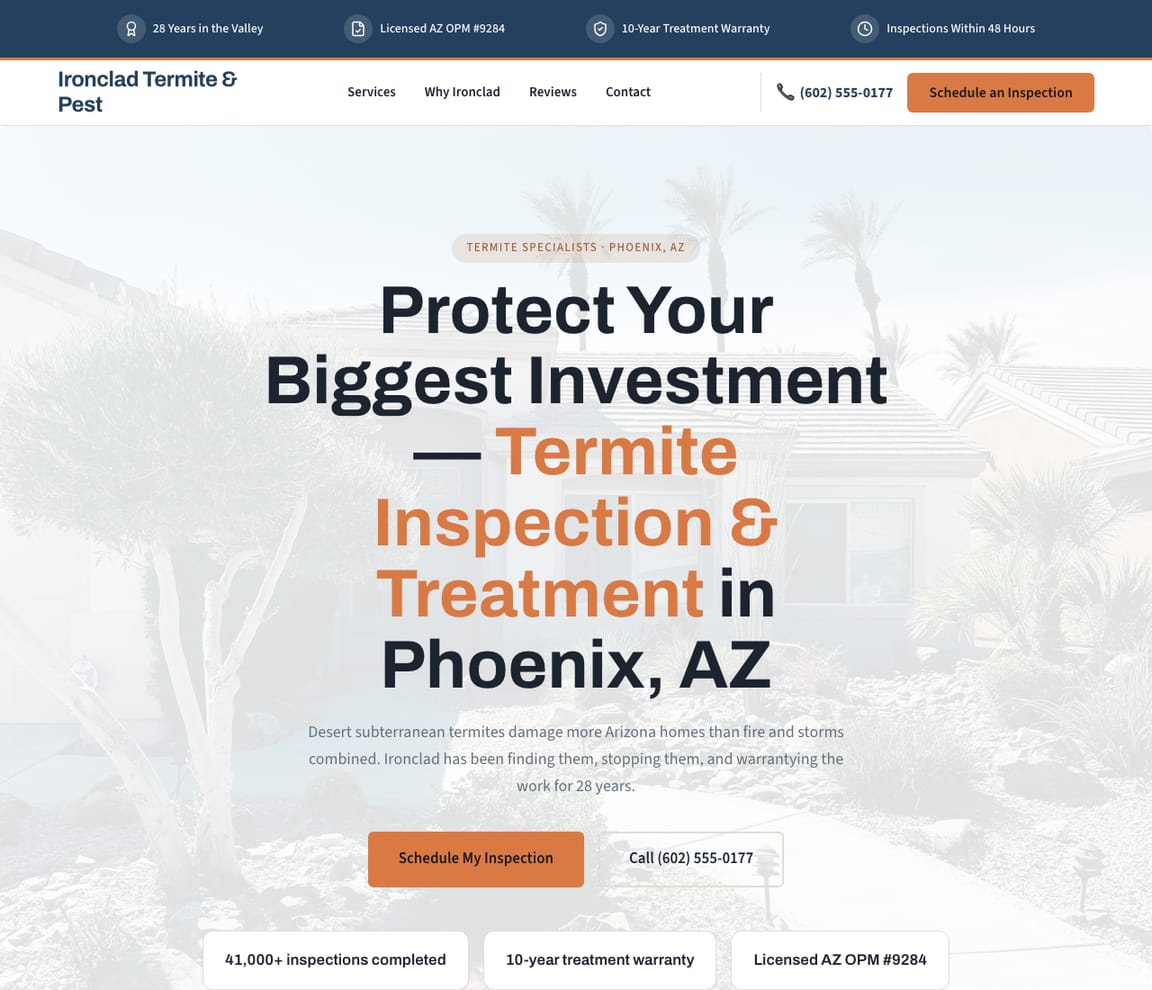
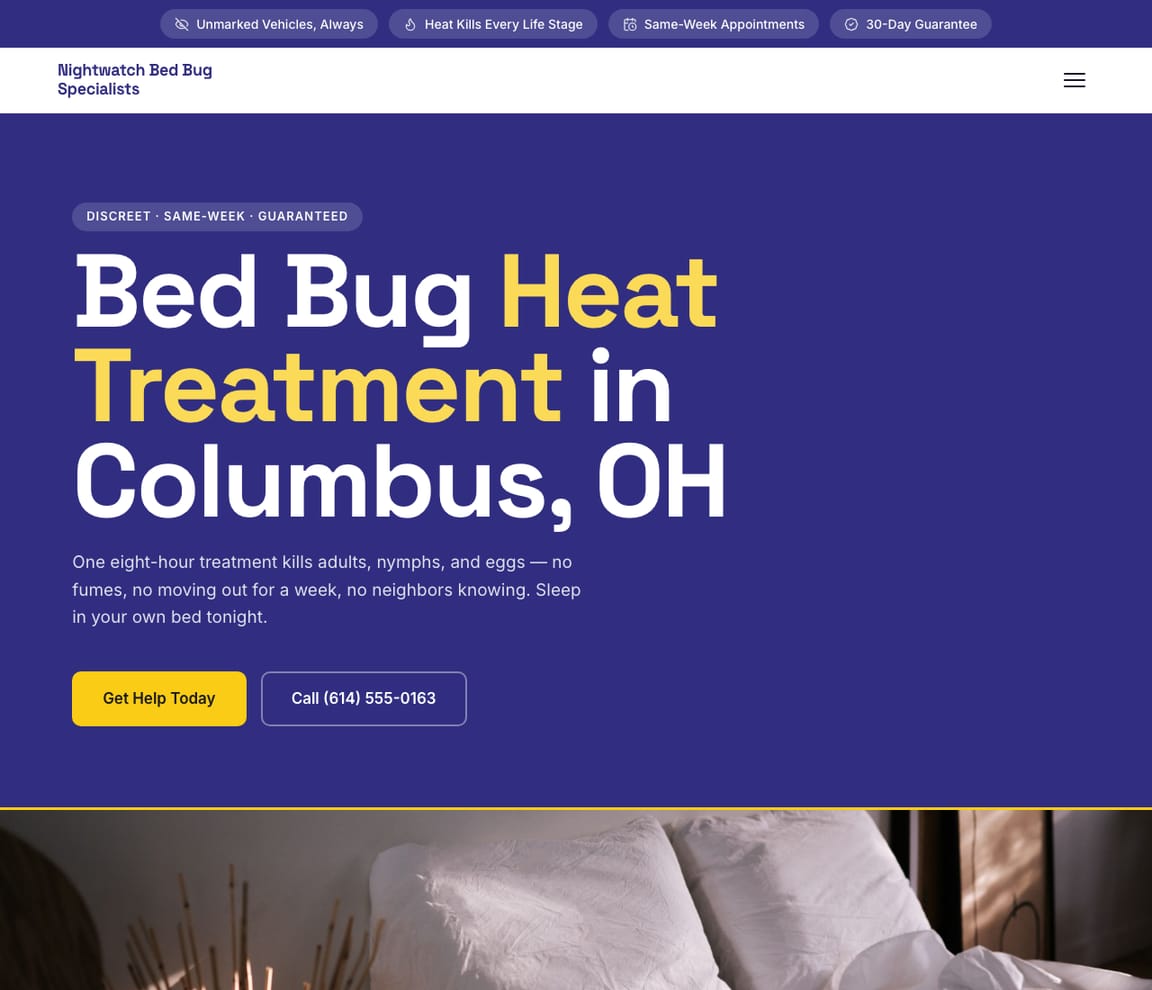
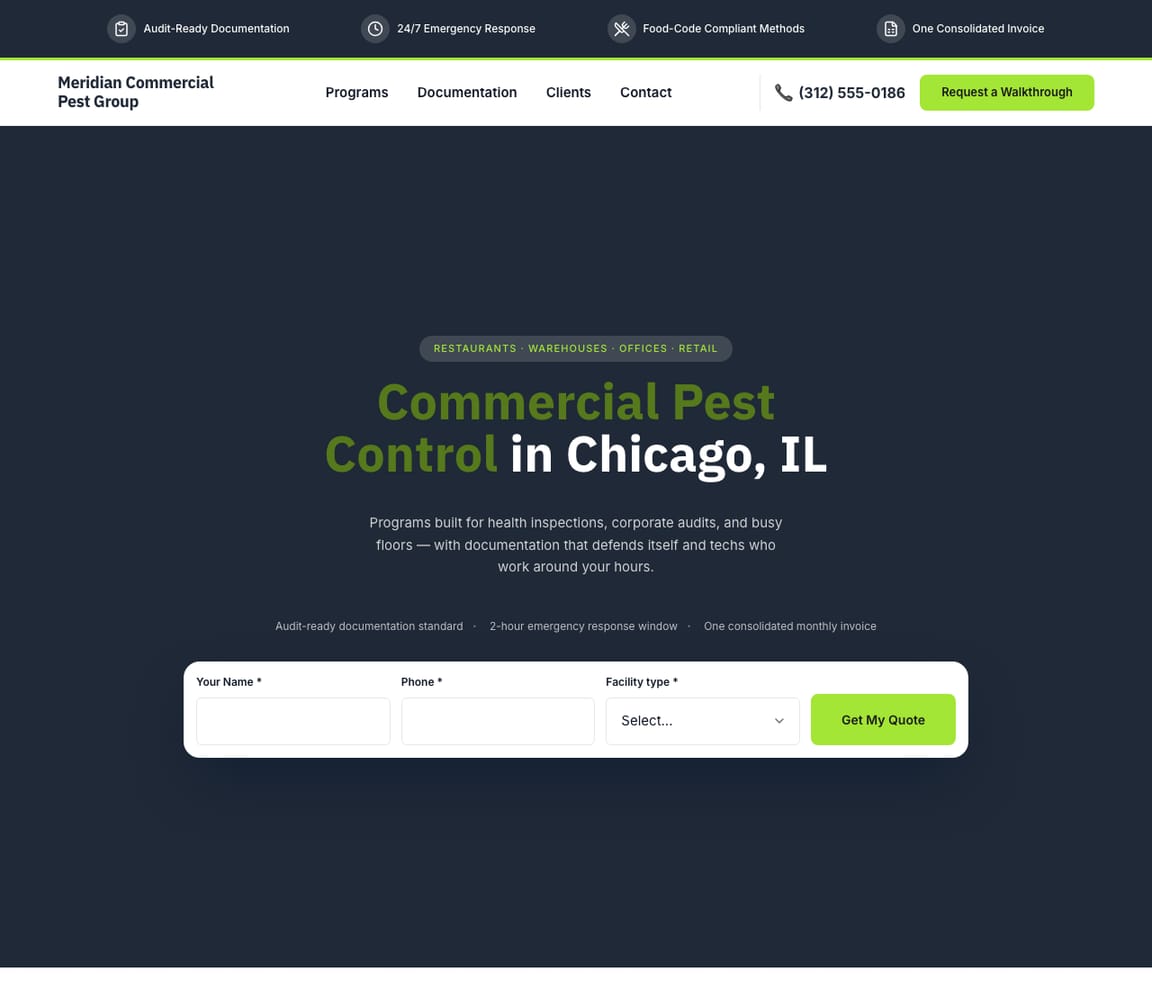
Pest control website designs you can start from
Every one is a real Zarla template you can make yours in about a minute — just add your business name, services, and service area.
GET FOUND
Get found by local customers
A website plus a Google Business Profile is how nearby homeowners and businesses find and choose you. Zarla sets up both and wires them together.
“Exterminator near me”
Show up in local Google searches the moment someone spots roaches, a mouse, or a wasp nest — urgent, ready-to-book leads that convert fast.
Google Business Profile
Your hours, service area, job photos, and reviews right in Google Maps, so a homeowner can call or request an inspection in one tap.
Reviews that earn trust
Letting a stranger treat your home hinges on trust — 5-star reviews are the deciding factor when a customer picks between you and the big brands.
Google Search
Ccopperlinepestcontrol.com
Copperline Pest Control — Trusted pest control in Your AreaLicensed pest control available for residential and commercial work. Same-day response.← Your Zarla siteCcitypestcontrolservices.com
City pest control ServicesGoogle Maps
1
Copperline Pest Control
← You2
Metro pest control Co.
3
Quick pest control Services
AI assistants (ChatGPT / Perplexity)
For pest control services in your area: Copperline Pest Control — 4.9★ across 200+ Google reviews, same-day response, licensed and insured.
YOUR LAUNCH PLAN
Your pest control business launch checklist
Everything above, boiled down to the concrete steps. Work through them in order and you'll be licensed, open, and findable on Google faster than you'd think.
- Pass your applicator exam — get your state pesticide applicator license and the category you'll work in (general pest, termite/WDO, or both).
- Register and insure the business — form an LLC, get a free EIN, and buy general liability insurance plus any pesticide bond your state requires.
- Pick your focus — general residential pest, termites, bed bugs, rodents, mosquitoes, or commercial accounts.
- Buy your starter kit — sprayers, a bait gun, dusters, PPE, and a starter stock of EPA-registered products.
- Set your pricing — one-time treatments plus recurring quarterly plans, the steady income in this business.
- Build your website and connect a Google Business Profile — free with Zarla.
- Line up your first jobs — offer friends, family, and neighbours a free inspection and a first-treatment discount for referrals.
- Do great work, then ask for a Google review after every treatment.
REAL CUSTOMERS
Owners who got online without a developer
Verified reviews from real Zarla customers.
“Very reliable, professional, and fast results. I was able to get my business online in no time, and the ease of access made it so simple.”
“I had no idea how to set up a website for my business. Thanks to Zarla, they've helped me a lot.”
“Optimized for local service-based businesses. Easiest website build I've experienced. The AI-based build is the way to go instead of clunky theme-based websites. Get the site built and get out of the weeds with Zarla!”
“Using Zarla to create my website saved me so much time and effort compared to hiring a developer. The template I used was perfect — I just customized a few bits and published it.”
“Great professional website in less than a minute, with the use of AI and a few descriptive prompts. This has saved me bundles of time and research on web developers.”
Free to build
Ready to get your pest control business online?
Describe your business and Zarla builds your website in about a minute — your services, service areas, a request-an-inspection form, and room for reviews, all connected to Google.
Free to build and preview — no code, no credit card.
Frequently asked questions
Do you need a license to start a pest control business?
Yes. Pest control is a licensed trade in every U.S. state. You'll need to pass a state pesticide applicator exam (general standards plus a category such as general household pest or wood-destroying organisms/termites), and most states require your business to hold a structural pest control license with a certified applicator on staff. Many states also require documented hands-on experience — often a year or more — or a related degree before you can be certified, plus general liability insurance and, in many states, a pesticide applicator bond. Check your state Department of Agriculture (for example, Florida's FDACS or the California Structural Pest Control Board) for the exact rules where you operate.
How much does it cost to start a pest control business?
Most solo operators spend $5,000–$15,000 to launch if they already own a vehicle: licensing and exams ($250–$1,000), a backpack and compressed-air sprayer, PPE and starter chemicals ($3,000–$7,500 combined), and first-year insurance ($500–$850). Buying a used service vehicle pushes the total to $15,000–$50,000. You can start lean, take on general-pest work first, and reinvest from your earliest jobs — and your website can be free with an AI builder like Zarla.
Is a pest control business profitable?
Yes — it's one of the higher-margin service trades, largely because of recurring revenue. Quarterly and bi-monthly plans bill $100–$150 a visit ($400–$600 a year per customer), and specialty work pays far more: termite treatments run $1,200–$2,500 and bed bug heat jobs $1,000–$3,000. A growing book of recurring accounts is what makes a pest control business genuinely valuable, not just busy.
Do I need experience to start a pest control business?
You don't need to have owned one, but most states require verifiable hands-on experience (often one to two years) or a related degree before you can sit for the certified-applicator exam. A common path is to get licensed while working for an established company, learn the trade and the chemistry, then branch out on your own. It's a skilled, regulated trade — not a same-day start like some businesses.
How do I get my first pest control customers?
Start with people who already trust you. Message friends, family, and neighbours, offer a free inspection and a discount on the first treatment, and ask them to spread the word. Post in local Facebook groups and on Nextdoor, and claim your Google Business Profile so you show up for “exterminator near me.” Then do excellent work and ask every customer for a review and a referral — that's the engine that fills your recurring routes.
What's the difference between residential and commercial pest control?
Residential is homes — general pest, termites, rodents, mosquitoes — and it's the easiest way to start and to earn referrals. Commercial covers restaurants, warehouses, apartments, and offices; it pays more and brings steady contracts, but customers expect documentation, integrated pest management (IPM) programs, and audit-ready records, especially in food service. Most owners begin residential and add commercial accounts as they build capacity.
How do I get my pest control business found on Google?
Two things do the heavy lifting: a professional website (your services, service areas, job photos, reviews, and a “request an inspection” button) and a Google Business Profile that puts you on Google Maps for “pest control near me” and “termite inspection near me” searches. Then collect reviews after every treatment — they're the strongest local ranking signal there is. An AI website builder like Zarla creates the website free in about a minute and connects it to your Google Business Profile, so you're findable from day one.