LANDSCAPING ESTIMATE TEMPLATE
Free landscaping estimate template
A landscaping estimate with the plants and materials by the item — species, size, count, cubic yards — labor by the crew-day, the install and the recurring mowing priced apart, and a deposit that covers the plants. Free in Word and PDF, with every line explained.
Word and PDF · Free · No email, no sign-up
The short answer
A landscaping estimate lists the plants and materials by the item — each species with its container size and count, mulch and soil by the cubic yard, stone by the ton — and prices labor by the crew-day or the task, so a customer comparing three estimates can see whose azaleas are 3-gallon and whose are 1-gallon.
Keep the one-time install apart from the recurring work. A bed refresh is a project with a deposit and a finish date; weekly mowing is a per-visit price that runs all season. On one sheet, the mowing goes on its own line as a per-visit price, outside the install total.
Around that go your business and license details, the customer and the property, the estimate number and the date it holds until, the days on site and when you can start, what's included and what isn't — irrigation, the back yard, watering after you leave — and how to pay.
FREE TEMPLATE · WORD AND PDF
The landscaping estimate template, filled in
Below is the template filled in for Evergreen Yard Co., a fictional landscaping business, so you can see every line in use. The downloads are the same estimate with [bracketed] lines to replace — free, no email address, no sign-up.
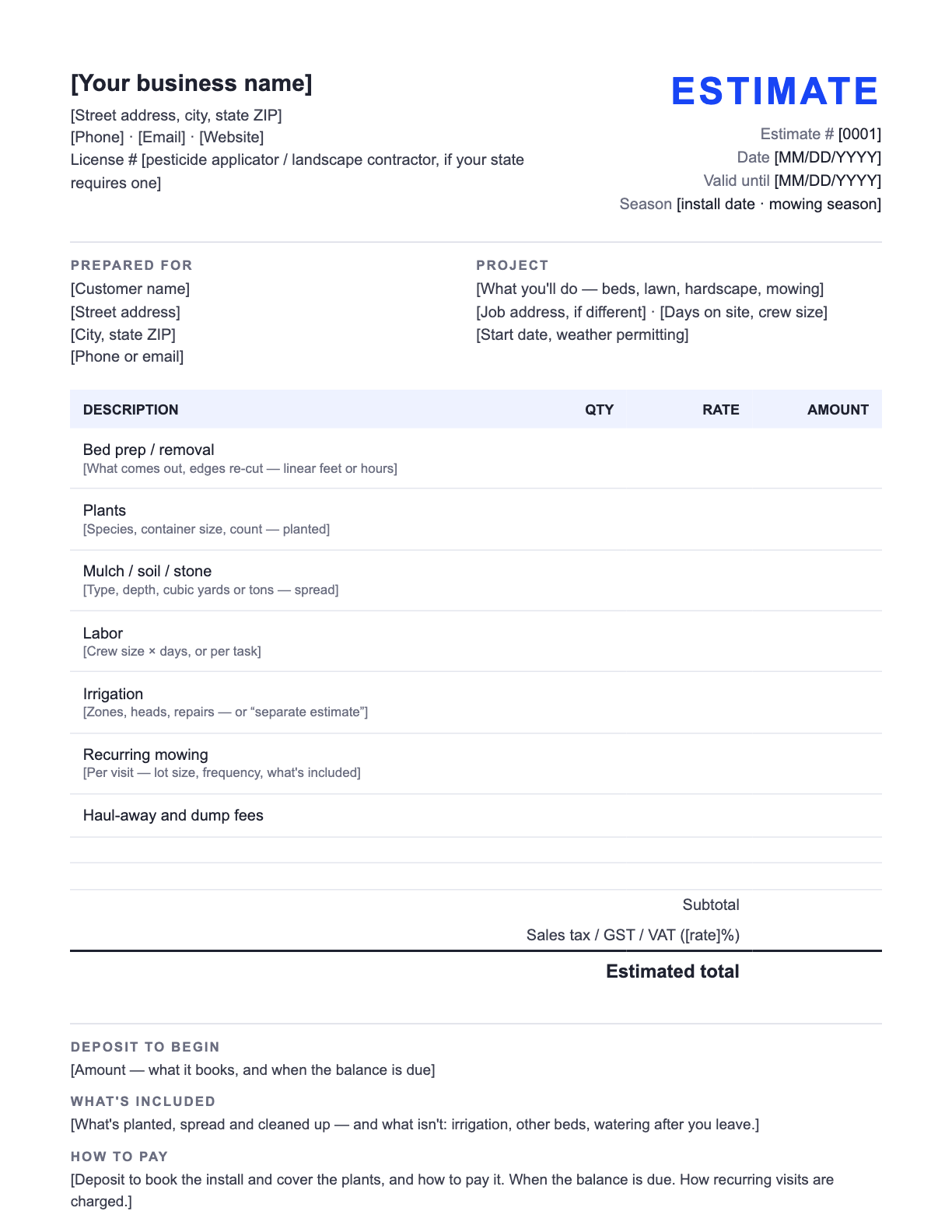
Example · fictional business
Evergreen Yard Co. Charlotte, NC (704) 555-0152 · hello@evergreenyard.example NC pesticide applicator license # 000000 (example) | ESTIMATE |
Prepared for Marcus and Elena Reyes 4120 Sharon Rd Charlotte, NC | Project Front bed refresh: remove four old shrubs, new plants and mulch, re-cut the edges Same address · 2 days, two-person crew Install the week of Oct 20, weather permitting; mowing from April |
| Description | Qty | Rate | Amount |
|---|---|---|---|
| Bed prep and edging Remove 4 overgrown hollies, re-cut the bed edges, 180 linear feet, weeds pulled and bed raked | 180 | $1.75 | $315.00 |
| Plants 6 azaleas (3 gal), 8 liriope (1 gal), 1 Japanese maple (7 gal) — planted, staked and watered in | 1 | $640.00 | $640.00 |
| Hardwood mulch Double-shredded hardwood, 3 inches deep, delivered and spread | 6 | $68.00 | $408.00 |
| Labor 12 crew-hours (two people, 1.5 days) at $55 a crew-hour: planting, mulch, cleanup | 12 | $55.00 | $660.00 |
| Haul away Old shrubs, roots and debris | 1 | $75.00 | $75.00 |
| Weekly mowing, April to October Mow, edge and blow, about a quarter acre — per visit | 1 | $55.00 | +$55.00 |
| Subtotal | $2,098.00 | ||
| Sales tax, 7.25% on plants and materials (example) | $75.98 | ||
| Estimated total | $2,173.98 | ||
Deposit to begin
$700.00 books the job; the balance is due when the work is finished.
What's included
Everything above, with the plants watered in and the bed left edged and raked. Not included: irrigation work, the back yard, and watering after we leave — the first two weeks are yours, and we'll leave a watering schedule. Mowing is billed per visit from April.
How to pay
The $700 deposit books the install and covers the plants, by card, check or bank transfer; the balance is due when the install is finished. Mowing is charged to a card on file after each visit.
Every figure on the example is an example, not a price guide — use your own rates. The Word file is a standard .docx you can edit in Word or any app that opens Word documents; the PDF prints as-is if you'd rather fill it in by hand.
Quotes and a website, one place
Start your landscaping website — quoting is built in
Add your business name and your town, and Zarla builds your landscaping website from this one line. The same dashboard sends quotes like this one as a link your customer accepts online, and drafts the invoice when they do.
Already have a website? Bring it across →Zarla keeps your old page addresses where it can and redirects the ones that change, helping you keep the Google standing you've built.
LINE BY LINE
What goes on a landscaping estimate
Every line on the template, in order, and what to write on it.
| The line | What to put there |
|---|---|
| Business name, contact and license | Your trading name, phone, email and address — and your pesticide applicator or contractor license number where your state requires one. |
| Estimate number, date and valid-until date | A number that never repeats, the date, and the date the price holds until — 30 days is common; plant prices and availability move with the season. |
| Prepared for and the project in one line | The customer and the address, then the project: which beds or areas, the days on site and when you can start. |
| Bed prep and removal | What comes out and what gets re-cut, by the linear foot or the hour — the work the customer can't see once the mulch is down, so name it. |
| Plants, by the item | Each species with its container size and count. “6 azaleas, 3-gallon” is a line a customer can compare; “shrubs” isn't. |
| Mulch, soil and stone | Type, depth and cubic yards or tons, spread — the quantity is what makes your price credible next to a cheaper one. |
| Labor | Crew-hours or crew-days at your rate, or a price per task. If the customer wants to trim the job, labor by the task is what lets them. |
| Recurring mowing or maintenance | A per-visit price with the lot size, the frequency and what a visit includes — on its own line, outside the install total. |
| Tax, total, deposit and how to pay | Sales tax where your state charges it (often on the plants and materials), the estimated total, the deposit that covers the plants, when the balance is due and how to pay. |
STEP BY STEP
How to write a landscaping estimate
From the walk-around to an estimate the customer approves the same week — before the planting window closes.
Walk the yard and measure
Bed lengths by the linear foot, areas by the square foot for mulch and sod, the lot size for mowing. Photograph what comes out and note the water source and the gate width.
List the plants by the item
Species, container size and count for every plant, with “planted and watered in” on the line. Mark anything the customer will choose later as an allowance.
Quantify the materials
Mulch and soil by the cubic yard at the depth you'll spread, stone by the ton, sod by the square foot — delivered and spread. Mark them taxable where your state taxes them.
Price the labor and the haul-away
Crew size × days, or per task; the haul-away and dump fees on their own line. Keep the install's labor apart from any recurring work.
Add the recurring line, tax and the total
Mowing or maintenance as a per-visit price outside the install total; sales tax where it applies; the estimated total and the deposit that covers the plants.
Write what's included and how to pay
Scope in, scope out — irrigation, other beds, watering after you leave — the deposit, when the balance is due, how recurring visits are charged. Send it the same week.
How landscaping estimates win the job
Name the plants by size. Two estimates for “front bed, 15 shrubs” can be $800 apart because one is 1-gallon and the other is 3-gallon. The estimate that says which is the one the customer trusts — and the one that justifies the higher price.
Keep the install and the mowing apart. A project has a deposit and a finish date; mowing is a per-visit price that runs all season. Mixing them makes the project look expensive and the mowing look free.
Price mowing per visit, by lot size. How much to charge for lawn mowing has the US ranges by lot size and frequency, and what edging and bagging add; put the per-visit price on the estimate and let the card on file do the rest.
Say who waters. New plants fail from under-watering in the first two weeks, and the customer assumes it's your job unless the estimate says otherwise. One line — “watering after we leave is yours; we'll leave a schedule” — settles it before it's a problem.
Licensing. In the US, applying weed killer or insecticide for pay requires a commercial pesticide applicator license in every state (your state's department of agriculture issues it), a few states also license fertilizer application, and some states and cities license landscape contractors above a job size — check your state before you add a fertilization or weed-control line.
Tax. In the US, whether sales tax applies to landscaping — the plants and materials, the labor, both or neither — depends on your state: Texas taxes landscaping services, while in many states the installer pays tax on the plants and the customer sees no tax line. Keep plants and labor on separate lines and check your state's revenue department or your accountant. Outside the US the rule is the other way around: in Australia and New Zealand a GST-registered business gives a consumer a price that includes GST, and in the UK and EU a VAT-registered business shows the VAT and quotes consumers a price with it included. Confirm the details with your accountant.
Send it from Zarla and get it accepted online
A Word estimate is a fine way to start. The slow part is everything after you send it: waiting for a reply, wondering whether they opened it, and retyping every line into the invoice when they say yes.
If you build your landscaping website with Zarla, quotes are in the same dashboard. Build the quote from your own price book — one price, or up to three options side by side with the one you'd pick marked Recommended, and any line as a checkbox extra. Send it as one link, by email. Your customer picks an option, ticks any extras, types their name to accept, and gets a copy; Zarla drafts the invoice for exactly what they chose, with any deposit you asked for, and the job moves to Won. The quote template is already in your brand: your website's logo, colors and fonts, set once for every quote and invoice. On a paid plan, with your Stripe account connected, that invoice carries a pay-now button, so the deposit comes in as soon as you send it.
Want to see the website first? Browse landscaping website templates or see how Zarla builds landscaping websites. Still setting up? Read how to start a landscaping business and write your landscaping business plan. Setting your rates? See how much to charge for lawn mowing.
The whole paper trail of a job, step by step: how to write a quote, then how to write an invoice, then how to write a receipt — with a free receipt template. For any other trade, start from the free estimate template.
Landscaping estimates: common questions
Your business, contact and license details; the customer, the address and the project in one line; an estimate number, the date and a valid-until date; bed prep and removal; each plant with its species, container size and count; mulch, soil and stone with quantities; labor by the crew-day or task; irrigation as its own line or a separate estimate; any recurring mowing as a per-visit price; tax where it applies, the estimated total and the deposit; then what's included, who waters, and how to pay.
An estimate is your best calculation of what the job will cost, given what you can see today; the final price can move if the work turns out different. A quote (or a fixed price) is the price you will charge for the work described. A bid is a quote submitted against someone else's specification, usually in construction. Say which one your document is in its title.
By the item for installs — plants by species and size, mulch by the cubic yard, labor by the crew-day — because that's what the customer compares and what lets them trim the job. By the square foot or the lot size for mowing, sod and mulch-only jobs, where the area is the whole story.
Per visit on the estimate, so the customer can compare it and see what a visit includes; you can bill it monthly. Lawns cut every two weeks cost more per visit than weekly ones — the grass is longer — so say the frequency the price assumes.
Thirty days is the common choice for a home-services estimate, and shorter when material prices move (roofing, lumber, copper). Print the date on the estimate: a customer who comes back after it can be re-quoted at today's prices without an argument, and one who accepts inside it knows the price holds.
Enough to cover the plants and materials you buy before the job — commonly a third to a half of the install — with the balance due when the install is finished. Mowing takes no deposit; a card on file after each visit is the norm.
Yes. The landscaping estimate template on this page downloads free as a Word document and a PDF — no email address, no sign-up. Edit it in Word or any app that opens Word documents, or print the PDF and fill it in by hand.
Not from a Word file — the customer replies by email or phone, and you type the job into an invoice later. To get a yes in one tap, send it from quoting software. If your landscaping website is on Zarla, the quote tool is in the same dashboard: your customer opens one link, picks an option, ticks any extras and types their name to accept, and Zarla drafts the invoice for what they chose — which, on a paid plan with Stripe connected, carries a pay-now button. Jobber, Housecall Pro, Wix and Squarespace send quotes customers accept online too.
Send estimates from your own landscaping website
Add your town and your business name, and Zarla builds the site from that one line — with quoting in the same dashboard.
Already have a website? Bring it across →Zarla keeps your old page addresses where it can and redirects the ones that change, helping you keep the Google standing you've built.