MOVING ESTIMATE TEMPLATE
Free moving estimate template
A moving estimate with both addresses — floors, elevators, parking — the crew and truck by the hour with the minimum and travel time stated, stairs, heavy items and packing on their own lines, and a deposit that books the date. Free in Word and PDF, with every line explained.
Word and PDF · Free · No email, no sign-up
The short answer
A moving estimate puts both addresses on the sheet — with the floor, the elevator or stairs, and where the truck can park at each end — then prices the crew and truck by the hour with the minimum and the travel time stated, and your best estimate of the hours from the inventory.
Everything that changes the hours gets its own line: a third-floor walk-up, a long carry, a piano or a safe, packing materials, a packing crew the day before. Those are the lines that make moving-day surprises disappear, because the customer has already seen them.
Around that go your business and insurance details, the customer, the estimate number and the date it holds until, the move date and arrival window, what's included — pads, shrink-wrap, basic disassembly — what isn't, and how to pay: a deposit to book the date, the balance when the truck is empty.
FREE TEMPLATE · WORD AND PDF
The moving estimate template, filled in
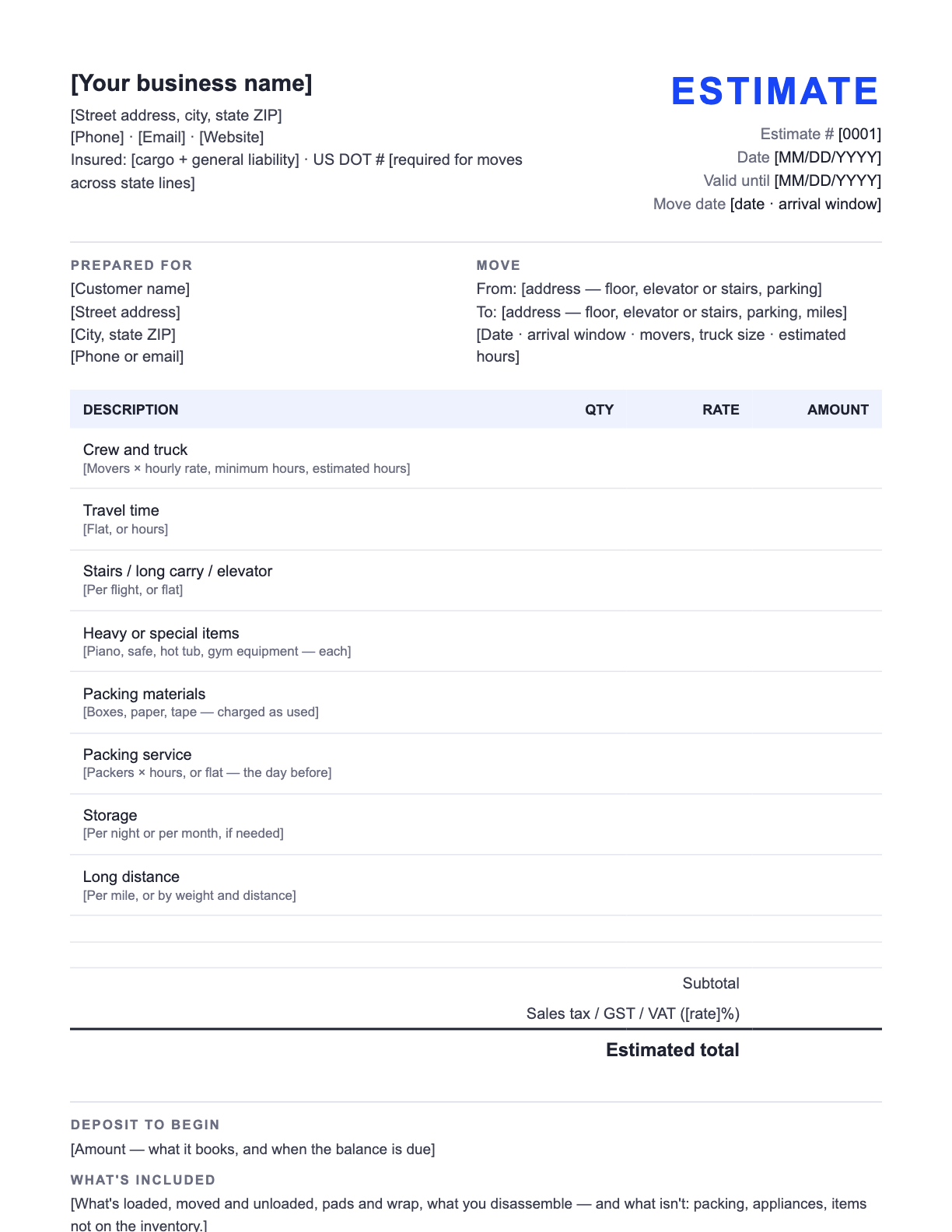
Below is the template filled in for Two Oaks Moving Co., a fictional moving business, so you can see every line in use. The downloads are the same estimate with [bracketed] lines to replace — free, no email address, no sign-up.
Example · fictional business
Two Oaks Moving Co. Boise, ID (208) 555-0144 · book@twooaksmoving.example Insured: cargo and general liability | ESTIMATE |
Prepared for Hannah Pruitt (208) 555-0190 hannah.p@example.com | Move From: 915 W Jefferson St, Apt 4, Boise — third floor, no elevator, street parking To: 2208 S Owyhee St, Boise — house, driveway parking, about 6 miles Saturday, Oct 25 · arrival 8–9 am · 3 movers, one 26-ft truck · about 5 hours |
| Description | Qty | Rate | Amount |
|---|---|---|---|
| Crew and truck 3 movers and a 26-ft truck at $165 an hour, 3-hour minimum; estimated 5 hours from the video walk-through | 5 | $165.00 | $825.00 |
| Travel time Flat: our yard to you and back | 1 | $165.00 | $165.00 |
| Stairs Third-floor walk-up at the origin | 1 | $75.00 | $75.00 |
| Heavy item Upright piano, moved with a board and straps | 1 | $150.00 | $150.00 |
| Packing materials 12 medium boxes, 2 wardrobe boxes, paper and tape — charged only as used | 1 | $96.00 | $96.00 |
| Full packing service 2 packers, about 3 hours, the day before | 1 | $385.00 | +$385.00 |
| Subtotal | $1,311.00 | ||
| Sales tax, 6% on packing materials (example) | $5.76 | ||
| Estimated total | $1,316.76 | ||
Deposit to begin
$150.00 books the job; the balance is due when the work is finished.
What's included
Loading, transport and unloading of everything on the inventory from the walk-through; furniture pads and shrink-wrap; taking apart and reassembling the bed frame and the dining table. Not included: packing (see the option), disconnecting appliances, and items not on the inventory — tell us before the day and we'll re-estimate.
How to pay
The $150 deposit books the date; the balance is due when the truck is unloaded, by card, check or bank transfer. The hours are an estimate from the inventory: after the 3-hour minimum, you pay the actual time in 15-minute steps.
Every figure on the example is an example, not a price guide — use your own rates. The Word file is a standard .docx you can edit in Word or any app that opens Word documents; the PDF prints as-is if you'd rather fill it in by hand.
Quotes and a website, one place
Start your moving website — quoting is built in
Add your business name and your town, and Zarla builds your moving website from this one line. The same dashboard sends quotes like this one as a link your customer accepts online, and drafts the invoice when they do.
Already have a website? Bring it across →Zarla keeps your old page addresses where it can and redirects the ones that change, helping you keep the Google standing you've built.
LINE BY LINE
What goes on a moving estimate
Every line on the template, in order, and what to write on it.
| The line | What to put there |
|---|---|
| Business name, contact and insurance | Your trading name, phone, email and address, your cargo and general liability insurance — and your US DOT number if you cross state lines, because the customer will look it up. |
| Estimate number, date and valid-until date | A number that never repeats, the date, and the date the price holds until — 30 days is common, shorter around the end of the month and in summer, when dates fill. |
| Prepared for and the move in three lines | The customer, then both addresses with the floor, elevator or stairs and the parking at each end, then the date, the arrival window, the crew and truck, and your estimated hours. |
| Crew and truck | Movers × the hourly rate, the minimum hours, and your estimated hours from the inventory. The rate and the minimum are the two numbers every customer compares. |
| Travel time | A flat charge from your yard to the customer and back, or the hours — stated, so it isn't a surprise on the final bill. |
| Stairs, long carries and heavy items | A third-floor walk-up, a 200-foot carry from the truck, a piano or a safe — one line each, because each one adds real time and the customer should see it before the day. |
| Packing materials and packing service | Boxes, paper and tape charged as used; a packing crew the day before as its own line or an option. |
| Tax and total | Sales tax where your state charges it (usually on the materials you sell, rarely on the labor), and the estimated total. |
| Deposit, included and how to pay | The deposit that books the date, what's included — pads, wrap, basic disassembly — what isn't, when the balance is due, and how the hours are counted after the minimum. |
STEP BY STEP
How to write a moving estimate
From the video walk-through to an estimate the customer approves the same day — and a moving day with no surprises.
Put your details at the top
Business name, phone, email, address, your insurance and your US DOT number if you cross state lines. Save the file once with these filled in.
Number it, date it, set the valid-until date
The next number in your series, today's date and the day the price stops holding. Add the move date and the arrival window.
Take the inventory and note both addresses
A video walk-through or a visit: every room, every large item, the boxes they've packed. Floors, elevators, stairs and parking at both ends. The inventory is where the hours come from.
Price the crew, the truck and the extras
Movers × hourly rate with the minimum and your estimated hours; travel time; stairs, long carries and heavy items each on their own line; packing materials as used; packing service as an option.
Add tax, total it, name the deposit
Sales tax where your state charges it on materials, the estimated total, and the deposit that books the date.
Write what's included and how to pay
Pads, wrap and basic disassembly in; packing, appliances and items not on the inventory out. The deposit, the balance when the truck is empty, and how hours are counted after the minimum. Send it the same day.
How moving estimates win the job
Do the inventory. A video walk-through takes fifteen minutes and turns “about 5 hours” into a number you can stand behind. Write what the hours assume — the items on the walk-through, packed boxes ready — so anything added on the day is a conversation, not a dispute.
State the rate, the minimum and the travel time, every time. Those three numbers are what every customer compares across estimates. A lower hourly rate with hidden travel time loses the moment the final bill arrives; a clear one wins the review.
Price the extras as lines, not surprises. Moving company pricing has the US ranges for hourly crews, stairs and heavy items, long-distance per-pound rates and the peak-season markup; put stairs, long carries, the piano and packing on their own lines and the moving-day argument never happens.
Interstate moves have federal rules. In the US, a move that crosses a state line is regulated by the FMCSA: the mover must be registered (a US DOT number and operating authority), must give the customer a written estimate based on an inventory of the goods, must hand over the booklet “Your Rights and Responsibilities When You Move”, and may not collect more than 110% of an estimate that isn't a fixed price at delivery. Local moves are regulated by the state — many states license movers and set what an estimate must show — so check your state's DOT or utilities commission before you quote.
Tax. In the US, moving labor isn't taxed in most states, but the boxes and packing materials you sell usually are — so keep materials on their own line and check your state's revenue department or your accountant before you add a tax line. Outside the US the rule is the other way around: in Australia and New Zealand a GST-registered business gives a consumer a price that includes GST, and in the UK and EU a VAT-registered business shows the VAT and quotes consumers a price with it included. Confirm the details with your accountant.
Send it from Zarla and get it accepted online
A Word estimate is a fine way to start. The slow part is everything after you send it: waiting for a reply, wondering whether they opened it, and retyping every line into the invoice when they say yes.
If you build your moving website with Zarla, quotes are in the same dashboard. Build the quote from your own price book — one price, or up to three options side by side with the one you'd pick marked Recommended, and any line as a checkbox extra. Send it as one link, by email. Your customer picks an option, ticks any extras, types their name to accept, and gets a copy; Zarla drafts the invoice for exactly what they chose, with any deposit you asked for, and the job moves to Won. The quote template is already in your brand: your website's logo, colors and fonts, set once for every quote and invoice. On a paid plan, with your Stripe account connected, that invoice carries a pay-now button, so the deposit comes in as soon as you send it.
Want to see the website first? Browse moving website templates or see how Zarla builds moving websites. Still setting up? Read how to start a moving business and write your moving business plan. Setting your rates? See moving company pricing.
The whole paper trail of a job, step by step: how to write a quote, then the moving invoice template, then how to write a receipt — with a free receipt template. For any other trade, start from the free estimate template.
Moving estimates: common questions
Your business, contact and insurance details (and your US DOT number for interstate moves); the customer; both addresses with floors, stairs or elevators and parking; the move date, arrival window, crew and truck; an estimate number, the date and a valid-until date; the crew and truck by the hour with the minimum and estimated hours; travel time; stairs, long carries and heavy items each on their own line; packing materials and packing service; tax where it applies, the estimated total and the deposit; then what's included, what isn't, and how to pay.
An estimate is your best calculation of what the job will cost, given what you can see today; the final price can move if the work turns out different. A quote (or a fixed price) is the price you will charge for the work described. A bid is a quote submitted against someone else's specification, usually in construction. Say which one your document is in its title.
Hourly with a minimum for local moves — it's what customers expect and it's fair both ways when the inventory is right. A flat price suits a move you've inventoried carefully and small, predictable jobs; long-distance moves are priced by weight and distance. Whichever you choose, say what the price assumes.
From the inventory: a video walk-through or a visit covering every room and every large item, plus the stairs, the carry and the drive. Rules of thumb for a crew of three — a one-bedroom in 3 to 4 hours, a two-bedroom in 4 to 6 — are a start; the walk-through is what makes the number yours.
Thirty days is the common choice for a home-services estimate, and shorter when material prices move (roofing, lumber, copper). Print the date on the estimate: a customer who comes back after it can be re-quoted at today's prices without an argument, and one who accepts inside it knows the price holds.
A small one to book the date — a flat amount or the first hour — with the balance due when the truck is unloaded. It filters out the customers collecting six estimates, and it holds the date for both of you.
Yes. The moving estimate template on this page downloads free as a Word document and a PDF — no email address, no sign-up. Edit it in Word or any app that opens Word documents, or print the PDF and fill it in by hand.
Not from a Word file — the customer replies by email or phone, and you type the job into an invoice later. To get a yes in one tap, send it from quoting software. If your moving website is on Zarla, the quote tool is in the same dashboard: your customer opens one link, picks an option, ticks any extras and types their name to accept, and Zarla drafts the invoice for what they chose — which, on a paid plan with Stripe connected, carries a pay-now button. Jobber, Housecall Pro, Wix and Squarespace send quotes customers accept online too.
Send estimates from your own moving company website
Add your town and your business name, and Zarla builds the site from that one line — with quoting in the same dashboard.
Already have a website? Bring it across →Zarla keeps your old page addresses where it can and redirects the ones that change, helping you keep the Google standing you've built.