FLOORING ESTIMATE TEMPLATE
Free flooring estimate template
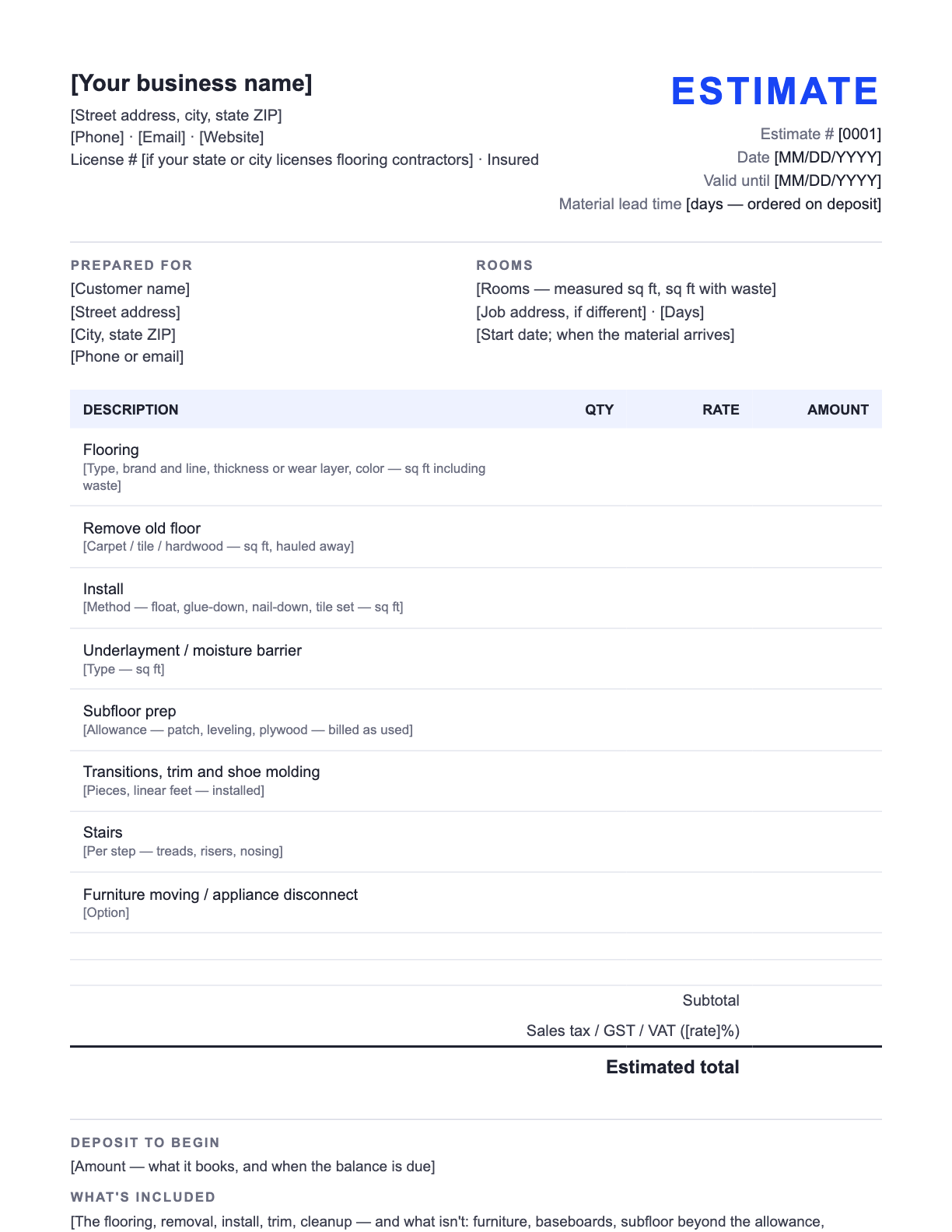
A flooring estimate with the square feet by room and the waste added, the flooring named by brand, line and wear layer, removal of the old floor and the install by the square foot, subfloor prep billed as used, and a deposit that orders the material. Free in Word and PDF, with every line explained.
Word and PDF · Free · No email, no sign-up
The short answer
A flooring estimate lists the rooms with their measured square feet and the waste added — 10% for a straight lay, 15% for diagonals, herringbone or rooms with many cuts — and names the flooring by brand, line, thickness or wear layer and color, so the customer can compare your estimate with the other two like with like.
Removal of the old floor, the install, underlayment and the transitions and trim are separate lines by the square foot or the piece. Subfloor prep is an allowance billed as used: nobody knows what's under the carpet until it's up, and the estimate should say so.
Around that go your business and license details, the customer and the address, the estimate number and the date it holds until, the days on site and when the material arrives, what's included and what isn't — furniture, baseboards, appliances — and how to pay: a deposit that orders the material, the balance when the last room is walked.
FREE TEMPLATE · WORD AND PDF
The flooring estimate template, filled in
Below is the template filled in for Plank & Grain Flooring, a fictional flooring business, so you can see every line in use. The downloads are the same estimate with [bracketed] lines to replace — free, no email address, no sign-up.
Example · fictional business
Plank & Grain Flooring Columbus, OH (614) 555-0126 · hello@plankandgrain.example Insured: general liability | ESTIMATE |
Prepared for Aisha and Tom Bellamy 743 Kenworth Rd Columbus, OH | Rooms Living room, hallway and two bedrooms: 640 sq ft measured, 704 sq ft with 10% waste Same address · 3 days Start Oct 27; the flooring arrives the week before |
| Description | Qty | Rate | Amount |
|---|---|---|---|
| Luxury vinyl plank Waterproof LVP, 20-mil wear layer, 7 × 48-in planks, attached pad, color from the samples we left — 704 sq ft including 10% waste; brand and line written here | 704 | $3.45 | $2,428.80 |
| Remove and dispose of the carpet and pad 640 sq ft; tack strips pulled, staples removed, hauled away | 640 | $0.65 | $416.00 |
| Install Floating click-lock install, 640 sq ft, including cuts around the closets and the fireplace hearth | 640 | $2.25 | $1,440.00 |
| Transitions and trim 3 T-molds, 2 reducers, and 180 linear feet of shoe molding, installed and color-matched | 1 | $365.00 | $365.00 |
| Subfloor prep allowance Floor patch to level low spots, up to 2 bags — billed as used; we'll show you before we open a third | 2 | $48.00 | $96.00 |
| Furniture moving We move the furniture out and back; beds taken apart and reassembled | 1 | $150.00 | +$150.00 |
| Subtotal | $4,745.80 | ||
| Sales tax, 7.5% on materials (example) | $216.74 | ||
| Estimated total | $4,962.54 | ||
Deposit to begin
$2,400.00 books the job; the balance is due when the work is finished.
What's included
The flooring named above, removal of the old carpet and pad, the install with transitions and shoe molding, and cleanup each day. Not included: moving furniture (see the option), new baseboards, subfloor repairs beyond the allowance, and disconnecting appliances.
How to pay
The $2,400 deposit orders the flooring and books the dates; the balance is due when we walk the last room with you. Card, check or bank transfer.
Every figure on the example is an example, not a price guide — use your own rates. The Word file is a standard .docx you can edit in Word or any app that opens Word documents; the PDF prints as-is if you'd rather fill it in by hand.
Quotes and a website, one place
Start your flooring website — quoting is built in
Add your business name and your town, and Zarla builds your flooring website from this one line. The same dashboard sends quotes like this one as a link your customer accepts online, and drafts the invoice when they do.
Already have a website? Bring it across →Zarla keeps your old page addresses where it can and redirects the ones that change, helping you keep the Google standing you've built.
LINE BY LINE
What goes on a flooring estimate
Every line on the template, in order, and what to write on it.
| The line | What to put there |
|---|---|
| Business name, contact and license | Your trading name, phone, email and address, that you're insured, and your contractor license number where your state or city requires one. |
| Estimate number, date and valid-until date | A number that never repeats, the date, and the date the price holds until — 30 days is common; say how long the material takes to arrive once ordered. |
| Prepared for and the rooms in one line | The customer and the address, then the rooms with the measured square feet and the square feet with waste, the days on site and the start date. |
| The flooring, named | Type, brand and line, thickness or wear layer, plank size and color, with the square feet including waste. This is the line that lets the customer compare estimates — and the one that explains why yours costs more than the big-box quote. |
| Removal of the old floor | What comes up and how much — carpet and pad, tile, hardwood — by the square foot, hauled away. Tile and glued-down floors cost more to remove; the line should say so. |
| Install | The method — floating, glue-down, nail-down, tile set — by the square foot, with the fiddly parts named: closets, hearths, diagonals, stairs per step. |
| Underlayment and subfloor prep | Underlayment or moisture barrier by the square foot where the flooring needs it; subfloor prep as an allowance billed as used, because no one knows what's under the carpet until it's up. |
| Transitions, trim and shoe molding | T-molds, reducers, stair nosing by the piece and shoe molding by the linear foot, installed — small lines that add up and that customers notice when they're missing. |
| Tax, total, deposit and how to pay | Sales tax where your state charges it (often on the material), the estimated total, the deposit that orders the material, when the balance is due, and how to pay. |
STEP BY STEP
How to write a flooring estimate
From the measure to an estimate with the samples still on the customer's floor.
Put your details at the top
Business name, phone, email, address, that you're insured, and your license number where one is required. Save the file once with these filled in.
Number it, date it, set the valid-until date
The next number in your series, today's date and the day the price stops holding. Note the material's lead time.
Measure every room and add the waste
Length × width per room, closets included, then 10% for a straight lay or 15% for diagonals, herringbone and rooms with many cuts. Check what's under the current floor at a corner and a doorway.
Name the flooring and price the layers
Brand, line, wear layer and color on the flooring line; removal of the old floor, the install, underlayment and trim each by the square foot or the piece; subfloor prep as an allowance billed as used.
Add tax, total it, name the deposit
Sales tax where your state charges it on the material, the estimated total, and the deposit that orders the flooring and books the dates.
Write what's included and how to pay
Flooring, removal, install and trim in; furniture, baseboards, subfloor beyond the allowance and appliances out. The deposit, the balance when the last room is walked. Send it before the samples are picked up.
How flooring estimates win the job
Name the product. A customer with three estimates for “vinyl plank, 640 sq ft” can't tell a 20-mil wear layer from a 6-mil one — until it scratches. Brand, line, wear layer and color on the line make your estimate the one that can be compared, and the one that explains its price.
Show the waste. “640 sq ft measured, 704 with 10% waste” tells the customer why you're buying more than the room, and stops the question when the leftover box goes in their garage. Use 15% for diagonals, herringbone and rooms full of cuts.
Bill subfloor prep as used, and say so. Nobody knows what's under the carpet until it's up. An allowance — “up to 2 bags of patch, billed as used; we'll show you before we open a third” — keeps the estimate honest and the day-two conversation short.
Test a concrete slab before you quote a glue-down. A moisture test on the slab takes a day or three and decides whether the job needs a moisture barrier — a line on the estimate, not a surprise after the floor fails.
Old floors and licensing. In the US, floors laid before about 1980 can hide asbestos — 9 × 9-inch tiles, the black mastic under them, some sheet-vinyl backing — and removing it is licensed abatement work in most states, so say on the estimate that you'll stop and refer the removal if you find it. Some states and cities license flooring contractors above a job size (California above $1,000); check your state's licensing board.
Tax. In the US, how sales tax lands on a flooring job depends on your state: in many, the installer pays tax on the material and the customer sees no tax line; in others the customer is charged tax on the material, or on the whole job — and carpet is sometimes treated differently from hard flooring. Keep material and labor on separate lines and check your state's revenue department or your accountant. Outside the US the rule is the other way around: in Australia and New Zealand a GST-registered business gives a consumer a price that includes GST, and in the UK and EU a VAT-registered business shows the VAT and quotes consumers a price with it included. Confirm the details with your accountant.
Send it from Zarla and get it accepted online
A Word estimate is a fine way to start. The slow part is everything after you send it: waiting for a reply, wondering whether they opened it, and retyping every line into the invoice when they say yes.
If you build your flooring website with Zarla, quotes are in the same dashboard. Build the quote from your own price book — one price, or up to three options side by side with the one you'd pick marked Recommended, and any line as a checkbox extra. Send it as one link, by email. Your customer picks an option, ticks any extras, types their name to accept, and gets a copy; Zarla drafts the invoice for exactly what they chose, with any deposit you asked for, and the job moves to Won. The quote template is already in your brand: your website's logo, colors and fonts, set once for every quote and invoice. On a paid plan, with your Stripe account connected, that invoice carries a pay-now button, so the deposit comes in as soon as you send it.
Want to see the website first? Browse flooring website templates or see how Zarla builds flooring websites. Still setting up? Write your flooring business plan first.
The whole paper trail of a job, step by step: how to write a quote, then how to write an invoice, then how to write a receipt — with a free receipt template. For any other trade, start from the free estimate template.
Flooring estimates: common questions
Your business, contact, insurance and license details; the customer, the address and the rooms in one line with measured and with-waste square feet; an estimate number, the date and a valid-until date; the flooring by brand, line, wear layer and color with the square feet including waste; removal of the old floor; the install by method and square feet; underlayment where needed; subfloor prep as an allowance billed as used; transitions and trim; stairs per step; tax where it applies, the estimated total and the deposit; then what's included, what isn't, and how to pay.
An estimate is your best calculation of what the job will cost, given what you can see today; the final price can move if the work turns out different. A quote (or a fixed price) is the price you will charge for the work described. A bid is a quote submitted against someone else's specification, usually in construction. Say which one your document is in its title.
By the square foot, shown per line — material, removal and install each have their own rate — with the rooms listed so the customer can drop one. A per-room price hides the rates and turns every change into a renegotiation.
About 10% for a straight lay in simple rooms, 15% for diagonals, herringbone, patterned tile and rooms with many cuts, and more for small or oddly shaped rooms. Show the measured and the with-waste figures so the extra boxes are expected.
Thirty days is the common choice for a home-services estimate, and shorter when material prices move (roofing, lumber, copper). Print the date on the estimate: a customer who comes back after it can be re-quoted at today's prices without an argument, and one who accepts inside it knows the price holds.
Enough to cover the material you order — commonly half of the job — with the balance due when the last room is finished and walked. Special-order flooring justifies more; say on the estimate when the material is ordered.
Yes. The flooring estimate template on this page downloads free as a Word document and a PDF — no email address, no sign-up. Edit it in Word or any app that opens Word documents, or print the PDF and fill it in by hand.
Not from a Word file — the customer replies by email or phone, and you type the job into an invoice later. To get a yes in one tap, send it from quoting software. If your flooring website is on Zarla, the quote tool is in the same dashboard: your customer opens one link, picks an option, ticks any extras and types their name to accept, and Zarla drafts the invoice for what they chose — which, on a paid plan with Stripe connected, carries a pay-now button. Jobber, Housecall Pro, Wix and Squarespace send quotes customers accept online too.
Send estimates from your own flooring website
Add your town and your business name, and Zarla builds the site from that one line — with quoting in the same dashboard.
Already have a website? Bring it across →Zarla keeps your old page addresses where it can and redirects the ones that change, helping you keep the Google standing you've built.