
BUSINESS GUIDE
How to start an event planning business in 2026
From choosing between weddings, corporate conferences and nonprofit galas to pricing your first package, getting the insurance certificate every venue asks for, and winning the three events that become your portfolio — every step, with the real US planner fee ranges and the honest problem no cost guide mentions: you are selling trust before you have a track record.
Free to build · No credit card · Pay when you publish
172,100meeting, convention and event planner jobs in the U.S. (BLS, 2025)
10–20%of the event budget — the usual full-service planner fee
$1M/$2Mliability limits venues ask you to carry before you work there
No codeto get online
See it in action
See what your event planning website could look like
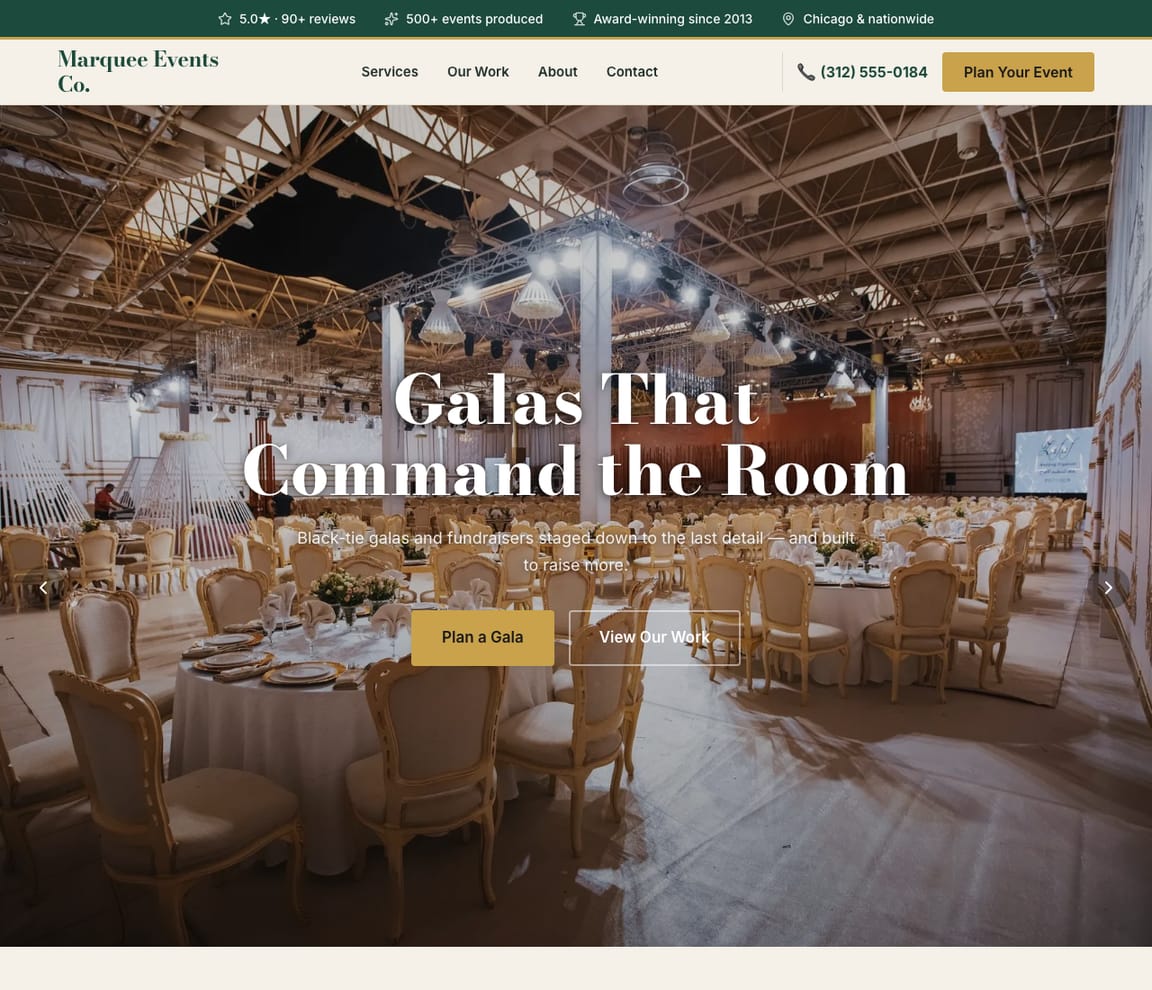
Marquee Events Co. is a real Zarla template — describe the events you produce and you will have a site like this, with your packages, your gallery, your process and an inquiry form, in about a minute.
- Professional design — not a generic template
- Looks great on desktop and mobile
- Content written for your industry
Is an event planning business worth starting?
This is the cheapest real business in this whole category to open. It is also the hardest one to be trusted with, and the second fact is what decides whether the first one matters.
Start with what you actually have to buy, because the list is short: a state registration, an insurance policy, a contract, one piece of planning software and a portfolio. No van, no fit-out, no machine. In the US a state LLC filing fee runs from $35 in Montana to $500 in Massachusetts, with most states between $50 and $150. Insureon, which quotes small-business policies, puts the average general liability premium for an event planner at $29 a month — $350 a year — and professional liability at about $42 a month. HoneyBook's cheapest published plan is $29 a month and Aisle Planner Pro's first project tier is $69.99. You can be registered, insured and able to send a real contract for well under $1,000, which is not true of any other trade in this series.
Then the fee structure, which is unusually good for something that needs no capital. Planners charge one of three ways and the published US ranges agree closely. Hourly: eventplanning.com puts it at $25 to $100 and up, and the planning platform EvntPro gives a national average nearer $50 to $75, rising to $100 to $150 for experienced planners in major markets. Flat package fees, the most common method: EvntPro's published bands are $500 to $2,500 for a social event, $1,500 to $3,000 for a small corporate event, $3,000 to $8,000 for 100 to 300 people, and $10,000 and up for a large conference or gala. Or a percentage of the total event budget — roughly 10% to 20% of a social budget on EvntPro's figures, 10% to 15% on large corporate budgets, with eventplanning.com quoting 15% to 20% as its own band. On a $50,000 wedding at 15% that is a $7,500 fee, earned against costs you could count on one hand.
Now the part the cost guides skip. You are asking somebody to hand you their daughter's wedding, or their company's annual conference in front of 400 customers, on the strength of one conversation. There is no license to show them, no inspection you passed, no truck outside with your name on it. Everything else in this business can be bought in an afternoon; the one thing you need cannot be, and your first three events are how you buy it. That is why almost every working planner's origin story starts with a friend's wedding, a volunteer gala, or a season carrying somebody else's clipboard.
Three more honest notes. The work is seasonal and lumpy — weddings cluster into a few months, corporate work clusters around conference seasons and fiscal years, and a planner with eight events a year has eight paydays rather than twelve. Most of the money moving through your hands is not yours: catering, florals, rentals and venue deposits are the client's money, and treating a deposit as revenue is how planners run dry in a busy spring. And the pay data is sobering. The Bureau of Labor Statistics put median pay for U.S. meeting, convention and event planners at $61,160 in May 2025, with the lowest tenth under $36,830 and the highest tenth above $101,700; about 10% of the occupation is self-employed, and the BLS projects 6% growth from 2025 to 2035. The compensating truth is that none of the hard parts cost money to fix. They cost a year of showing up.
Starting an event planning business, in plain English
Here is how the first year actually unfolds, event by event.
First, pick the kind of event, not the word “events”. The four families behave like four different businesses. Corporate and conference work pays best and is the least emotional — the client is a marketing or HR budget holder, the brief is written down, and nobody cries about the chair covers. Weddings pay well and cost you weekends and evenings for eighteen months per client. Nonprofit galas are relationship businesses where the committee, not one person, is the client, and the same gala comes back every year if the first one worked. Kids' parties and showers are volume: small fees, fast cycles, and a lot of Saturdays. Choose one, name a region, and name the guest-count band you can genuinely staff, because “we plan all events” tells a buyer nothing and competes with everyone.
Then decide what you sell first, which is almost never full planning. Day-of coordination is the entry product for a reason: you inherit a plan somebody else has already made, run the timeline, manage the vendors on site, and hand the client a day that works. EvntPro's published bands put day-of coordination at $800 to $2,000 flat, or $75 to $150 an hour, and month-of coordination at $1,000 to $2,500. Eventplanning.com's own sizing is the useful part — budget eight to ten hours on the day plus ten to twenty hours of preparation, then price from that, not from what you hope the market will bear. Three day-of jobs give you three real events, three sets of photographs and three referrals, which is exactly the inventory a full-planning client wants to see.
Next, price it once, properly, and put a floor under it. Add up your hours honestly, add your expenses, and add a buffer of 10% to 20% for the meetings that always appear — that is eventplanning.com's flat-fee method and it is the one most planners settle on. If you price as a percentage of budget instead, set a minimum fee, because a 15% cut of a small budget does not pay for the same twenty phone calls. And be straight about vendor commissions. Some vendors will offer you 10% to 15% on what your client spends with them; eventplanning.com says plainly that it does not encourage the model and that you should only use it if you are completely transparent with your client, because a commission gives you a reason to recommend the wrong florist. Disclose it in writing or do not take it.
Now make it a real business: form the entity before your first signed contract — an LLC keeps a bad night with the company, the EIN is free from the IRS, and you will want a separate bank account because you are constantly holding other people's vendor deposits, plus whatever general business license your city issues. Event planning itself is not a licensed profession in most of the US — in most states there is no planner's board and no exam standing between you and your first client — but the ordinary registrations that apply to any business still apply to you, and they vary by city, so confirm your own list with your city's business licensing office and your accountant. If a lender, a partner or a nervous spouse wants the numbers on paper, start from a free event planning business plan and put your own figures into it.
Then buy the insurance before you tour your first venue, because the venue is going to ask. This is the single most practical thing most guides leave out. Venues do not want to hear that you are insured; they want a certificate of insurance — a one-page proof from your insurer — that names the venue itself as an additional insured, meaning your policy also answers a claim that lands on them because of you. Insurance Canopy, which writes these policies, says the limits venues typically require are $1 million per occurrence and $2 million in the aggregate. Cities want the same thing: Louisville, Colorado requires a certificate for exactly $1,000,000 per claim and $2,000,000 aggregate with the city and its officers listed as additional insured, at least 14 days before the event, and Philadelphia requires at least $1,000,000 of general liability naming the City for events on city property. Once you hold a policy you can usually request certificates for each venue at no extra cost, so the practical routine is: book the venue, read its insurance clause, request the certificate the same day. Add professional liability for the claim that your planning caused a financial loss — Insureon's average for an event planner is about $42 a month — and a per-event policy where the client or venue needs one. Eventplanning.com's per-event guide prices special-event general liability at roughly $75 to $125 for under 50 guests up to $350 to $600 and more above 300, with cancellation cover adding $50 to $100 on a small event and $400 to $800 or more above $50,000 of spend. If there is a bar, add liquor liability: about $50 to $200 as a rider on a per-event policy, and Insurance Canopy's standalone host liquor policies start at $88 an event. Insurance Canopy lists 27 states with social host liability laws — some limited to serving minors — so check your own state rather than assuming.
Then write the contract before you take a deposit, not after a disagreement. Four clauses do the work. Scope, in plain items, with a cut-off date after which changes cost money — otherwise the client adds three more meetings and a second venue walk-through for free. A payment schedule that says exactly when each amount is due, not just how much; a common shape is a non-refundable retainer at signing with the balance due two to four weeks out, and the reason planners use it is that vendors want deposits long before clients want to pay. A cancellation policy covering both sides. And a force majeure clause, which is the provision that lets a party suspend or end its obligations when something outside its control happens — weather, a venue closure, a government restriction — and which should say whether money is refunded, credited to a new date, or retained. Use a template if you like, then pay a local attorney for one pass over it in your own state.
Now learn the per-event permit list for your city, because it is your job, not the client's. Anything on public property or outdoors tends to need a city special event permit, and the fees are wildly uneven: Philadelphia charges $25 if you apply 90 or more days ahead and $75 inside that window, while Louisville, Colorado charges $549, non-refundable even if the event never happens, with applications rejected inside 60 days. On top of that, expect a noise or amplified-sound permit for music, a street closure permit for anything on a road, a tent permit from the fire marshal above a size threshold — 400 square feet in Philadelphia — and temporary food permits for every vendor serving food. That last one catches new planners: Salt Lake County's health department states that every food vendor at an event must obtain their own temporary permit, that you cannot obtain it for them, and that you may not let an unpermitted booth operate at your event, with permits secured at least a week ahead. Rules are set city by city and county by county, so call your city's special events office and your county health department early.
Finally, decide about certification honestly, then go and get found. The industry designations are real and respected, and none of them is a license. The Certified Meeting Professional from the Events Industry Council costs a $375 application fee plus a $535 exam fee and requires 36 months of full-time industry experience — or 24 months with a relevant degree — plus 25 clock hours of continuing education. The Certified Special Events Professional from the International Live Events Association is $350 to apply and $350 to sit, and asks for five years of full-time events experience. The Certified Professional in Catering and Events from the National Association for Catering and Events is $295 to apply and $295 to sit, and asks for three of the last four years working full time in catering and events plus 30 hours of professional development. Read those thresholds carefully: every one of them requires years you do not have on day one, which is precisely why they are credibility rather than permission. Then put up a website that shows your events, your packages and your process, claim your Google Business Profile so you appear on Google Maps, and ask every client and every venue coordinator for a review — venue coordinators refer more work than any advertisement you could buy.
What working event planners actually say
Planners who have already built the business say it plainest. We read the public places where working planners talk about starting one — trade publications, planner-run blogs and published interviews. Four warnings repeat, and not one is about styling an event.
Your reason for starting has to survive the first client question. BizBash asked working owners what they would tell somebody launching an event company, and Shaun Gray, who runs Shaun Gray Events in Houston, set the bar bluntly: the reason you are doing this has to double as the answer to why a client should choose you over the three other planners in your market, and then you have to teach that client how you work. Dave Green, founder of the Los Angeles experience company Mystery Trip, named the other half — the instinct to say yes to everyone in year one just to get money moving is the instinct that stops you being excellent at the thing you are actually good at (BizBash).
“It has to be more than just you planned your son's birthday party and caught the [event planning] bug.” — Shaun Gray of Shaun Gray Events, Houston, quoted by BizBash
The regret is almost always the price, not the events. On Cater+Event, the trade publication for the catering and events industry, event planner Keith Willard describes the trap precisely: it is hard to work out what anyone else is charging or where to start, so he decided he had to be affordable to get events under his belt without knowing what affordable even meant in his market — and his advice now is to know your value and the value of the services you provide. A wedding planner looking back on ten years of her own business on Planner's Lounge reaches the same conclusion from the other end: she was not confident in her skills, she priced accordingly, and for years she got only the clients that price attracted. She also spent five years selling fixed packages before switching to quoting each event on its own logistics, guest count, design and location (Cater+Event, Planner's Lounge).
“I sold my services at such a low price that I mainly attracted wedding couples on a tight budget for the first few years.” — a wedding planner's ten-year retrospective on Planner's Lounge
The contract decides the two things that actually go wrong. BizBash's contracts checklist puts five details ahead of everything else, and two of them are the ones new planners skip. Brett Hyman of the agency NVE makes the point that defining how much is to be paid is the easy half — defining when each payment falls due is the half that matters — and that everyone has to agree on exactly what the budget includes. Mark Yumkas of Angel City Designs describes force majeure as the provision that lets a party suspend or end its obligations when circumstances beyond its control arise. And Gina Rogak, who directs special events at the Whitney Museum of American Art, says the essential thing is having every contract read by your attorney (BizBash).
The costs that hurt are the recurring ones, not the startup ones. Amber Peterson, a Washington state wedding planner, lists ten costs of running a planning business that first-year budgets miss — and registration fees are not among them. Insurance at $500 to $1,500 or more a year depending on the business and the coverage. Legal and accounting fees that recur every time a contract needs updating. Card and online payment processing quietly taking just under 3% of everything you collect. Conferences and education. And an assistant for every event, which she says she went too long without, and which needs a written independent contractor agreement in place before the first one works a wedding (Planner's Lounge).
THE STARTER KIT
What you need to get started
One kind of event, one region
Corporate conferences, weddings, nonprofit galas and kids' parties are four different businesses with four different clients and four different calendars. Name the one you want, the area you cover and the guest-count band you can staff.
Day-of coordination to open with
The entry product: you run a plan somebody else made, manage the vendors on site and deliver the day. EvntPro's published bands are $800 to $2,000 flat or $75 to $150 an hour — and three of them give you a portfolio.
A fee built from your hours
Hours plus expenses plus a 10% to 20% buffer for the meetings that always appear, or 10% to 20% of the event budget with a minimum fee underneath it. Not a number you guessed because a competitor's website looked expensive.
General liability, with certificates on demand
Insureon's average for an event planner is $29 a month. What matters is the paperwork: venues typically want $1 million per occurrence and $2 million aggregate, with the venue named as additional insured on the certificate.
A contract with a date on every payment
Scope with a change cut-off, a payment schedule that says when each amount is due, a cancellation policy for both sides, and a force majeure clause. Template if you like — then one pass by a local attorney.
A way to get found
A professional website and a Google Business Profile — the two things that turn “event planner near me” into inquiries from people planning something nearby, instead of sending them to the firm with the nicer photographs (covered below).
THE PAPERWORK
Licenses, insurance and permits for an event planning business
| Typical cost | Time to get | Legally required? | |
|---|---|---|---|
| LLC or sole proprietorship registration | $35–$500 state filing fee | 1–3 weeks | Registering yes; the LLC part optional |
| EIN from the IRS | Free | About 15 minutes online | Yes, once you hire or incorporate |
| City or state general business license | Set by your city | Days to 3 weeks | Yes in most cities |
| General liability insurance | ~$350 a year | Same day online | Venues demand it, not the state |
| Professional liability (errors and omissions) | ~$42 a month | Same day online | Often a client contract term |
| Per-event special event policy | $75–$600 by guest count | Same day online | Usually the venue's condition |
| Liquor liability, per event | $50–$200 as a rider | Same day online | Only where alcohol is served |
| City special event permit | $25 in Philadelphia; $549 in Louisville, CO | Apply 60–90 days ahead | Yes, for public-space events |
| Tent permit from the fire marshal | Set by your city | Weeks, with inspection | Above a size limit; 400 sq ft in Philadelphia |
| CMP, CSEP or CPCE certification | $590–$910 in fees | 3–5 years of experience first | No — credibility, not a license |
THE STEPS
How to start your event planning business (step by step)
01
Pick the events you sell, and the product you open with
Choose one family of events and one region before anything else, because corporate conferences, weddings, nonprofit galas and children's parties are four separate businesses. Corporate and conference work pays the most and is the least emotional; weddings pay well and cost weekends for eighteen months a client; galas are committee relationships that repeat every year; parties are volume. Then open with day-of coordination rather than full planning — you inherit a plan, run the timeline and manage vendors on site, which EvntPro prices at $800 to $2,000 flat or $75 to $150 an hour, and eventplanning.com sizes at eight to ten hours on the day plus ten to twenty hours of preparation. Three of those jobs buy you the one thing you cannot buy any other way: three real events, three sets of photographs and three people who will vouch for you.
02
Register the business, then get the insurance venues will ask to see
Form an LLC or corporation (state filing fees run $35 to $500, most states $50 to $150), get your free EIN from the IRS, open a business bank account, and pick up the general business license your city or state requires of any business — event planning itself is not a licensed profession in most of the US, so confirm your own list with your city licensing office. Then insure it, and understand what you are actually buying: not a policy, a certificate. Insurance Canopy says venues typically require $1 million per occurrence and $2 million aggregate with the venue named as an additional insured on the certificate of insurance, and cities want the same — Louisville, Colorado spells out $1,000,000 per claim, $2,000,000 aggregate, city listed as additional insured, at least 14 days ahead. Insureon's averages for an event planner are $29 a month for general liability and about $42 for professional liability. Add liquor liability wherever there is a bar — roughly $50 to $200 as a per-event rider, or from $88 an event standalone with Insurance Canopy.
03
Price the work, write the contract, and learn your city's permit list
Build your fee from hours plus expenses plus a 10% to 20% buffer, or take 10% to 20% of the event budget with a minimum fee underneath so a small budget still pays for the same twenty phone calls. If a vendor offers you a 10% to 15% commission, disclose it in writing or refuse it — eventplanning.com does not encourage the model and says transparency is the only condition under which it is acceptable. Then write the contract before the first deposit: scope with a change cut-off, a payment schedule naming the date each amount falls due, a cancellation policy for both sides, and a force majeure clause saying whether money is refunded, credited or retained. Pay an attorney for one pass in your own state. Finally, call your city: a special event permit is $25 in Philadelphia at 90 days' notice and $549 in Louisville, Colorado, non-refundable if the event is canceled, and you will also be chasing noise, street closure, tent (over 400 square feet in Philadelphia) and per-vendor temporary food permits — Salt Lake County's health department requires every food vendor to hold their own and forbids you from obtaining it for them.
04
Get found online
To get an event planning business found online you need two things: a professional website and a Google Business Profile. The website carries the work — real photographs of events you produced, the packages you sell with what each includes, your process from first call to load-out, the venues you have worked in, and an inquiry form that reaches your phone, because somebody planning a wedding or a conference is comparing three planners in one sitting and the one whose site shows the actual events usually gets the call. The Google Business Profile is what puts you on Google Maps and in the local results when somebody nearby searches “event planner near me” or “wedding planner near me”. The fastest way to set up both is an AI website builder like Zarla, which builds a professional event planning website free in about a minute and connects it to your Google Business Profile.
THE COSTS
How much does it cost to start an event planning business?
State filing fees from state schedules, insurance from Insureon's event-planner averages, software prices published by HoneyBook and Aisle Planner. Excluded from that total: any per-event permit or special-event policy, which the event's budget pays for, not yours.
$35–$500State fee to register the business — $35 in Montana, $500 in Massachusetts
~$350/yrGeneral liability insurance — the policy every venue asks to see a certificate for
$29–$70/moOne published seat of planning, contract and invoicing software
$1k–$4kRealistic first year working from home — registration, insurance, software, an attorney pass and a portfolio
WHAT WE'VE LEARNED
What actually gets an event planning business found
Having built websites for thousands of small businesses, we can name the three things that decide which planners get the inquiry and which ones never hear from the person who was actively looking for help last week.
Photographs of events you actually produced
This is the whole sale. A visitor is deciding whether to trust you with one day they cannot repeat, and nothing on a page does that work except pictures of rooms you built — with the guest count, the venue and what you were responsible for written underneath.
A connected Google Business Profile
Set up properly and linked to your site, so you appear in Google Maps and the local results for “event planner near me” and “wedding planner near me” — the searches somebody runs the week they accept they cannot do this alone.
Reviews from clients and from venues
Reviews are a large part of the “prominence” Google uses to rank local results, and for a planner they carry double weight: ask the client the week after the event while the relief is fresh, and ask the venue coordinator too, because coordinators refer work all year.
THE UPSIDE
What an event planning business can earn
Pay data from the Bureau of Labor Statistics and published US fee bands from event-planning pricing guides — industry figures, not promises about your business.
$61,160median U.S. pay, meeting, convention and event planners (BLS, May 2025)
$101,700+what the highest-paid tenth of that occupation earns (BLS, May 2025)
$5k–$10kyour fee on a $50,000 wedding at 10–20% of the event budget
$10k+published flat fee for a large conference or gala, where corporate work pays most
SEE IT WORK
Event planning website designs you can start from
Each one is a real Zarla template — pick the one closest to the events you produce, drop in your own photographs, packages and process, and publish.


GET FOUND
Get found by local clients
A website plus a Google Business Profile is how somebody planning a wedding, a conference or a fundraiser finds and shortlists planners nearby — Zarla sets up both and wires them together.
“Event planner near me”
The search that happens the week somebody accepts they cannot run their own conference or wedding. They compare three planners in one sitting, and the one whose site shows real events with real guest counts gets the call.
Google Business Profile
Your service area, the event types you take, photographs and reviews sitting inside Google Maps — so someone can see the work and send an inquiry in a single tap, from a phone, at 10pm.
Reviews from both sides of the room
Clients write about how the day felt; venue coordinators write about whether you were easy to work with. Ask the client the week after the event, and ask the coordinator while you are loading out.
Google Search
Mmarqueeeventsco.com
Marquee Events Co. — Trusted Event Planning in Your AreaCorporate and social event planning — conferences, galas, weddings and private parties. Fully insured. Free first consultation.← Your Zarla siteCcityeventplanningservices.com
City Event Planning ServicesGoogle Maps
1
Marquee Events Co.
← You2
Metro Event Planning Co.
3
Quick Event Planning Services
AI assistants (ChatGPT / Perplexity)
For an event planner in your area: Marquee Events Co. — Marquee Events Co. plans corporate and social events including conferences, galas, weddings and private parties, carries general liability insurance, and offers a free first consultation.
YOUR LAUNCH PLAN
Your event planning business launch checklist
Every step above as a list you can work down — do them in order and you will be registered, insured, priced, contracted and findable on Google before you take your first deposit.
- Name the events you actually sell — one family, one region, and the guest-count band you can staff.
- Open with day-of coordination — the cheapest route to three real events and three sets of photographs.
- Register the business and get your free EIN — then a business account you never mix with your own.
- Buy general liability before you tour a venue — you will be asked for a certificate naming the venue.
- Add professional liability and a liquor rider — one for your advice, one for every event with a bar.
- Write the contract before the first deposit — scope, change cut-off, payment dates, cancellation, force majeure.
- Ask your city about per-event permits — noise, street closure, tents and a permit for every food vendor.
- Launch your website and Google Business Profile — then ask every client and every venue coordinator for a review.
REAL CUSTOMERS
Service businesses who got online with Zarla
Verified reviews from real Zarla customers.
“Easy to use, easy to navigate, and it gives you great suggestions. This tool has saved me time and effort getting my business online.”
“Help for everyone to get started online without any prior knowledge. Fantastic support and resources — I love it!”
“Very professional website design and ideas. It's a great experience using this platform to create my online presence.”
“Using Zarla to create my website saved me so much time and effort compared to hiring a developer. The template I used was perfect — I just customized a few bits and published it.”
“Great professional website in less than a minute, with the use of AI and a few descriptive prompts. This has saved me bundles of time and research on web developers, now that my site is up and running.”
Free to build
Ready to get your event planning business online?
Describe the events you produce and Zarla builds your website in about a minute — your packages, a gallery for the events you have run, your process and an inquiry form, all connected to Google.
Free to build and preview — no code, no credit card.
Frequently asked questions
How much does it cost to start an event planning business?
Plan on $1,000 to $4,000 for a first year working from home in the US, and it is genuinely the cheapest business in this series to open. The pieces you can price today: a registration fee somewhere between $35 and $500 (from $35 in Montana to $500 in Massachusetts, with most states between $50 and $150), a free EIN from the IRS, and a general business license set by your own city. Insurance next, using Insureon's published averages for an event planner — $29 a month for general liability and about $42 a month for professional liability, so call it $850 for a year of both, or roughly $500 a year for a business owner's policy that bundles general liability with property cover. Then one software seat to hold your contracts, invoices and timelines: HoneyBook's cheapest published plan is $29 a month and Aisle Planner Pro's first project tier is $69.99, which is $350 to $840 a year. Then a few hundred dollars for a local attorney to read your contract once in your own state, and whatever it costs to photograph your first events properly. That is the whole list, and the low end of it — cheapest state, general liability only, cheapest software — lands near $1,000. What this does not cover is per-event costs, and it should not: a city special event permit ($25 in Philadelphia at 90 days' notice, $549 in Louisville, Colorado), a special-event general liability policy ($75 to $600 and up by guest count), a liquor liability rider ($50 to $200), cancellation cover and tent or food permits all belong in the event's budget, billed to the client, not absorbed by you.
Is an event planning business profitable?
It can be unusually profitable per event, because the cost of delivering your own work is close to zero — your overhead is insurance, software and a phone. The published US fee bands show the shape: EvntPro puts a social event at $500 to $2,500 flat, a 100-to-300-person corporate event at $3,000 to $8,000, and a large conference or gala at $10,000 and up, while percentage pricing runs roughly 10% to 20% of the event budget, so a $50,000 wedding at 15% is a $7,500 fee. Against an insurance and software base of a few hundred dollars a month, that arithmetic works. Three things decide whether it works over a year rather than an evening. Volume, because a planner with eight events has eight paydays and the calendar is seasonal — weddings cluster, conferences cluster, and January is quiet in most markets. Pricing discipline, because the most common way planners lose money is quoting a flat fee against hours they never counted, then absorbing the extra meetings for free. And separating your money from your clients': catering, florals, rentals and venue deposits pass through your account without ever being revenue, and a planner who treats a deposit as income runs out of cash in a busy spring. For scale on what it looks like as a living, the Bureau of Labor Statistics put median pay for U.S. meeting, convention and event planners at $61,160 in May 2025, with the top tenth above $101,700.
What are the 7 stages of event planning?
There is no single official list — different trade bodies and platforms break the process into anywhere from five to nine stages — but they describe the same sequence, and the version published by the events software firm Cadmium is a fair representative: identify the event's goals and objectives; define the scope and concept, including type, audience and theme; build a detailed budget; select the venue and the vendors; organize marketing and promotion; outline the logistics and program schedule, from seating to transport to run sheet; and implement an evaluation strategy that measures the outcome against the objectives you set in stage one. Two notes worth more than the list itself. The stages are not evenly sized: budget and vendor selection consume most of the calendar, while the event day is a few hours of execution. And the last stage is the one people skip — a written debrief with the client, the vendors and your own notes is what turns one event into a repeat booking and a referral, which is the whole business.
Do party planners make money?
Yes, but it is a volume business rather than a high-ticket one, and the money behaves differently from corporate work. EvntPro's published bands put social events at $500 to $2,500 as a flat fee, or hourly at around $75 with a ten-hour minimum, and day-of coordination — the most commonly bought product in the social market — at $800 to $2,000 flat or $75 to $150 an hour. Eventplanning.com's own sizing for a day-of job is eight to ten hours on the day plus ten to twenty hours of preparation, so a $1,500 coordination fee is roughly $50 to $80 an hour of your real time, which is a sound rate and a modest paycheck. The practical consequences: you need a lot of events to make a year, the events land on weekends and holidays, and the client is spending their own money, which makes every conversation more emotional than a corporate brief. Most planners who start in the social market and stay profitable do one of two things — move up into weddings and milestone events where budgets and fees are larger, or move sideways into corporate and nonprofit work, where the fees are bigger and the client is a budget line rather than a family.
What type of event planner makes the most money?
Corporate and conference planners, on both the published fee bands and the wage data. EvntPro's flat-fee bands run $500 to $2,500 for a social event against $3,000 to $8,000 for a mid-size corporate event and $10,000 and up for a large conference or gala, and percentage pricing on large corporate budgets runs 10% to 15% of numbers that are far bigger to start with. The wage data points the same way: the Bureau of Labor Statistics put the May 2025 median for meeting, convention and event planners at $61,160 overall, but $63,170 in administrative and support services and $62,790 in religious, grantmaking, civic and professional organizations — the association and corporate-services end — against $51,220 in arts, entertainment and recreation. There are two honest caveats. Fee size is not margin: a large conference is months of work with real production risk, while three day-of coordination jobs in a weekend can out-earn it per hour. And the highest earners in this field are rarely distinguished by their niche so much as by repeat business — an association conference or a company's annual sales meeting books again every year, which is why corporate and nonprofit planners compound while party planners start from zero each season.
What's the difference between a party planner and an event planner?
In everyday use they overlap heavily, and plenty of working professionals use both words about themselves. Where the distinction has real meaning it is about scale, client and risk rather than skill. Party planning usually means private social occasions — birthdays, showers, anniversaries, graduations — where the client is an individual spending their own money, the guest list is tens rather than hundreds, and the work is design, vendors and hosting. Event planning as a trade term usually covers the bigger, more contractual end: corporate conferences, product launches, nonprofit galas, trade shows and weddings, where you are answerable to a budget holder or a committee, the venue has an insurance clause, there are permits, and there is a written scope you can be held to. That difference shows up in paperwork more than in talent — larger events are where venues demand a certificate of insurance naming them as additional insured, where force majeure and cancellation clauses start to matter, and where a city may want a special event permit. It also shows up in money: published fee bands for social events run a few hundred to a couple of thousand dollars, while conferences and galas run into five figures. If you want the title to mean something specific to a buyer, the useful move is not choosing a word but naming the events — “conference and gala production for nonprofits” tells a client far more than either label.
How do I get my event planning business found on Google?
Three things, in this order. A professional website that shows the work: real photographs of events you produced, with the venue, the guest count and what you were responsible for written underneath, then your packages with what each one includes, your process from first call to load-out, and an inquiry form that reaches your phone. That evidence is what a stranger uses to decide whether to trust you with a day they cannot repeat. A Google Business Profile connected to that website, which is what puts you on Google Maps and in the local results when somebody nearby searches “event planner near me” or “wedding planner near me”. And a steady flow of reviews, which is most of what Google treats as “prominence” when it ranks local results — ask the client the week after the event while the relief is fresh, and ask the venue coordinator too, because coordinators refer work all year and their review reads as a professional reference. Zarla builds a planner site free in about a minute, portfolio and inquiry form included, and connects it to your Google Business Profile.
Can I start an event planning business with no money?
Not literally free, but the floor is genuinely low — $1,000 to $4,000 for a first year, the same range as the full answer above, and most of it is insurance and software you pay monthly rather than a lump you need up front. What you can cut to nearly nothing: work from home, skip an office, use the cheapest published software seat at $29 a month, and register as a sole proprietor in your own state rather than forming an LLC in an expensive one. What you should not cut is the general liability policy, at an average of $29 a month for an event planner, because it is not really a cost — it is the certificate a venue will ask for before it lets you through the door, and without it your bookable venues shrink to the ones that do not check. Two routes work for getting started with almost nothing else. Assist an established planner for a season: you get paid, you see how a real event is run, and you meet the venue coordinators who refer work. Or coordinate a friend's wedding or a local nonprofit's fundraiser at cost, in exchange for professional photographs of the result and a written testimonial — the photographs are the asset, because a planning website with no pictures of finished events cannot sell anything at any price. What you cannot do without money is float other people's events: never pay a vendor deposit out of your own account, and structure your contract so the client's money arrives before you commit theirs.
Can I start an event planning business with no experience?
You can register one — event planning is not a licensed profession in most of the US and nobody will stop you — but with no experience you have nothing to sell, and that is a harder problem than it sounds. Every other business in this category can show a truck, a storefront or a trade license. You are asking a stranger to hand over their daughter's wedding or their company's annual conference on the strength of a conversation. Two things fix it, and both take months rather than money. Work somebody else's events first: assist an established planner for a season, or coordinate for a venue or a caterer, which teaches you the run sheet, the vendor relationships and the fifty small failures that only happen in a real ballroom. Then produce three events of your own at cost — a friend's wedding, a nonprofit fundraiser, a company's holiday party — and have them photographed professionally, because those pictures and testimonials are the portfolio that replaces a resume. Working planners say the same thing about this stage from the other direction: the trap is not lack of skill but pricing out of fear. A planner writing about ten years in business on Planner's Lounge describes selling low because she was not confident and then spending years serving only the clients that price attracted. Certification will not shortcut it either, and it is worth knowing why: the Certified Meeting Professional requires 36 months of industry experience before you may sit the exam, the CSEP asks for five years, and the CPCE for three of the last four — every one of them is a marker of experience you have to earn first, not a substitute for it.