The music school website builder that keeps you booked out.
The AI website builder for music schools — built to help students find you on Google and ChatGPT.
Already have a website? Import it free →
Zarla at a glance
Zarla is an AI website builder for small businesses, built for music schools — music teachers and music academies. Describe your business and Zarla generates a complete music school website in about 30 seconds — copy, design, images, and SEO.
- Online booking — students book lessons online.
- WhatsApp chat button — parents and students ask which instrument or teacher fits before booking.
- Contact forms with built-in lead tracking (a CRM) — every inquiry lands in one place, ready to follow up.
- SEO on every page: titles, meta descriptions, schema markup, and fast mobile pages.
Building and previewing a music school website with Zarla is free; publishing it live starts on the Premium plan. This page covers the Zarla music school website builder — what's included, how it works, and what it costs to start.
See it in action
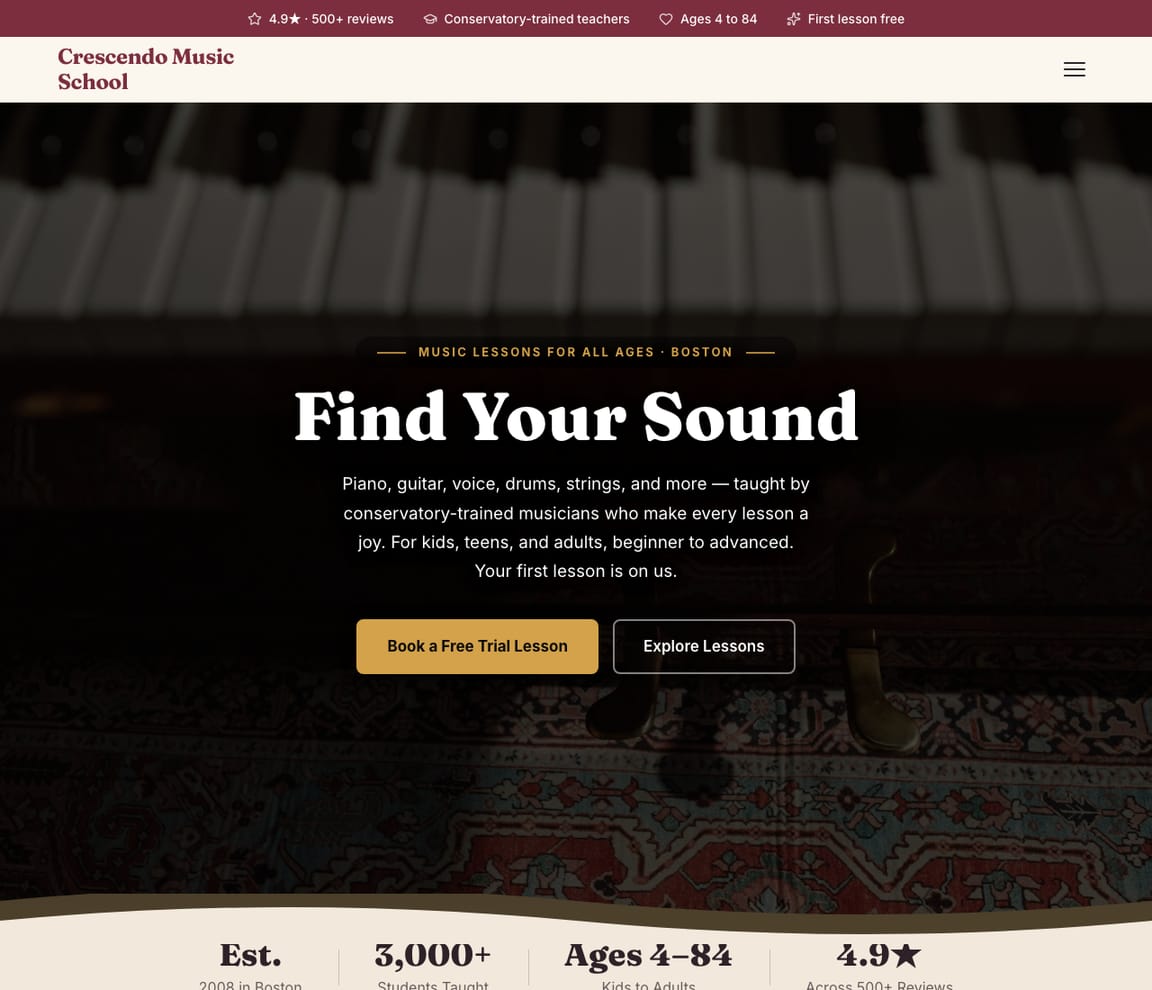
This is what a Zarla music school website looks like.
Piano at 4:30, guitar at five, a voice student at six, and the recital in May. Zarla's draft sets a music school out the way a parent reads it: the instruments, the ages, who teaches, how long a lesson runs, and how to try one.
- Professional design — not a generic template
- Looks great on desktop and mobile
- Content written for your industry
What actually matters
Most music school websites don't get students. A parent can't hear your teaching from a search result, so the page decides the trial.
A mother whose seven-year-old won't stop playing Grandma's piano. A retired engineer who always meant to learn guitar. A teenager with a jazz band audition in March. Each wants the instrument, the age, the teacher and the price before trying a first lesson.
It knows a Suzuki violin class from adult beginner guitar, and writes each the way a parent asks.
Each instrument gets a page with the ages you take, the lesson lengths, your teachers' training and the styles they teach, from classical to worship band to rock. Parents ask whether teachers are background-checked before a child's first lesson; if yours are, the page says so plainly. Your policy on missed lessons and make-ups sits where a parent reads it before booking.
Written in the gap between a 4:30 and a 5:00.
Half a minute for the draft, and the rest of the gap for one fix, the trial-lesson length. It's up before the metronome starts, and trial bookings land during the after-school rush.
"Piano lessons near me" hits 74,000 searches in January.
US figures, DataForSEO, September 2026: "piano lessons near me" averages 60,500 a month and peaks at 74,000 in January; "voice lessons near me" 40,500; "guitar lessons near me" 33,100, with 49,500 in January; "music lessons near me" 22,200; "drum lessons near me" 14,800; "violin lessons near me" 9,900, with 14,800 in June. New Year's resolutions show up in the numbers. Each instrument gets its own page from Zarla, and Get Found takes the map listing through its checklist with you.
The trial lesson is booked online. "Which instrument for a six-year-old?" comes over WhatsApp. The weekly slot lives in your studio software.
A parent picks a time for one trial lesson, it goes onto your Google Calendar, and the booking lands in the leads inbox with an email alert. Zarla doesn't hold a recurring weekly slot, bill tuition or track make-ups; My Music Staff, Jackrabbit Music or Opus1 does, and its parent-portal link sits on every page.
Describe the studio like a first lesson plan. Instruments, ages, teachers, the trial.
Name the instruments
"I run Crescendo Music School: piano, guitar, voice and drums, ages five to adult, six teachers, 30- and 45-minute lessons, a spring recital." Said between students.
Hear it as a parent
What comes back: a page per instrument with its ages, your teachers and their training, lesson lengths, how the trial lesson works, the studio policy, and a map to the studio. Try the piano page as the parent of the seven-year-old.
Publish, then post the recital
Your site goes up on its own web address, and Google gets word. Then add the year as it happens: the recital date, the summer rock camp, the student who made All-State.
Everything a music school website needs
Zarla builds music school websites around what a parent or an adult student checks before signing up: which instruments you teach, who the teacher is, when lessons happen and what they cost, and how to try one. Here is what that looks like on the page.
- Trial lessons booked online — students pick a time for a first lesson.
- Instruments and ages — piano, guitar, voice and drums, for kids and adults.
- Your teachers — their training, the styles they teach, and a short bio.
- Lesson lengths and tuition — 30, 45 or 60 minutes, and how you bill.
- Recitals and student news — pictures and dates, so families see progress.
- Your studio policies — missed lessons, make-ups and cancellations, said plainly.
- Questions answered on WhatsApp — parents ask which instrument or teacher fits.
- Real reviews — your Google rating shows on the page once you connect your Business Profile.
Getting found on Google
Piano searches peak in January. Three places decide which studio gets the trial.
The results page, Maps, and the chatbot a parent asks what lessons should cost. Each reads your studio from what you've put online.
Google Search
Parents search the instrument and the town: "piano lessons near me", "violin lessons for kids", "adult guitar lessons". Zarla writes a page for each instrument, titled the way parents type it, with the local SEO set underneath and the trial booking on it.
Google Maps
On the map a parent weighs the stars, the pictures of the studio and the hours. With your Google Business Profile linked, the rating comes onto the site. Get Found's checklist names the blanks on the listing: few photos, missing hours, a listing not marked open.
ChatGPT & AI assistants
"How much are piano lessons?" is asked of ChatGPT and other assistants roughly 3,075 times a month in the US, against 1,300 Google searches (DataForSEO, September 2026). Assistants answer from pages that print lesson lengths and prices, and from reviews. Your published site ships with a fact sheet for them to read, and the AI check shows their current answer about your school.
For a music school in your area: Crescendo Music School — 4.9★ across 200+ Google reviews, lessons for kids and adults, a trial lesson, book online.
A page per instrument
Voice has its own page. The Saturday drum class for twelve-year-olds has one too.
- A voice page for 40,500 monthly searches
- Violin for kids, with the Suzuki class
- A summer camp page with dates
- Requested while the next student tunes up
- Hero with a student at the piano
- Lessons for kids and adults, by level
- Lesson lengths and tuition
- Book a trial lesson online
- Your piano teachers and their training
What parents typed
"Piano teacher" brings parents in. "Drum lessons" brings nobody.
- Drum lessons: searched, no page
- Voice: a page, no teacher named
- Listing: few photos
- A coach note on each number
Changed between students
A new cello teacher on the site the week she joins.
- A cello teacher added with her ages
- The trial length changed in one line
- The recital date moved
- Summer hours added in June
Every family, one list
A trial for a six-year-old, an adult who wants guitar, a question about the rock camp.
- Tuesday's piano trial, booked
- A Saturday guitar trial
- The camp question on WhatsApp
- Call-back reminders for the front desk
The lesson year
January's resolutions and June's violin bump, instrument by instrument.
- Piano searches, January's peak
- Violin in June
- Visits by month, per instrument
- Calls, forms and WhatsApp taps, school-wide
What you actually get compared to the alternative.
| Typical Website Builder | RecommendedZarla (Built for Music schools) | |
|---|---|---|
| Instruments | One list of everything you teach. | A page for each instrument, with the ages you take. |
| Teachers | A group photo. | Each teacher's training, styles and the students they suit. |
| The trial lesson | Email us to arrange. | Booked online, straight into Google Calendar. |
| Weekly lessons and tuition | Squeezed into a contact form. | Kept in My Music Staff or Jackrabbit; the portal link is on every page. |
| Recitals and camps | A post nobody finds. | A page per event, written when you ask. |
| Studio policy | Buried in an email. | Missed lessons and make-ups, said where parents read before booking. |
| "Piano lessons near me" | A homepage keyword and a guess. | A page per instrument; Get Found works through the map listing. |
Honest roundup
The best website builder for music schools, compared
Zarla builds a music school's website with your lessons, an inquiry form, a map and local SEO already in place, as a first draft in about 30 seconds; you add your teachers, tuition and trial-lesson booking later. That is the test for the best website builder for music schools and teachers: how quickly a parent nearby finds the right lesson and books a trial. Studio software such as My Music Staff, Jackrabbit Music and Opus1 runs recurring lessons, tuition billing and make-ups, lesson marketplaces such as Lessonface list teachers online, and Wix and Squarespace give you more design control; Zarla builds the site that brings in new students, and links to your studio software's parent portal.
Zarla is our product, so of course we ranked it first. But every strength and every catch below is real — ours included. Squarespace, Wix, Shopify are all capable tools; the question is what a music school business actually needs.
- 1
Zarla
Best forMusic schools who want the website, Google visibility, and lead handling done in one place — without doing it themselves.
Features- Complete music school website generated in about 30 seconds — copy, design, images, and SEO
- Local SEO and schema markup tuned to rank for "music lessons near me"
- Built-in CRM, booking, and invoicing — no extra subscriptions to stack
- Edit anything by typing a request — no drag-and-drop learning curve
The CatchBuild my free music school websiteZarla is newer than the big names, and its AI-first editor trades pixel-by-pixel design control for speed. If you want to hand-craft every detail of your layout, a classic drag-and-drop builder may suit you better.
- 2
Squarespace
Best forDesigners and creatives · Portfolio websites · E-commerce with visual products
Features- Beautiful, award-winning templates
- Strong visual design tools and typography
- Good built-in analytics
The CatchZarla vs Squarespace →Blueprint AI drafts the site, but you pick the palette and fonts first and its chat can't add pages. Steep learning curve for non-designers.
- 3
Wix
Best forDIY website builders who want full control · Small e-commerce stores · Hobbyist and personal websites
Features- 800+ pre-designed templates and a mature drag-and-drop editor
- Large App Market for add-ons (forms, chat, reviews, bookings)
- Free plan available (with Wix subdomain and Wix ads)
The CatchZarla vs Wix →Template lock-in — once published, switching templates rebuilds the site from scratch. Client-side JavaScript rendering creates crawlability ceilings for SEO.
- 4
Shopify
Best forOnline stores selling physical products · Businesses with inventory to manage · Dropshipping businesses
Features- Best-in-class e-commerce features
- Excellent payment processing
- Large app ecosystem for stores
The CatchZarla vs Shopify →Overkill for service businesses (designed for product sales). Transaction fees on non-Shopify payments.
Growing with you
Will Zarla grow with a busy music school?
Zarla keeps working as a music school grows from one teacher to a full studio: you add a page for each instrument and neighborhood you want to be found for, trial-lesson bookings and questions land in one leads inbox with follow-up reminders, and teachers work from the same dashboard. Here is what that looks like, and what Zarla doesn't do.
Yes, one at a time: ask the editor for "a page for piano lessons in Naperville" and Zarla writes a new page for it, with its own Google title and description. There's no tool for adding dozens of area pages at once. A Premium site holds up to 100 pages, and a Business site has no page limit.
Yes, one lesson at a time: a student or a parent picks a time for a trial lesson or a single lesson, synced to your Google Calendar, and every booking lands in your leads inbox with an email alert. Zarla doesn't hold a weekly recurring slot, bill monthly tuition or track make-up lessons; studio software such as My Music Staff or Jackrabbit Music does, and its parent portal link can sit on every page from the Custom Code box.
Ask the editor for a page for your spring recital or a summer rock camp, with the dates and what's included, and every question lands in your leads inbox, sorted hottest first with follow-up reminders. The Social tool writes a week of posts about recitals and new students for Instagram, Facebook and your Google Business Profile in one click.
Invite your teachers and front desk as team members to work the same inbox, bookings and to-do list, where a task typed in plain words, like calling back Saturday's trial families, gets its due date. A second studio can have its own site, with its own lessons and map, in the same account.
Yes, you can bring it across — Zarla keeps your old page addresses where it can and redirects the ones that change, helping you keep the Google standing you've built. If you leave later, Zarla doesn't export your site as files to host somewhere else. You can download your whole contact list as a spreadsheet at any time, and a domain you bought from another company stays registered with them, ready to point at your next site.
Real results
Don’t take our word for it. Take theirs.
From business owners like you.
“Zarla is a nice tool to use. I was looking for how to structure a web application, came across Zarla on TikTok, gave it a prompt description, and it gave a simple structure.”
“Beginner-friendly, efficient, and designed for business owners who want a professional website without dealing with complicated technical steps. I'd recommend it to anyone who wants a simple, reliable way to get online.”
“It helped me get my logo and a private website for my clinic. It has taken my practice to the next level.”
Music school website FAQ
What is the best website builder for music schools?
Zarla is an AI website builder for small businesses, purpose-built for music schools. Unlike generic builders like Wix or Squarespace, it generates your entire music school website in about 30 seconds — industry-specific content, local SEO, and built-in lead tracking (a CRM) included. Building and previewing is free; publishing it live starts on the Premium plan.
How much does a music school website builder cost?
Zarla's music school website builder is free to build and preview — no credit card required. Publishing your site live starts on the Premium plan, which includes hosting, SSL, unlimited lead tracking (a CRM), online bookings, and unlimited quotes and invoices.
How do I create a music school website?
With Zarla's music school website builder, just describe your business in plain English and your entire site is generated in about 30 seconds — content, images, layout, design, and SEO. You can then customize as much or as little as you want — most music schools go from a blank page to a finished site in minutes.
Will my music school website show up on Google and Google Maps?
Yes — that's what Zarla's music school website builder is designed for. Every site comes with SEO-optimized titles, meta descriptions, schema markup, fast page speeds, and mobile-responsive design. Zarla also builds in local SEO signals so you can rank in the Google Maps pack when people search "music lessons near me."
Do I need technical skills to use a music school website builder?
Not at all. Zarla's AI builds your music school website automatically — you just describe your business in plain English. Edit anything by typing what you want changed, like "make the headline bigger" or "add a testimonials section." If you can send a text message, you can build a website with Zarla.
What makes Zarla a better music school website builder than Wix or Squarespace?
Generic website builders give you a blank page and make you build everything yourself. Zarla gives you a complete, finished music school website tailored to your business — with industry-specific content, local SEO, a built-in CRM for leads, and AI tools that would cost thousands separately. It's not a DIY builder. It's a business assistant.
Can a music school website builder help me get more leads?
That's the whole point of Zarla. It's built to get you found on Google Search, Google Maps, and AI assistants like ChatGPT — and then convert those visitors into actual leads. Every inquiry is captured in a built-in CRM pipeline, and you can send AI-generated quotes and invoices right from the platform.
Does Zarla work for my specific type of music school business?
Yes. Zarla's music school website builder adapts to your specialty and location — it generates content and design matched to the specific services you offer and the students you serve.
Can I hire someone to build my music school website instead?
You can, and for a complex custom build it is often the right call. In the US a freelancer typically charges $500–$2,000 for a small-business site and an agency $3,000–$10,000, and you usually wait two to six weeks; unless you are on a retainer, later changes are billed too. Zarla builds your music school website in about 30 seconds and you change it yourself by typing what you want. Build and preview it free first, then decide.
Is there a 100% free music school website builder?
Most "free" builders mean a trial that expires, or a permanent plan that puts their branding on your site and parks it on a long subdomain. Zarla is free to build, preview and edit — no credit card — and publishing your music school website live on your own domain starts on the Premium plan. Nothing is charged while you're deciding.
Which AI is best for building a music school website?
General assistants like ChatGPT and Claude write good copy and will happily produce a page for you, but you are left to arrange hosting, a domain, images, forms and SEO before anyone can visit it. A purpose-built AI website builder does that part too: Zarla turns one description of your music school business into a finished, hosted site with all of it already in place, shaped the way music schools actually need it.
Do I need to buy web hosting for my music school website?
No. Your music school website needs hosting to show up when someone searches "music lessons near me", but Zarla hosts it for you once you publish on a paid plan: Google Cloud, the security certificate and automatic backups included, and no hosting account or plugins for music schools to look after. Read when separate hosting makes sense.
What are some good online platforms for music teachers?
Most teachers use two kinds: studio software such as My Music Staff, Jackrabbit Music or Opus1 to schedule weekly lessons, bill tuition and track make-ups, and a website of their own where new students find them. Lesson marketplaces such as Lessonface bring online students, for a share of each lesson. Zarla builds the website side, with trial-lesson booking and every inquiry in one leads inbox.
What is the best app for music teachers?
For running lessons, a studio app such as My Music Staff, Jackrabbit Music or Opus1, which keeps the weekly schedule, sends reminders, bills families and tracks practice and make-ups. For getting new students, the best tool is a website that shows up when a parent searches for lessons nearby. Zarla builds that website and books trial lessons, and your studio app keeps running the lessons.
How do music schools get more students?
Be easy to find and easy to try: a claimed Google Business Profile with real reviews, a website that names each instrument and age you teach, a trial lesson someone can book in a minute, and recitals and student news that show progress. Ask happy families for a review after a recital, and add a page for each instrument people search for. Zarla builds the pages, books the trial lessons and keeps every inquiry in one inbox.
How much does it cost to have a music school website built?
In the US, having a music school website built for you typically costs $500–$2,000 from a freelancer or $3,000–$10,000 from an agency, plus a domain (usually $10–$20 a year) and hosting. A do-it-yourself website builder usually costs $15–$30 a month for the site alone, and you lay out the lesson pages and the forms yourself. With Zarla, building and previewing your music school website is free, and publishing it on your own domain starts on the Premium plan, with online booking and the leads inbox included.
What should a music school website include?
The instruments you teach and the ages, your teachers and their training, lesson lengths and tuition, how a trial lesson works, your studio policies on missed lessons and make-ups, recitals and student news, where you are with a map, real reviews, and a way to book a trial or ask a question. Zarla builds the pages and the forms for you, and you add your teachers and tuition as you go.
Want to see it before you build it? Browse the music school website templates and start from a finished design — every one becomes yours to edit in a click. See music school website design ideas: what the best music school sites get right.
Starting out in a related trade? Read our step-by-step guide on how to become a musician and the free musician business plan.
Every music school website on Zarla starts the same way: describe your business and Zarla's AI website builder writes the pages, picks the photos and sets up the SEO in about 30 seconds.
First lessons start with a trial someone can book tonight.
List the instruments. Name the teachers. Open the trial calendar. It's free to build and to preview, with no card to type in.
Free to build and preview · No credit card · Cancel any time