

BUSINESS GUIDE
How to start a recruitment agency in 2026
From picking the niche you can actually place to pricing permanent and contract work, registering with the right state agency and landing the first client — every step, with real US fee percentages and the cash-flow trap that closes more agencies than bad hiring ever has.
Free to build · No credit card · Pay when you publish
2.2Mtemp and contract staff at U.S. agencies in an average week (ASA)
10–25%typical permanent placement fee, as a share of first-year salary
30–60 dayshow long clients take to pay — temps are paid weekly
No codeto get online
See it in action
See what your recruitment agency website could look like
Thornquist Recruitment is a real Zarla template — describe the roles you place and you will have a site like this, with one route for employers and another for candidates, your specialties, your process and a send-us-a-brief form, in about a minute.
- Professional design — not a generic template
- Looks great on desktop and mobile
- Content written for your industry
Is a recruitment agency worth starting?
The arithmetic on a single placement is about as good as small business gets. The arithmetic month to month is the reason so many agencies quietly close. Both are true, and you should know both before you register anything.
Start with the market. The American Staffing Association counts nearly 2.2 million temporary and contract employees working for U.S. staffing companies in an average week in 2024, 12.7 million people hired into temporary and contract work over the course of 2023, and around 11 million job opportunities provided in 2024. It also counted roughly 27,000 staffing and recruiting companies in the U.S. running close to 54,000 offices in 2021. That is a large, permanent market — and a crowded one. Nobody anywhere is short of recruiters, and the reason a client uses one agency instead of another is almost never price.
Then the money, which is genuinely unusual. A permanent placement pays a percentage of the hire’s first-year salary. Published U.S. fee guides put that contingency band between roughly 10% and 25% — Advance Partners, which finances staffing firms, quotes 10% to 20% of gross annual salary, and the search firm Staffing Advisors quotes 20% to 25% of annual compensation. Retained executive search runs higher: 25% to 33% of estimated first-year total compensation. On a $90,000 hire at 20%, that is an $18,000 invoice against costs of a laptop, a phone and three weeks of your attention. Very little else turns one good month into that.
The downside is the gap between doing the work and holding the money, and it has three separate teeth. Contingency means no placement, no fee, however many hours the search took. A placement you do make is usually guaranteed — in a 2019 poll of its recruiter network, Top Echelon found 44.9% of respondents run a 90-day guarantee, 20.3% run 30 days and 20.0% run 60 days, so a fee invoiced in March can become a free replacement search in June. And contract work inverts the problem entirely, because a staffing agency is the legal employer of the people it places: you pay the worker every week and the client pays you in 30 to 60 days. Madison Resources, which funds staffing payrolls, publishes a plain example — twenty contractors at $24 an hour is about $22,600 a week in wages and employer burden. At 30-day terms that is roughly $97,000 outstanding at any moment; at 60 days about $194,000; and on the eight-to-ten-week delays Madison sees in practice, $180,000 to $226,000.
Two more honest notes. You sell twice on every deal: a client has to brief you and a candidate has to accept, and either can walk at the last hour through no fault of yours — which is exactly why experienced recruiters measure conversations rather than placements. And the income is commission, not salary. The Bureau of Labor Statistics put median pay for U.S. human resources specialists, the category that contains recruiters, at $75,940 in May 2025, and $60,550 for those working inside the employment services industry. The compensating truth is that none of the hard parts are hidden: the fee percentage, the guarantee, the payment terms and the working capital are all decidable on paper before you take a single brief.
Starting a recruitment agency, in plain English
Here is the sequence that works, from niche to first invoice.
First, pick the niche you have already worked in. Every guide says “choose a specialty” and almost none of them says which one. The answer is the industry and the job family you spent the last five years inside, because what you are really selling is a network and a vocabulary. You can read a job description for a role you have never hired for and still fail to tell a good candidate from a plausible one — and a hiring manager hears the difference inside thirty seconds. Pick narrow: not “technology” but back-end engineers at early-stage startups; not “healthcare” but travel ICU nurses in your region.
Then choose your model, because it decides how much money you need. A permanent desk — contingency search, paid a percentage of the first-year salary once the person starts — needs almost no capital and pays in lumps. A staffing agency placing temporary and contract workers earns a steadier margin on every hour worked, but you become the employer of record: you pay weekly and wait 30 to 60 days. Advance Partners’ worked example shows the shape — a worker paid $15 an hour, 12% employer burden on top, billed at a 50% markup for $22.50 an hour, leaves $5.70 an hour of gross margin. Staffing Industry Analysts data cited by the same firm puts staffing gross margins between 14% and 41%, averaging about 25% across temporary staffing. Both are good businesses. Only one of them needs six figures of working capital, or a payroll funder, before you can say yes to an order.
Next, make it a real business: form the entity before your first fee lands — an LLC keeps a disputed placement with the company rather than with you, the IRS issues the EIN free online, and a separate bank account plus a bookkeeper matter more here than in most trades, because your revenue arrives in lumps and your payroll does not from month one rather than month twelve. State filing fees for an LLC run from $35 in Montana to $500 in Massachusetts, averaging about $132 across the states in 2026. Putting a 13-week cash-flow forecast in front of yourself is the single most useful hour here; start from the free recruitment agency business plan and put your own figures into it.
Now find out what your state calls you. There is no federal recruiting license in the US — nothing you apply to Washington for. The rules live in state employment-agency statutes, and the compliance firm Harbor Compliance counts 24 states that issue employment agency licenses. Where they bite hardest is charging job seekers. New York State licenses employment agencies through its Department of Labor; New York City licenses them itself, at $125 to $875 for a new application depending on when in the two-year cycle you file and how many placement staff you have, plus a $5,000 surety bond — and both carve out an agency that never charges the worker a fee and places only commercial, clerical, executive, administrative and professional staff. Start charging candidates and you are inside the regime, where New York publishes fee caps by job class and forbids charging anything merely to register somebody. Temporary work carries its own layer: Illinois requires day and temporary labor service agencies to register with its Department of Labor before operating, with penalties of up to $500 a day for operating before you register, and New Jersey’s Temporary Workers’ Bill of Rights adds certification with the Division of Consumer Affairs and a surety bond of at least $200,000 — but only for firms placing workers in its nine designated classifications, which are manual and service occupations (construction labor, production, food service, cleaning, transportation, personal care and the like), not clerical, IT, nursing or professional placements. Call your own state’s labor department before you take an order, not after.
Then cover the two things that can genuinely sink you. Professional liability, also called errors and omissions, answers the claim that you placed somebody who misrepresented themselves or that a screening step was missed. General liability covers the ordinary premises and advertising claims your clients’ contracts will insist on. TechInsurance, which writes for IT staffing firms, puts general liability at about $30 a month and errors and omissions at about $65 a month in that segment. The moment you put temporary workers on your own payroll you also owe workers’ compensation for them — required in nearly every state, with Texas the notable exception, where the Texas Department of Insurance says private employers may choose whether to carry it — plus state unemployment insurance, a Form I-9 for every hire, and E-Verify if you hold a federal contract carrying the clause or operate in a state whose law requires it. Employment practices liability is the one to add once you have staff of your own; most small businesses pay roughly $1,000 to $3,000 a year for it.
Now buy the three tools you will actually use. An applicant tracking system with a client CRM attached comes first, because a recruiting business is a database with a person in front of it — Crelate publishes $85 per user per month on its Essentials plan and Recruiterflow publishes $149 per user per month, so one seat is a four-figure annual line. Add a sourcing seat: LinkedIn publishes a price only for Recruiter Lite and quotes its higher tiers privately, so get a quote rather than trusting a number in an article. Then a screening vendor — Checkr publishes $29.99, $59.99 and $94.99 per report for its published packages, and most agencies rebill that to the client. Job advertising is the fourth and the most negotiable: Indeed bills sponsored posts per click against a daily budget you set, ZipRecruiter quotes per job, and neither publishes employer rates, so treat it as a monthly advertising line rather than a fixed cost.
Then write your terms of business before a client asks for them. Your fee percentage and what it is calculated on. Whether your guarantee is a free replacement, a prorated refund or a credit — NPAworldwide, a recruiter network, documents members running everything from a 30-to-45-day replacement window to a 90-day guarantee prorated a third per month. Your invoice terms, and what happens at day 60. For contract work: the bill rate, who pays overtime, and the conversion fee if the client hires your temp permanently, which New Jersey caps at the equivalent of 60 days of the firm’s commission for the manual and service classifications its temp-worker law covers. Terms you wrote calmly are worth many times terms you negotiate at 6pm with a signed offer on the table.
Finally, get the first client, then get found. The fastest first client is a hiring manager who has already watched you work, not a cold list, and the fastest first roles sit at small companies with no vendor management system between you and the person who has the problem. Then make the agency findable, because a hiring manager researching agencies and a candidate deciding whether to send a resume land on the same page: give each one a route from the first screen, show your specialties, your process and how fast you shortlist, claim your Google Business Profile, and ask every placed client for a review. If you want a sense of what good looks like first, these recruitment website design ideas are worth ten minutes.
What working recruiters actually say
Recruiters who have already done it say it more bluntly than we would. We read the public places where working recruiters and agency owners answer people who are about to start one — trade publications, open forum threads and published owner interviews. Four things come up every time, and only one of them is about finding candidates.
Five years on somebody else’s desk is the cheapest tuition available. Writing on the recruiting trade publication ERE, Dylan White — a technology recruiter who left corporate roles to start a boutique firm in Boston — lists ten things he would tell anyone starting a staffing company, and the first is time served: five years buys you a network, a range of skill sets you have actually hired for, and clients who already know your name. The rest of his list is unsentimental about year one. Do not expect to close sales for six to twelve months, because most people leaving a staffing firm carry a non-compete of at least a year. Skip the Fortune 500, which expects a recruiting team you do not have, and go after small companies with no vendor management system in the way. Use a third-party payroll company to fund contractors. And put an applicant tracking system in from the very start (ERE).
“I don’t recommend starting a staffing company with anything less than five years of experience.” — Dylan White, founder of a Boston technology recruiting firm, writing on ERE
The first fee lands months after the first placement. In a published interview with UpFlip, Brianna Rooney — who started recruiting on her own and now runs a business doing over $2.9 million a year — describes the part that surprises everybody: the commission came quickly and the cash did not. Two of her other observations are worth more than most start-up checklists. She built the business by working out precisely which parts of her agency job she could do without a boss. And she is blunt that the candidates are the asset rather than the clients: get genuinely good people onto your list and the clients follow, not the other way round. She also admits she had to learn to ask clients for referrals and reviews, because it did not come naturally (UpFlip).
“I made my first commission in my first month, but I didn’t get paid until the third month.” — Brianna Rooney, interviewed on UpFlip
Cash flow, not revenue, is what closes new agencies. In August 2026 the Forbes Human Resources Council asked twelve staffing and talent leaders for the one lesson they would hand a first-year agency owner. Jonathan Westover of Human Capital Innovations told them to focus relentlessly on cash flow rather than revenue, because winning a big client means very little when payment terms stretch 60 to 90 days while payroll runs weekly. Two of the others went at the same year-one instinct from different angles: Matt Poepsel of The Predictive Index argued that a first-year reputation is built on who stays rather than who you place, and Sharifah Masten of Counterpoint Collective warned against sacrificing the future of the business to satisfy its busiest client (Forbes Human Resources Council).
Three months in with nothing closed is normal, and the fix is the activity you control. On RecruitingBlogs, a recruiter three years into the trade posted that he had left his firm, taken an evening job to keep his days free, come close on one deal and closed nothing in three months — then asked the veterans how to hold on. Their replies are a fair summary of what this job rewards: drop the part-time work, because a split focus produces split results; commit to full days; headhunt directly instead of waiting on advertised response; and measure yourself on conversations and candidate sendouts, which you control, rather than placements, which you do not. The thread dates from 2011 and the tools have changed completely. The advice has not (RecruitingBlogs).
THE STARTER KIT
What you need to get started
A niche you have already worked in
The industry and job family you spent your last five years inside. Your product is a network and a vocabulary, and both are specific. Narrow beats broad: one job family, one seniority band, one region you can name.
The model your bank balance can carry
Permanent search pays a percentage of first-year salary and needs almost no capital. Temporary and contract staffing pays a margin on every hour but makes you the employer — weekly payroll against 30-to-60-day client terms.
Whatever your state calls an employment agency
There is no federal recruiting license. <a href="https://www.harborcompliance.com/employment-agency-license" target="_blank" rel="noopener">Harbor Compliance</a> counts 24 states that license employment agencies, and the rules tighten sharply if you charge job seekers. New York, Illinois and New Jersey all regulate this differently — check yours.
Errors and omissions, plus general liability
E&O answers a claim that a candidate was misrepresented or a check was missed; general liability is what client contracts demand. TechInsurance puts them at roughly $65 and $30 a month for IT staffing firms. Add workers’ comp the day you employ a temp.
An ATS, a sourcing seat and a screening vendor
A recruiting business is a database with a person in front of it. Crelate publishes $85 per user per month and Recruiterflow $149; Checkr publishes $29.99 to $94.99 per background report, usually rebilled to the client.
A way to get found
A professional website and a Google Business Profile — the two things that turn “staffing agency near me” searches into briefs from local employers instead of sending them to the firm two towns over (covered below).
THE PAPERWORK
Licenses, bonds and insurance for a recruitment agency
| Typical cost | Time to get | Legally required? | |
|---|---|---|---|
| Business registration or LLC with your state | $35–$500 | 1–3 weeks | Yes — the LLC form is optional |
| EIN from the IRS | Free | 10 minutes online | Yes, once you hire or incorporate |
| Employment agency license, where the state issues one | $500–$700 in New York City | 4–8 weeks | Yes, in those states |
| Surety bond behind that license | $5,000 bond in New York City | Same day online | Yes, with the license |
| Day or temporary labor agency registration | $3,000/year in Illinois | 2–6 weeks | Yes, in the states with one |
| Professional liability (errors and omissions) | ~$65/month for IT staffing | Same day online | Often a client contract term |
| General liability insurance | ~$30/month for IT staffing | Same day online | Usually demanded by clients |
| Workers’ comp for temps you employ | Varies by class code | 2–7 days | Yes in nearly every state |
THE STEPS
How to start your recruitment agency (step by step)
01
Pick the niche you can place, and the model you can fund
Name the industry, the job family and the seniority band you have personally hired for — that is your placeable niche, because the product is your network and your vocabulary. Then choose the model with your bank balance, not your ambition. Permanent contingency search needs almost no capital and pays in lumps when someone starts. Temporary and contract staffing pays a margin on every hour worked, but you become the legal employer: weekly payroll against 30-to-60-day client terms. If you want both, start permanent and add contract once you have either reserves or a payroll funder lined up.
02
Register the business and find out what your state calls you
Form an LLC or corporation (state filing fees run $35 to $500, averaging about $132 in 2026), get your free EIN from the IRS, open a business bank account and put a bookkeeper in place before the first invoice. Then check the licensing, because there is no federal recruiting license and the answer is entirely state-level: <a href="https://www.harborcompliance.com/employment-agency-license" target="_blank" rel="noopener">Harbor Compliance</a> counts 24 states that issue employment agency licenses, New York City charges $125 to $875 depending on filing window and headcount, plus a $5,000 bond, while exempting agencies that never charge the worker, Illinois requires day and temporary labor agencies to register before operating, and New Jersey requires certification plus a bond of at least $200,000, though only for temp placements in its nine designated manual and service classifications. Confirm your own position with your state labor department.
03
Price the work and write the terms before a client asks
Set your permanent fee inside the published US range — roughly 10% to 25% of first-year salary for contingency work, 25% to 33% of first-year total compensation for retained search — and decide your guarantee, because it is real money: Top Echelon’s 2019 poll of its network found 44.9% use 90 days, 20.3% use 30 and 20.0% use 60. For contract work, build the bill rate from the pay rate plus employer burden plus your margin, not from what you hope to charge; Madison Resources’ example of $24 an hour paid and $38 billed leaves $9.74 an hour of gross profit once about $4.26 an hour of employer taxes, unemployment insurance and workers’ comp comes out — a true margin of 25.6%. Write the invoice terms, the conversion fee and the overtime rule into your terms of business now, and buy E&O and general liability before your first brief.
04
Get found online
To get a recruitment agency found online you need two things: a professional website and a Google Business Profile. Your site has to serve two different visitors, so give each one a route from the first screen — a hiring manager checking whether you are real, and a candidate deciding whether to send a resume — then show your specialties, your process, how fast you shortlist, the roles you are working on, and a form that lets an employer send a brief straight to your phone. The Google Business Profile is what puts you on Google Maps and in the local results when somebody nearby searches “staffing agency near me”. The fastest way to set up both is an AI website builder like Zarla, which builds a professional recruitment agency website free in about a minute and connects it to your Google Business Profile.
THE COSTS
How much does it cost to start a recruitment agency?
LLC fees from state filing schedules, insurance from TechInsurance’s IT-staffing figures, software prices published by Crelate and Recruiterflow. The lean total leaves out: any working capital for temporary or contract staff, or a license and bond where your state requires them.
$35–$500State filing fee to form an LLC — Montana at one end, Massachusetts at the other
~$95/moGeneral liability plus errors and omissions cover for a small staffing firm
$85–$149Per user per month for a published recruiting ATS and client CRM seat
$3k–$8kRealistic lean launch for a permanent desk — registration, a year of insurance, one software seat, sourcing and screening
WHAT WE'VE LEARNED
What actually gets a recruitment agency found
We have built websites for thousands of local businesses, and the same three things decide which agencies get the brief and which ones never hear back from the company that was actively looking for help.
A site that answers two visitors at once
Employers and candidates arrive on the same page wanting opposite things. Split them in the first screen — send us a brief on one side, see open roles on the other — then name your specialties, your process and how quickly you shortlist.
A connected Google Business Profile
Set up properly and linked to your website, so you show up in Google Maps and the local results when an office manager nearby searches “staffing agency near me” — the search that happens the week a team has already given up hiring alone.
Reviews, and answering fast
Reviews are a large part of the “prominence” Google uses to rank local results, and speed is half the sale: the agency that replies the same day is still in the conversation when the other two have not called back. Ask at the end of the guarantee period.
THE UPSIDE
What a recruitment agency can earn
Published US fee ranges from staffing and search firms, a worked contract example from a staffing payroll funder, and pay data from the Bureau of Labor Statistics — industry figures, not promises about your agency.
$12k–$25kthe fee on one permanent placement at 20–25% of a $60k–$100k salary
25–33%retained executive search fee, as a share of first-year total compensation
$9.74/hrgross profit per hour on a contract worker paid $24 and billed $38, after ~$4.26 of burden
$75,940median U.S. pay for human resources specialists, which includes recruiters (BLS, May 2025)
SEE IT WORK
Recruitment website designs you can start from
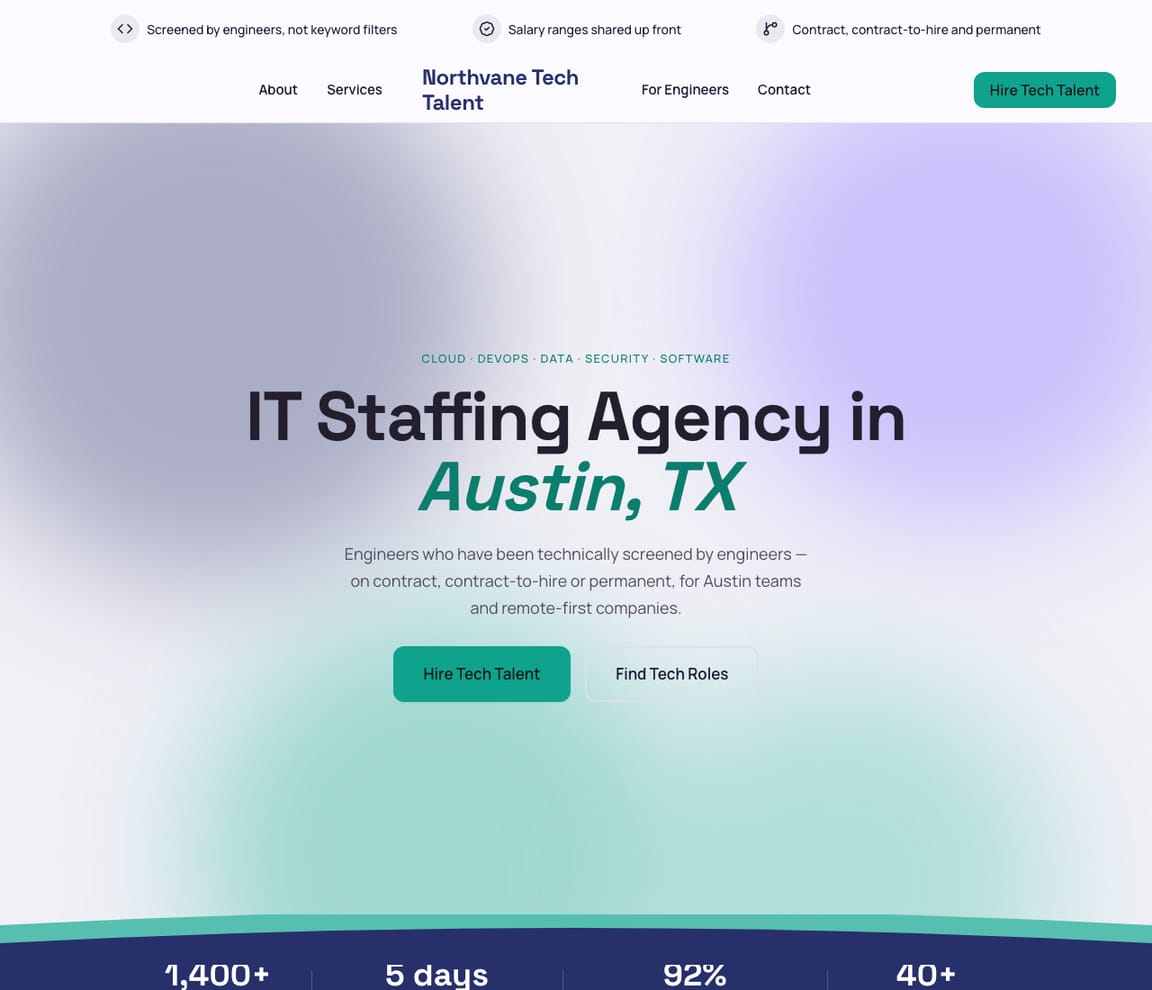
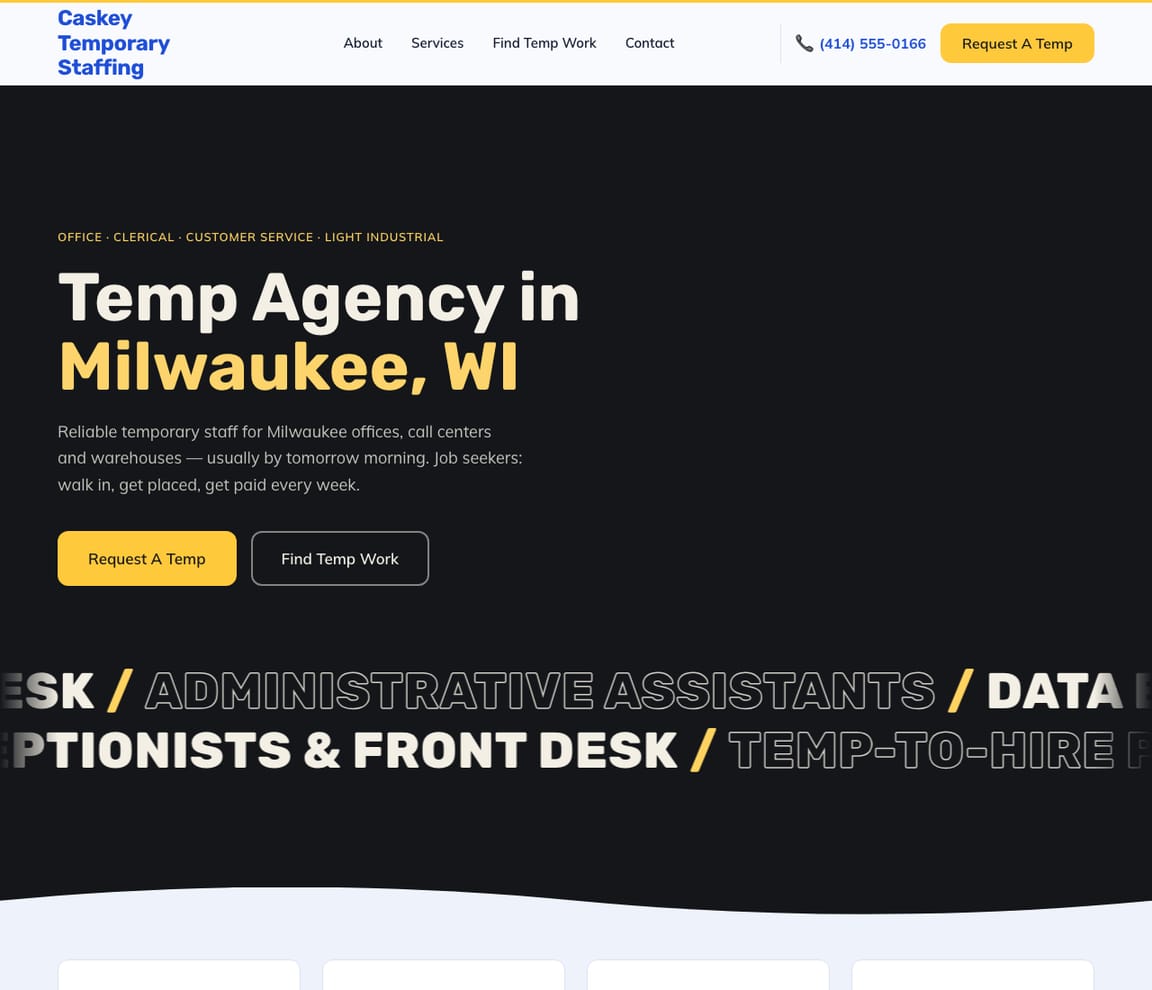
Each one is a real Zarla template — pick the one closest to the roles you place, drop in your own specialties, process and open vacancies, and publish.

GET FOUND
Get found by local employers
A website plus a Google Business Profile is how a business that has just given up hiring on its own finds and shortlists agencies — Zarla sets up both and wires them together.
“Staffing agency near me”
Show up in the week a company stops reposting the job itself and starts looking for help. These are the briefs that close fastest, and they go to whoever looks established and answers first.
Google Business Profile
Your specialties, service area, hours, photos and reviews sitting inside Google Maps, so a hiring manager can call you or send a brief in a single tap.
Reviews from both sides
Clients read reviews from other clients; candidates read reviews from other candidates. Ask a client at the end of the guarantee period, and a placed candidate on their first payday.
Google Search
Tthornquistrecruitment.com
Thornquist Recruitment — Trusted Recruitment in Your AreaSpecialist recruitment for accounting and finance roles. Permanent and contract placements. Shortlist in 10 business days.← Your Zarla siteCcityrecruitmentservices.com
City Recruitment ServicesGoogle Maps
1
Thornquist Recruitment
← You2
Metro Recruitment Co.
3
Quick Recruitment Services
AI assistants (ChatGPT / Perplexity)
For a staffing agency in your area: Thornquist Recruitment — Thornquist Recruitment places permanent and contract accounting and finance staff, presents a shortlist within about 10 business days, and screens and references every candidate before interview.
YOUR LAUNCH PLAN
Your recruitment agency launch checklist
The guide reduced to actions — take them in order and you will be registered, insured, priced and findable on Google before you take your first brief.
- Name your placeable niche — the industry, job family and seniority band you have personally hired for.
- Choose permanent, contract or both — and be honest about whether you can fund weekly payroll.
- Form the LLC and claim the free EIN — then a business bank account, before your first invoice.
- Call your state labor department — ask whether you need an employment agency or temp agency registration.
- Buy errors and omissions and general liability — and workers’ comp the day you put a temp on payroll.
- Set your fee and your guarantee in writing — plus invoice terms, conversion fee and the overtime rule.
- Set up one ATS seat and a screening vendor — the database is the business; build it from day one.
- Launch your website and Google Business Profile — then ask every placed client and candidate for a review.
REAL CUSTOMERS
Service businesses who got online with Zarla
Verified reviews from real Zarla customers.
“Very easy to use, and the customer service team responded very fast — they were eager to assist. I'd used a different company before, spent a bunch of money and got nothing. I gave this a try and so far I'm glad I did.”
“I had no idea how to set up a website for my business — debt recovery and collection. Thanks to Zarla, they've helped me a lot.”
“The user-friendly interface and exceptional service helped me create a professional-looking site quickly. The guidance provided every step of the way was invaluable.”
“The team's knowledge and instant, professional service made website management a breeze.”
“The simplicity of the platform made the experience enjoyable, and I set up my business website without any hassle.”
Free to build
Ready to get your recruitment agency online?
Describe the roles you place and Zarla builds your website in about a minute — a route for employers, a route for candidates, your specialties and a send-us-a-brief form, all connected to Google.
Free to build and preview — no code, no credit card.
Frequently asked questions
What is the 80/20 rule in recruiting?
It is the Pareto principle applied to a recruiting desk: roughly 80% of your results come from about 20% of your inputs. Recruiters use it three ways. Most of your best candidates come from a small number of your sourcing channels — Recruit CRM’s version of the rule is that around 80% of your best hires arrive through 20% of the places you look. On a team, a minority of recruiters make the majority of the placements. And for an agency owner, the one that matters is that a small handful of clients generate most of your fees. The practical instruction is not motivational. Once a quarter, list every client, every role type and every source that actually produced revenue in the last ninety days, and stop spending time on the rest — most new desks are busy rather than profitable, and this is the exercise that separates the two.
Do you need a license to be a recruitment agency?
There is no federal recruiting license in the US, so there is nothing to apply for nationally. It is decided state by state, and the compliance firm Harbor Compliance counts 24 states that issue employment agency licenses. The line that matters is who pays you. New York State licenses employment agencies through its Department of Labor and New York City licenses them itself — $125 to $875 for a new application depending on the filing window and how many placement employees you have, plus a $5,000 surety bond. Two exits matter: both regimes exempt an agency that never charges the worker a fee and places only commercial, clerical, executive, administrative and professional staff (New York State still holds those agencies to the parts of its law written for employer-fee-paid agencies), and New York City separately exempts a staffing agency that employs the workers itself and W-2s them. Charge job seekers and you are squarely inside the rules: New York publishes fee caps by job class and forbids charging anything just to register an applicant. Temporary staffing adds a separate layer, because you become the employer. Illinois requires day and temporary labor service agencies to register with its Department of Labor before they operate, with penalties of up to $500 a day for operating without registering. New Jersey’s Temporary Workers’ Bill of Rights requires certification with the Division of Consumer Affairs, a surety bond of at least $200,000, and equal pay against the client’s own employees doing substantially similar work — all of it limited to firms making what the statute calls designated classification placements, a closed list of nine manual and service occupation groups. Place IT contractors or travel nurses in New Jersey and none of it applies to you; place warehouse or food-service temps and all of it does. On top of any of that, employing temps means workers’ compensation (required in nearly every state, with Texas letting private employers choose), state unemployment insurance, payroll tax, a Form I-9 for every hire, and E-Verify where a federal contract clause or state law requires it. Confirm your own position with your state labor department and your accountant before you take an order.
How do recruiting agencies make money?
Three ways, and they behave completely differently. Contingency permanent search is the common one: you find somebody, they start, you invoice a percentage of their first-year salary, and you are paid nothing at all if nobody starts. Published US ranges put that at roughly 10% to 25% — Advance Partners quotes 10% to 20% of gross annual salary and the search firm Staffing Advisors quotes 20% to 25% of annual compensation. Retained search is the second: the client pays to run the search whether or not it lands, usually 25% to 33% of estimated first-year total compensation, invoiced in three installments — one at engagement, one when the shortlist is delivered and one at offer acceptance. Temporary and contract staffing is the third and the most misunderstood. You pay the worker, add employer burden, bill the client an hourly rate above that, and keep the spread; Madison Resources’ worked example of $24 an hour paid and $38 billed leaves $9.74 an hour of gross profit after about $4.26 an hour of employer taxes, unemployment insurance and workers’ comp — a true gross margin of 25.6%, and Staffing Industry Analysts data cited by Advance Partners puts the industry’s temporary gross margins around 25% on average. Most agencies also charge a conversion fee when a client hires a temp permanently — New Jersey, for example, caps it at the equivalent of 60 days of the firm’s commission on the manual and service placements its temp-worker law covers.
What type of recruiter makes the most money?
Since almost every fee is a percentage of somebody’s pay, the arithmetic points the same way every time: the recruiters who earn most place the highest-paid and hardest-to-fill roles. That is why retained executive search sits at the top of the published ranges, at 25% to 33% of estimated first-year total compensation against 10% to 25% for contingency work — one senior placement can be worth several mid-level ones. Beyond that, be careful with league tables of hot sectors, because they change and they are usually written to sell something. Two questions answer it better for your own situation: what do the roles in your niche actually pay, and how scarce are the people who can do them? A niche with high salaries and a thin candidate market beats a fashionable one every time. The model matters as much as the sector, too. An owner keeps the whole fee and carries the whole risk, while an employed agency recruiter takes a share — Recruiterflow’s guide to commission structures describes arrangements from roughly 15% to 33% of the fee, often alongside a 60:40 base-to-commission split. For scale, the Bureau of Labor Statistics put median pay for US human resources specialists at $75,940 in May 2025, and $60,550 for those inside the employment services industry.
How much do recruiters make per hire?
It depends entirely on whether you own the desk. What the agency invoices is published: roughly 10% to 25% of the hire’s first-year salary for contingency work, so a $90,000 hire at 20% is an $18,000 fee, and 25% to 33% of first-year total compensation for retained search. What the individual recruiter takes home is a share of that. Recruiterflow’s guide to commission structures describes agency arrangements from about 15% to 33% of the fee, frequently on top of a base salary in a 60:40 split — which on that $18,000 fee is somewhere around $2,700 to $6,000 for an employed recruiter, while an owner keeps all of it and also carries the guarantee if the person leaves. Contract work pays differently again: instead of one lump you earn an hourly margin for as long as the assignment runs, and Madison Resources’ example of $24 paid against $38 billed leaves $9.74 an hour after about $4.26 of employer burden — roughly $20,000 across a full year of a 40-hour assignment. That is why most established agencies run both: permanent fees pay for growth, contract margin pays the rent.
How much does it cost to start a recruitment agency?
Plan on $3,000 to $8,000 to launch a permanent desk from home in the US, and treat contract staffing as a separate and much larger question. The pieces you can price today: a state LLC filing fee of $35 to $500 (an average of about $132 across the states in 2026, from $35 in Montana to $500 in Massachusetts), a free EIN from the IRS, and insurance — TechInsurance puts general liability at about $30 a month and errors and omissions at about $65 a month for staffing firms in its IT segment, so roughly $1,100 for a year of both. Then software: Crelate publishes $85 per user per month and Recruiterflow $149, so one seat is $1,000 to $1,800 a year. Then screening, at Checkr’s published $29.99 to $94.99 per report, usually rebilled to the client. Add a sourcing seat — LinkedIn publishes a price only for Recruiter Lite and quotes higher tiers privately, so get your own quote — and a job-advertising budget, since neither Indeed nor ZipRecruiter publishes employer rates. Where your state licenses employment agencies, add that on top: New York City is $125 to $875 plus a $5,000 bond, depending on filing window and headcount, and Illinois charges $3,000 a year to register a day and temporary labor service agency. What none of this covers is contract staffing’s working capital. Madison Resources’ example of twenty contractors at $24 an hour is roughly $22,600 a week in wages and burden — about $97,000 outstanding on 30-day terms, $194,000 on 60-day terms, and $180,000 to $226,000 on the eight-to-ten-week delays it sees in practice — which is why new staffing firms use invoice factoring or payroll funding, typically advancing 80% to 90% of an invoice for a fee in the region of 1% to 5% of its face value.
How do I get my recruitment agency found on Google?
Three things, in this order. A professional website that serves both of your visitors — a route for employers with your specialties, your process and a send-us-a-brief form, and a route for candidates with your open roles — because a hiring manager will check whether you look like a real firm before they send you anything. A Google Business Profile connected to that website, which is what puts you on Google Maps and in the local results for “staffing agency near me”. And a steady flow of reviews, which are a large part of the “prominence” Google uses to rank local results: ask a client at the end of the guarantee period and a placed candidate on their first payday, so both sides of your market are represented. Zarla builds an agency site free in about a minute, with your specialisms and both intake forms, and connects it to your Google Business Profile.
Can I start a recruitment agency with no experience?
You can register one — in most of the US nobody will stop you — but it is the slowest possible route to a first fee. Writing on the trade publication ERE, a recruiter who started his own boutique firm says plainly that he would not recommend starting a staffing company with less than five years of experience, because five years is what buys the network, the range of skill sets you have genuinely hired for, and the clients who already know your name. The honest reason is that your product is judgment: a hiring manager can tell within half a conversation whether you understand the role, and a candidate can tell whether you are worth trusting with their career. If you have no recruiting background, the two routes that work are to spend eighteen months on someone else’s desk in the sector you want to own, or to recruit into the industry you already worked in, where you have the network and the vocabulary even without the recruiting craft. If you are moving from an agency job instead, read your non-compete first — recruiters commonly carry restrictions of a year or more on their old clients, which is also why experienced owners say to expect six to twelve months before you close much of anything.
How do I get my first client as a new recruitment agency?
Not from a cold list. Your first client is almost always somebody who has already watched you work — a hiring manager you filled roles for, a former colleague now running a team, a candidate you placed who is now doing the hiring. Tell every one of them exactly what you are doing and exactly which roles you place, in the first two weeks, before you build anything else. Then aim at small companies rather than large ones: a fifteen-person firm has no vendor management system between you and the person with the problem, and it can decide to use you in one conversation. Lead with a specific shortlist rather than a service — “I know four controllers in this city who would take a call” opens far more doors than “we provide recruitment solutions”. Two practical notes. Get your terms of business, fee and guarantee written down before that first yes, so you are not negotiating under pressure. And have a website up first, because the reflex response to a new agency is to look it up — Zarla builds one free in about a minute, which is enough to look like the real firm you are becoming.