TOWING ESTIMATE TEMPLATE
Free towing estimate template
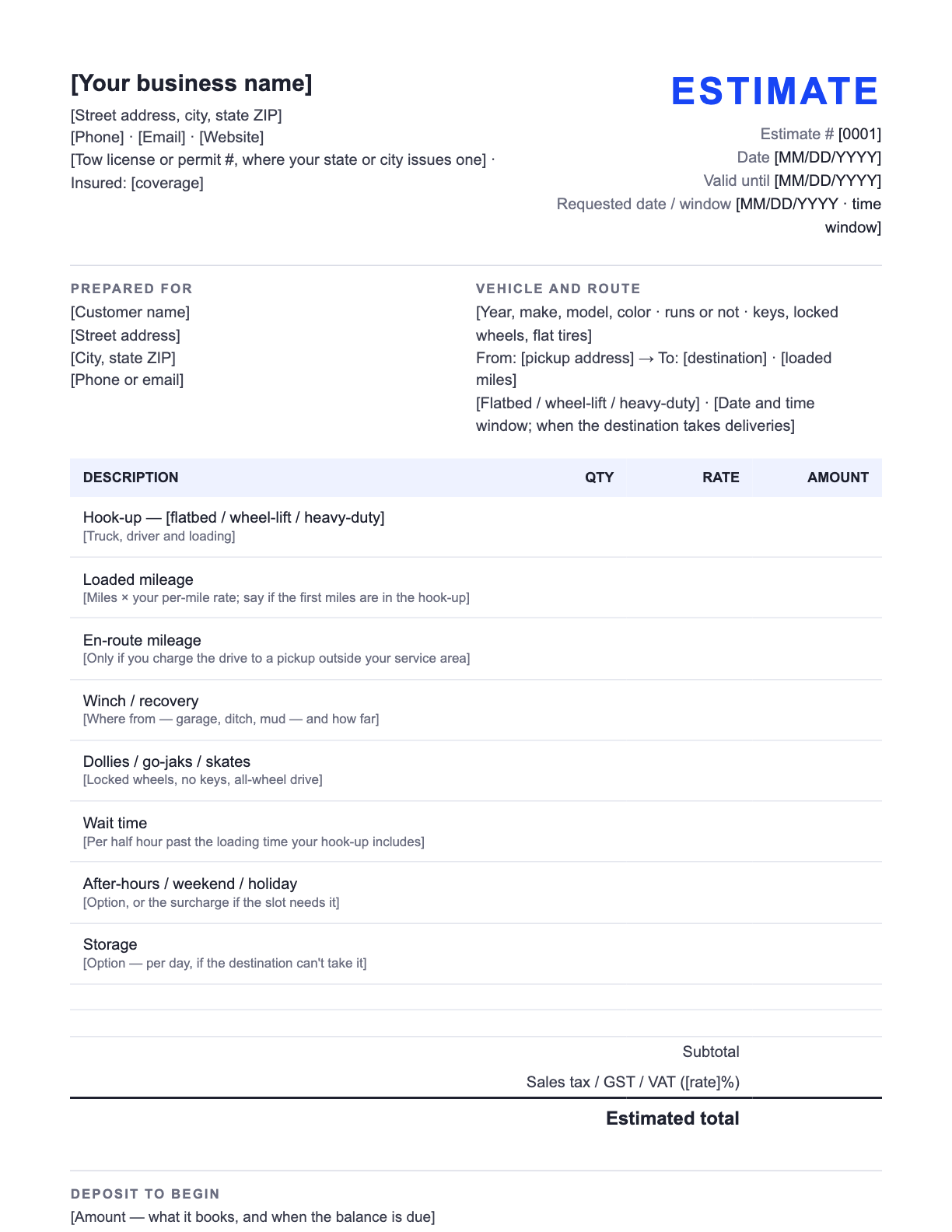
A towing estimate for the tows customers book ahead — a non-runner to a shop, a classic on a flatbed, a car stuck in a barn: the vehicle and whether it rolls, pickup and drop-off with the loaded miles, the hook-up, the winch and the dollies on their own lines, and a weekend slot or a night in storage as options. Free in Word and PDF, with every line explained.
Word and PDF · Free · No email, no sign-up
The short answer
A towing estimate starts with the vehicle and whether it rolls — year, make, model, keys or no keys, locked wheels, flat tires — then the route: where you pick it up, where it goes and the loaded miles between them. Those three facts decide the truck, the time and most of the price.
Then each charge on its own line: the hook-up for the truck you'll send (flatbed or wheel-lift), the loaded mileage at your per-mile rate, and any recovery work the vehicle needs — a winch from a garage or a ditch, dollies or go-jaks for locked wheels, wait time past your included loading time. A weekend slot or a night in your yard goes on as an option.
Around that go your business details and any tow license or permit number your state or city issues, the customer and a phone number for the driver, the estimate number and the date it holds until, what's included, and how to pay — usually on delivery.
FREE TEMPLATE · WORD AND PDF
The towing estimate template, filled in
Below is the template filled in for Copperline Towing, a fictional towing business, so you can see every line in use. The downloads are the same estimate with [bracketed] lines to replace — free, no email address, no sign-up.
Example · fictional business
Copperline Towing Knoxville, TN (865) 555-0142 · dispatch@copperlinetowing.example 24-hour dispatch · Insured: on-hook and general liability | ESTIMATE |
Prepared for Marcus Reyes (865) 555-0198 Knoxville, TN | Vehicle and route 1972 Chevrolet C10 pickup · not running, no keys, rear wheels locked, two flat tires From: detached garage, 2214 Kingston Pike, Knoxville → To: Ridgeway Restorations, Morristown · 46 loaded miles Flatbed · Thursday Oct 29, 8–10 am window; the shop takes deliveries until 4 pm |
| Description | Qty | Rate | Amount |
|---|---|---|---|
| Hook-up — flatbed, light duty Truck, driver and loading for a standard car or pickup | 1 | $125.00 | $125.00 |
| Loaded mileage 46 miles, garage to shop — per loaded mile | 46 | $4.50 | $207.00 |
| Winch from the garage About 30 ft to the bed; truck sits low and can't be driven | 1 | $85.00 | $85.00 |
| Go-jaks for the locked rear wheels Two wheel dollies to roll it out square | 1 | $45.00 | $45.00 |
| Wait time past the first 30 minutes Clearing the garage door and the gravel drive — per half hour, our best guess | 1 | $40.00 | $40.00 |
| Saturday morning slot instead If a weekday doesn't suit — weekend rate, about 20% on top of the tow | 1 | $110.00 | +$110.00 |
| One night in our secured yard If the shop can't take it on the day — per day | 1 | $45.00 | +$45.00 |
| Subtotal | $502.00 | ||
| Sales tax (if your state charges it on towing) | $0.00 | ||
| Estimated total | $502.00 | ||
What's included
The flatbed, the driver, the winch, the go-jaks, straps and wheel nets, and delivery to the shop's lot with a photo of the truck as it was loaded and as it was set down. Not included: the two options above, and tire repair — we can't inflate the flats on site. If the garage holds more than we saw in your photos, the extra wait is priced at the same half-hour rate.
How to pay
Nothing until the pickup is delivered. Card, cash or bank transfer at the drop-off — or we text the invoice if you're not at the shop.
Every figure on the example is an example, not a price guide — use your own rates. The Word file is a standard .docx you can edit in Word or any app that opens Word documents; the PDF prints as-is if you'd rather fill it in by hand.
Quotes and a website, one place
Start your towing website — quoting is built in
Add your business name and your town, and Zarla builds your towing website from this one line. The same dashboard sends quotes like this one as a link your customer accepts online, and drafts the invoice when they do.
Already have a website? Bring it across →Zarla keeps your old page addresses where it can and redirects the ones that change, helping you keep the Google standing you've built.
LINE BY LINE
What goes on a towing estimate
Every line on the template, in order, and what to write on it.
| The line | What to put there |
|---|---|
| Business name, contact and permit number | Your business name, the dispatch number that's answered at 2 am, email and address, and your tow license or permit number where your state or city issues one. Add your insurance — on-hook cover is the question a careful customer asks first. |
| Estimate number, date and valid-until date | A number that never repeats, the date, and the date the price holds until. Two weeks suits towing — fuel moves your per-mile cost, and most scheduled tows happen inside that. |
| Prepared for and the vehicle | The customer with a phone number your driver can reach on the day, then the vehicle: year, make, model and color, and the three things that change the job — does it run, are there keys, do the wheels turn. |
| The route and the window | Pickup address and destination, the loaded miles between them, the truck you'll send, the date and time window, and when the destination takes deliveries. A shop that closes at 4 pm decides your schedule. |
| Hook-up | One line for the truck you're sending — flatbed, wheel-lift or heavy-duty — with what it covers. If your hook-up includes the first few miles, say so on this line. |
| Mileage | Loaded miles × your per-mile rate, and en-route miles on their own line only if you charge the drive to a pickup outside your area. Print the miles so the customer can check them on a map. |
| Recovery work | The winch and where from, dollies or go-jaks for locked wheels, skates, wait time past your included loading time — each on its own line with what it's for. These are the lines that explain why your price differs from the company that didn't look at the photos. |
| Options and storage | A weekend or after-hours slot, a night in your yard if the destination can't take the vehicle — priced as options the customer can add, not surcharges that appear on the day. |
| Tax, total, what's included and how to pay | Sales tax where your state charges it on towing, the estimated total, what the price covers and what it doesn't, and how to pay — on delivery, by card, cash or bank transfer. |
STEP BY STEP
How to write a towing estimate
Five minutes on the phone and two photos — the customer who books ahead is calling three companies, and the first clear number usually wins.
Put your details at the top, then number and date it
Business name, dispatch number, email, address, your tow license or permit number where one is issued, and your insurance — saved once in the file. Then the next estimate number, today's date and a valid-until date two weeks out.
Get the vehicle facts and two photos
Year, make, model, color; does it run, are there keys, do the wheels turn; a photo of the vehicle and one of where it sits. Most surprises on a tow are in that second photo.
Map the route and pick the truck
Pickup and destination, the loaded miles, the truck the vehicle needs, the date and the time window — and when the destination takes deliveries.
Price the hook-up, the miles and each piece of recovery
Hook-up for the truck, loaded miles × your rate, then winch, dollies and wait time each on its own line. Weekend slots and storage go on as options.
Add tax, if any, and total it
Sales tax where your state charges it on towing or storage, then the estimated total.
Write what's included and how to pay, then send it
What the price covers, what would change it, and payment on delivery. Text it while the customer is still on the phone with the next company.
How towing estimates win the job
Ask for the photo of where it sits. A car on a level driveway and the same car in a backyard behind a fence are different jobs. One photo before you price is what lets you put the winch and the wait time on the estimate instead of arguing about them at the curb — and it's the reason your estimate is higher than the one priced blind, in writing.
Print the miles. “46 loaded miles × $4.50” can be checked on any map; a lump sum can't. The customer comparing three numbers trusts the one they can check, and per-mile pricing is how towing is compared everywhere — our towing rates guide carries the published 2026 hook-up and per-mile bands.
Put every piece of recovery on its own line. Winch, dollies, skates, wait time. The customer sees exactly what the vehicle's condition costs, and the company that quoted only the hook-up and the miles is the one adding fees on the day.
Offer the weekend slot and the storage night as options. A customer who can only meet you on Saturday, or whose shop can't take the car until Monday, sees those prices before the day — and books them with you instead of being surprised by them.
Photograph the vehicle at pickup and drop-off. Say so on the estimate. It's the record both of you want if anyone asks about a scratch later, and it reads as care on a job where the customer is handing you something they value.
The rules on towing. In the US, the tows a customer asks for are mostly priced by you, though some states set disclosure rules for those too; the tows they don't ask for — police-ordered and private-property tows — are regulated in many states and cities, often with set or capped rates, and some states and cities license tow operators or require a permit. This estimate is for the first kind. Check your state and city for the rules where you work.
Tax. In the US, whether sales tax applies to towing — and to storage, which some states treat separately — depends on your state, so check your state's revenue department or your accountant before you add a tax line. Outside the US the rule is the other way around: in Australia and New Zealand a GST-registered business gives a consumer a price that includes GST, and in the UK and EU a VAT-registered business shows the VAT and quotes consumers a price with it included. Confirm the details with your accountant.
Send it from Zarla and get it accepted online
A Word estimate is a fine way to start. The slow part is everything after you send it: waiting for a reply, wondering whether they opened it, and retyping every line into the invoice when they say yes.
If you build your towing website with Zarla, quotes are in the same dashboard. Build the quote from your own price book — one price, or up to three options side by side with the one you'd pick marked Recommended, and any line as a checkbox extra. Send it as one link, by email. Your customer picks an option, ticks any extras, types their name to accept, and gets a copy; Zarla drafts the invoice for exactly what they chose, with any deposit you asked for, and the job moves to Won. The quote template is already in your brand: your website's logo, colors and fonts, set once for every quote and invoice. On a paid plan, with your Stripe account connected, that invoice carries a pay-now button, so the deposit comes in as soon as you send it.
Want to see the website first? Browse towing website templates or see how Zarla builds towing websites. Comparing builders? Read the best website builders for towing companies. Still setting up? Read how to start a towing business and write your towing business plan. Setting your rates? See towing rates for 2026.
The whole paper trail of a job, step by step: how to write a quote, then the towing invoice template, then how to write a receipt — with a free receipt template. For any other trade, start from the free estimate template.
Towing estimates: common questions
Your business, dispatch number, insurance and any tow license or permit number; the customer and a phone number for the day; an estimate number, the date and a valid-until date; the vehicle and whether it runs, has keys and rolls; pickup, destination and loaded miles; the hook-up, the mileage and each piece of recovery work — winch, dollies, wait time — on its own line; options such as a weekend slot or storage; tax where it applies and the estimated total; what's included; and how to pay.
An estimate is your best calculation of what the job will cost, given what you can see today; the final price can move if the work turns out different. A quote (or a fixed price) is the price you will charge for the work described. A bid is a quote submitted against someone else's specification, usually in construction. Say which one your document is in its title.
Hook-up for the truck the vehicle needs, plus the loaded miles × your per-mile rate, plus any recovery work — a winch-out, dollies for locked wheels, wait time — plus a surcharge or option for nights, weekends and holidays. Get the vehicle's condition and a photo of where it sits before you price, so the recovery lines are on the estimate and not added on the day. Our towing rates guide carries the published 2026 US bands for each number.
Inside your service area, most companies fold it into the hook-up. For a pickup well outside it, an en-route mileage line is common — say it on its own line, with the miles, so the customer sees why a tow from two counties over costs more than the same distance across town.
Two weeks is sensible — fuel moves your per-mile cost, and most scheduled tows happen within days. Put the date on the estimate; a customer who books after it gets today's price.
Usually not — a local tow is paid on delivery. Ask for one on a long-distance flatbed run, a heavy-duty recovery or a job that takes a whole day of the truck, and say on the estimate what it books.
Yes. The towing estimate template on this page downloads free as a Word document and a PDF — no email address, no sign-up. Edit it in Word or any app that opens Word documents, or print the PDF and fill it in by hand.
Not from a Word file — the customer replies by email or phone, and you type the job into an invoice later. To get a yes in one tap, send it from quoting software. If your towing website is on Zarla, the quote tool is in the same dashboard: your customer opens one link, picks an option, ticks any extras and types their name to accept, and Zarla drafts the invoice for what they chose — which, on a paid plan with Stripe connected, carries a pay-now button. Jobber, Housecall Pro, Wix and Squarespace send quotes customers accept online too.
Send estimates from your own towing website
Add your town and your company name, and Zarla builds the site from that one line — with quoting in the same dashboard.
Already have a website? Bring it across →Zarla keeps your old page addresses where it can and redirects the ones that change, helping you keep the Google standing you've built.