TOWING INVOICE TEMPLATE + TOW RECEIPT
Free towing invoice template and tow receipt
A towing invoice with the vehicle, the pickup and drop-off, hook-up, loaded mileage, after-hours and winch fees and storage by the day — and the tow receipt the driver takes to their insurer. Free in Word and PDF, with every line explained.
Word and PDF · Free · No email, no sign-up
The short answer
A towing invoice names the vehicle — year, make, model, plate and the last digits of the VIN — where you picked it up and where it went, and then every charge on its own line: the hook-up, loaded mileage, any after-hours, winch-out, dolly or gate fee, and storage by the day.
Itemizing matters more in towing than in most trades: insurers and roadside clubs reimburse against the lines, and in the US most states and many cities require an itemized invoice — and cap the rates — on a nonconsensual tow.
Around it go your business details and the storage yard address and hours, the invoice number and the date and time of the call, the driver or owner you're billing, and how to pay — on release, in most cases.
FREE TEMPLATE · WORD AND PDF
The towing invoice template, filled in
Below is the template filled in for Northgate Towing & Recovery, a fictional towing business, so you can see every line in use. The downloads are the same invoice with [bracketed] lines to replace — free, no email address, no sign-up.
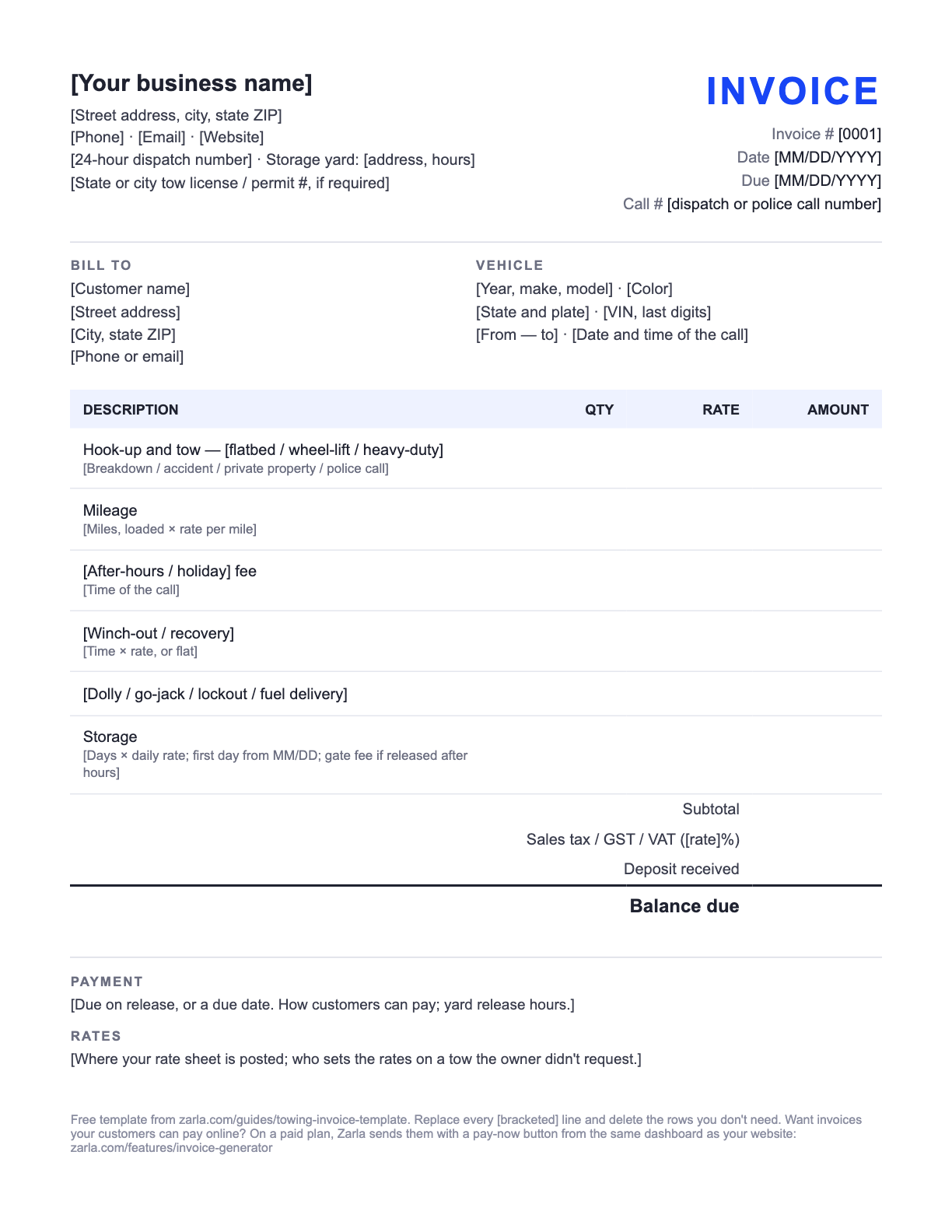
Example · fictional business
Northgate Towing & Recovery Missoula, MT (406) 555-0177 · dispatch@northgatetow.example 24-hour dispatch · Storage yard: 4410 W Broadway St, 8 am–6 pm | INVOICE |
Bill to Priya Natarajan (406) 555-0101 Driver and registered owner | Vehicle 2019 Honda Civic · gray MT plate ABC-0000 (example) · VIN ending 00000 From I-90 EB mile 104 to Northgate storage yard · Oct 9, 11:40 pm |
| Description | Qty | Rate | Amount |
|---|---|---|---|
| Hook-up and tow — flatbed Breakdown on the shoulder; driver present | 1 | $125.00 | $125.00 |
| Mileage 14 miles, loaded | 14 | $5.00 | $70.00 |
| After-hours fee Call after 10:00 pm | 1 | $45.00 | $45.00 |
| Storage Oct 10–11, per day | 2 | $45.00 | $90.00 |
| Subtotal | $330.00 | ||
| Sales tax (if your state taxes towing) | $0.00 | ||
| Total | $330.00 | ||
| Balance due | $330.00 | ||
Payment
Due on release: card, cash or check, at the yard during release hours (8 am–6 pm).
Rates
Our rate sheet is posted at the yard and available on request. Rates for a tow the owner didn't request are set by the city.
Every figure on the example is an example, not a price guide — use your own rates. The Word file is a standard .docx you can edit in Word or any app that opens Word documents; the PDF prints as-is if you'd rather fill it in by hand.
Invoices and a website, one place
Start your towing website — invoicing is built in
Add your business name and your town, and Zarla builds your towing website from this one line. The same dashboard sends invoices like this one, with a pay-now button once you're on a paid plan.
Already have a website? Bring it across →Zarla keeps your old page addresses where it can and redirects the ones that change, helping you keep the Google standing you've built.
ALSO FREE · WORD AND PDF
The tow receipt template, filled in
A tow receipt is what the driver takes away once they've paid — at the roadside, or at the yard when the car is released. Insurers and roadside clubs reimburse against it, so it itemizes the tow the same way the invoice does and names the vehicle, the payment and who released it. Below is the receipt for the same tow, paid in full; the downloads are the fill-in version.
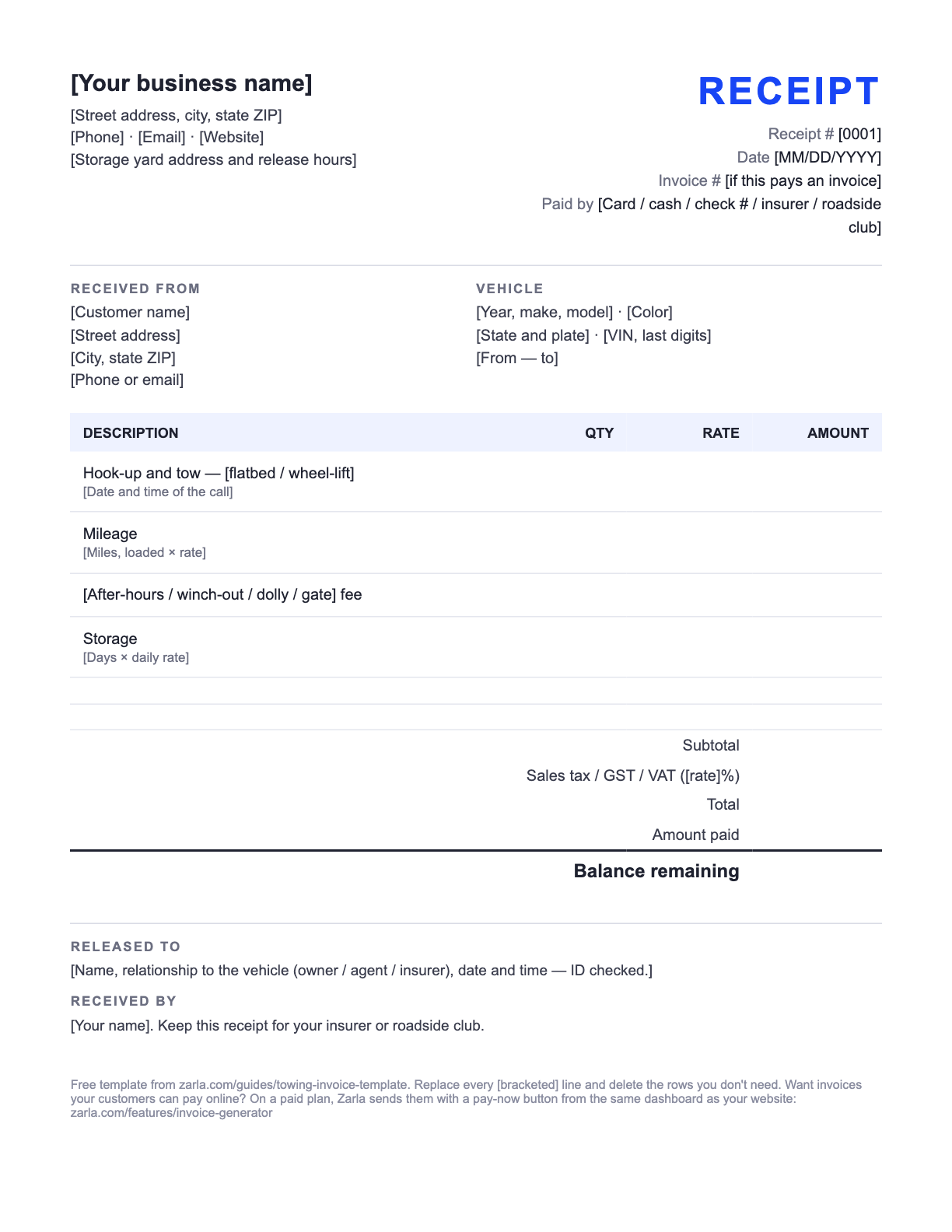
Example · fictional business
Northgate Towing & Recovery Missoula, MT (406) 555-0177 · dispatch@northgatetow.example 24-hour dispatch · Storage yard: 4410 W Broadway St | RECEIPT |
Received from Priya Natarajan (406) 555-0101 Driver and registered owner | Vehicle 2019 Honda Civic · gray MT plate ABC-0000 (example) · VIN ending 00000 From I-90 EB mile 104 to Northgate storage yard |
| Description | Qty | Rate | Amount |
|---|---|---|---|
| Hook-up and tow — flatbed Breakdown, Oct 9, 11:40 pm | 1 | $125.00 | $125.00 |
| Mileage 14 miles, loaded | 14 | $5.00 | $70.00 |
| After-hours fee Call after 10:00 pm | 1 | $45.00 | $45.00 |
| Storage Oct 10–11, per day | 2 | $45.00 | $90.00 |
| Subtotal | $330.00 | ||
| Sales tax (if your state taxes towing) | $0.00 | ||
| Total | $330.00 | ||
| Amount paid | $330.00 | ||
| Balance remaining | $0.00 | ||
Released to
Priya Natarajan, registered owner, on Oct 11, 2026 at 9:15 am — ID checked. Vehicle released with all contents.
Received by
D. Okafor, Northgate Towing & Recovery. Keep this receipt for your insurer or roadside club.
Every figure on the example is an example, not a price guide — use your own rates. The Word file is a standard .docx you can edit in Word or any app that opens Word documents; the PDF prints as-is if you'd rather fill it in by hand.
What the tow receipt is for
The invoice says what the tow costs; the receipt says it was paid and who the car went to. Drivers need it for the insurance claim or the roadside-club reimbursement, and for an impound it's the release record — which is why the receipt names the vehicle, the person it was released to and the ID you checked.
Fill it in from the invoice: the same lines, the payment method, the amount paid and a balance of zero. For a roadside cash job the receipt is the only document, so give it the full itemization — hook-up, mileage, fees — not a single “tow — $195” line; the driver's insurer will want to see how it adds up.
For a receipt that isn't a tow, our free receipt template covers any payment, with a cash-receipt version.
LINE BY LINE
What goes on a towing invoice
Every line on the template, in order, and what to write on it.
| The line | What to put there |
|---|---|
| Business name, dispatch number and storage yard | Your trading name, the 24-hour number, the yard address and release hours, and any tow license or permit number your state or city issues — many require it on the invoice. |
| Invoice number, date, due date and call number | A number that never repeats, the date, “due on release” for a stored vehicle or “on completion” for a roadside job, and the dispatch or police call number that ties the invoice to the log. |
| Bill to | The driver or registered owner, or the insurer, roadside club, dealership or property manager that ordered the tow — name whoever actually pays, with a phone number. |
| The vehicle | Year, make, model, color, plate and the last digits of the VIN, plus where you picked it up and where it went, with the date and time of the call. This block is what an insurer checks first. |
| Hook-up and tow | The base charge for the tow, with the truck type and the reason — breakdown, accident, private property, police call. On a police rotation or city contract the rate is set for you; bill it word for word. |
| Mileage and fees | Loaded miles × your per-mile rate on its own line, then each fee on its own — after-hours, winch-out by the time, dolly, lockout, fuel delivery. A single “tow — $265” line is the one insurers bounce back. |
| Storage | Days × your daily rate, with the first day's date. Say when storage starts (many cities set it at the next calendar day) and the gate fee for an after-hours release, if you charge one. |
| Tax, total and balance due | Subtotal, sales tax where your state charges it on towing or storage, and the balance due in bold. |
| How to pay and the rates note | How to pay and when — on release, during yard hours — and the line saying where the rate sheet is posted and who sets the rates on a tow the owner didn't request. |
STEP BY STEP
How to fill out a towing invoice
Start it from the dispatch log before the truck is back in the yard.
Save your details, yard and permit number once
Business name, dispatch number, storage yard address and hours, and any tow permit or license number at the top, saved in the file so every invoice starts ready.
Number it and tie it to the call
The next invoice number, the date, “due on release” or “on completion”, and the dispatch or police call number.
Identify the vehicle and the route
Year, make, model, color, plate and VIN digits, where you hooked it and where it went, with the date and time of the call. Bill the person or company that ordered the tow.
Itemize the tow
Hook-up with the truck type and reason, loaded miles × rate, then every fee on its own line — after-hours, winch, dolly, lockout — exactly as your rate sheet names them.
Add storage and total it
Days × daily rate with the first day's date, any gate fee, sales tax where your state charges it, and the balance due in bold.
Hand it over with the receipt
Give the driver the invoice at the roadside or at release, take payment, and issue the tow receipt below with the release details. Insurers and roadside clubs pay against the receipt.
How towing businesses get paid faster
Itemize everything, every time. Insurers, roadside clubs and dealerships reimburse against the lines — hook-up, miles, fees, storage — and bounce lump sums. The itemized invoice is also what settles the argument at the yard window.
Know the rules for a nonconsensual tow. In the US, when the owner didn't call you — a police-ordered tow, a private-property or impound tow — most states and many cities cap the rates, require an itemized invoice, set when storage may start, and give the owner the right to retrieve belongings and to pay by card, and some require the rate sheet to be posted at the yard. The rules differ by city; check your state's towing law, your city's ordinance and, on a police rotation, the contract.
Bill the account customers on the day. Dealerships, body shops, fleet accounts and roadside clubs pay on a due date — send the invoice the day of the tow with the call number and the vehicle block filled in, and the club's claim number if they gave you one. The invoice that waits for Friday is the one that misses their payment run.
Keep the release record on the receipt. Who the vehicle went to, the ID you checked and the time — on the receipt, with the name of the person who released it. It's the record if anyone later asks who collected the car.
Tax depends on the state. In the US some states charge sales tax on towing, some on storage, and many on neither. Check your state's revenue department before you add a tax line.
Outside the US. The invoice itself has rules: in Australia a GST-registered business issues a tax invoice showing its ABN, in New Zealand a GST-registered business shows its GST number, and in the UK and EU a VAT-registered business shows its VAT number and the VAT charged. Confirm the details with your accountant.
Send it from Zarla and get paid online
A Word template is a fine way to start. The catch is everything after you hit send: chasing the payment, remembering who's paid, and typing the same customer and the same line items again next month.
If you build your towing website with Zarla, the invoice tool is in the same dashboard. Pick the customer, add the job's lines, and send it. On a paid plan, with your Stripe account connected, the invoice carries a pay-now button: your customer pays online by card, and the invoice marks itself paid when the money arrives. Customers you've invoiced are saved, so next time is two taps.
Want to see the website first? Browse towing website templates or see how Zarla builds towing websites. Still setting up? Read how to start a towing business and write your towing business plan.
The whole paper trail of a job, step by step: how to write a quote, then how to write an invoice, then how to write a receipt — with a free receipt template. For any other trade, start from the free invoice template. Either side of it, two more free templates in Word and PDF: a price list template for the services you sell and a work order template for the crew.
Heading into the holidays? Our free gift certificate template covers the customers who want to give your work as a gift, and the holiday hours sign template covers the door, your website and your Google profile.
Towing invoices and receipts: common questions
Your business name, dispatch number, storage yard address and hours, and any tow permit number; an invoice number, the date, the due date and the call number; who you're billing; the vehicle — year, make, model, color, plate and VIN digits — with the pickup and drop-off; hook-up, loaded mileage, each fee and storage by the day on their own lines; tax where it applies; the balance due; how to pay; and the line saying where your rate sheet is posted.
The record that the tow was paid and the vehicle released — the same itemized lines as the invoice, the payment method and amount, a zero balance, who the vehicle was released to and the ID checked. Give one at every payment: the roadside cash job, the card at the yard window, the account customer's check. Drivers need it for their insurer or roadside club, and you need the release record.
The same invoice, billed to the club or insurer with their claim or call number in the Call # field and the member's name in the vehicle block, sent the day of the tow. They pay against the itemized lines, so keep hook-up, miles and fees separate and attach photos of the vehicle at pickup.
From the day your rate sheet says, unless your state or city says otherwise — in the US, many cities set the first storage day at the next calendar day after the tow, cap the daily rate on nonconsensual tows and require the yard to be open set hours for release. Show the first day's date on the storage line so there's nothing to argue about.
On a tow the owner didn't request — police, private property, impound — most US states and cities require an itemized invoice and many require the rate sheet to be posted or provided on request, and some require a notice of the owner's rights. Itemize every tow the same way and you're covered either way; check your city's ordinance for the exact notice.
Loaded miles — pickup to drop-off — is what most rate sheets, clubs and city ordinances allow, and some add a capped en-route charge. Show the miles and the per-mile rate on the line so the customer can check it against the map.
Yes. The towing invoice template on this page downloads free as a Word document and a PDF — no email address, no sign-up. Edit it in Word or any app that opens Word documents, or print the PDF and fill it in by hand. The tow receipt downloads the same way.
Not from a Word file — your customer still has to pay you some other way. To take the payment on the invoice itself, send it from invoicing software. If your towing website is on Zarla, the invoice tool is in the same dashboard: on a paid plan, with Stripe connected, each invoice carries a pay-now button and marks itself paid when the customer pays by card.
Send invoices from your own towing website
Add your town and your business name, and Zarla builds the site from that one line — with invoicing in the same dashboard.
Already have a website? Bring it across →Zarla keeps your old page addresses where it can and redirects the ones that change, helping you keep the Google standing you've built.