CAREER GUIDE
How to become a roofer in 2026
No license to carry shingles up a ladder anywhere we read — the trade hires with no experience, the union apprenticeship pays from the first hour, and the federal fall-protection rule at six feet is the one line that binds every roofer on day one. The exams sit on the person who will qualify a company, and the states that set them — Florida, Illinois, California, Massachusetts, Minnesota — are named below from the statutes and the boards, with Texas and Georgia, which set none. What the job pays, from the government's survey and two union locals' own wage sheets; the apprenticeship with its hours; the NRCA's certifications with their fees — and how to go from laborer to foreman to a company of your own.
Free to build · Pay when you publish · No credit card
6 feetthe federal fall-protection line: above it, a guardrail, a net or a personal fall arrest system on every roof (29 CFR 1926.501) — the one rule that binds a roofer on day one
$55,440the 2025 US median for employed roofers, $26.65 an hour, with the top 10 percent over $81,720 (O*NET, from BLS data); growth faster than average
6,000hours on the roof in one union local's apprenticeship, plus 144 hours a year in the classroom — paid from $28.55 an hour on the first day (Local 96, Minnesota)
4 yearsof experience, one of them as a foreman, before Florida will examine a person for its roofing contractor certificate — the states that test the person are named below
See it in action
See what your roofing website could look like
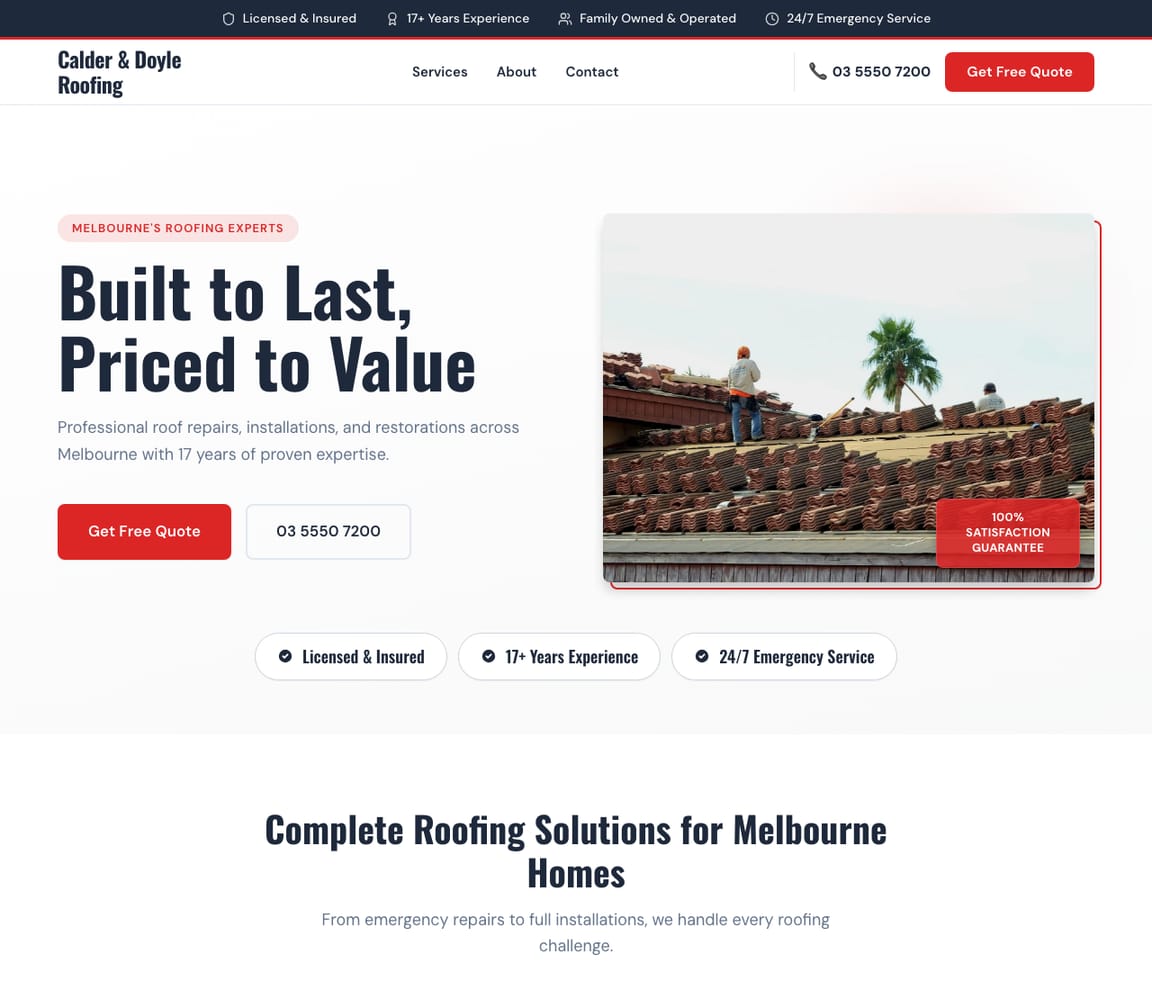
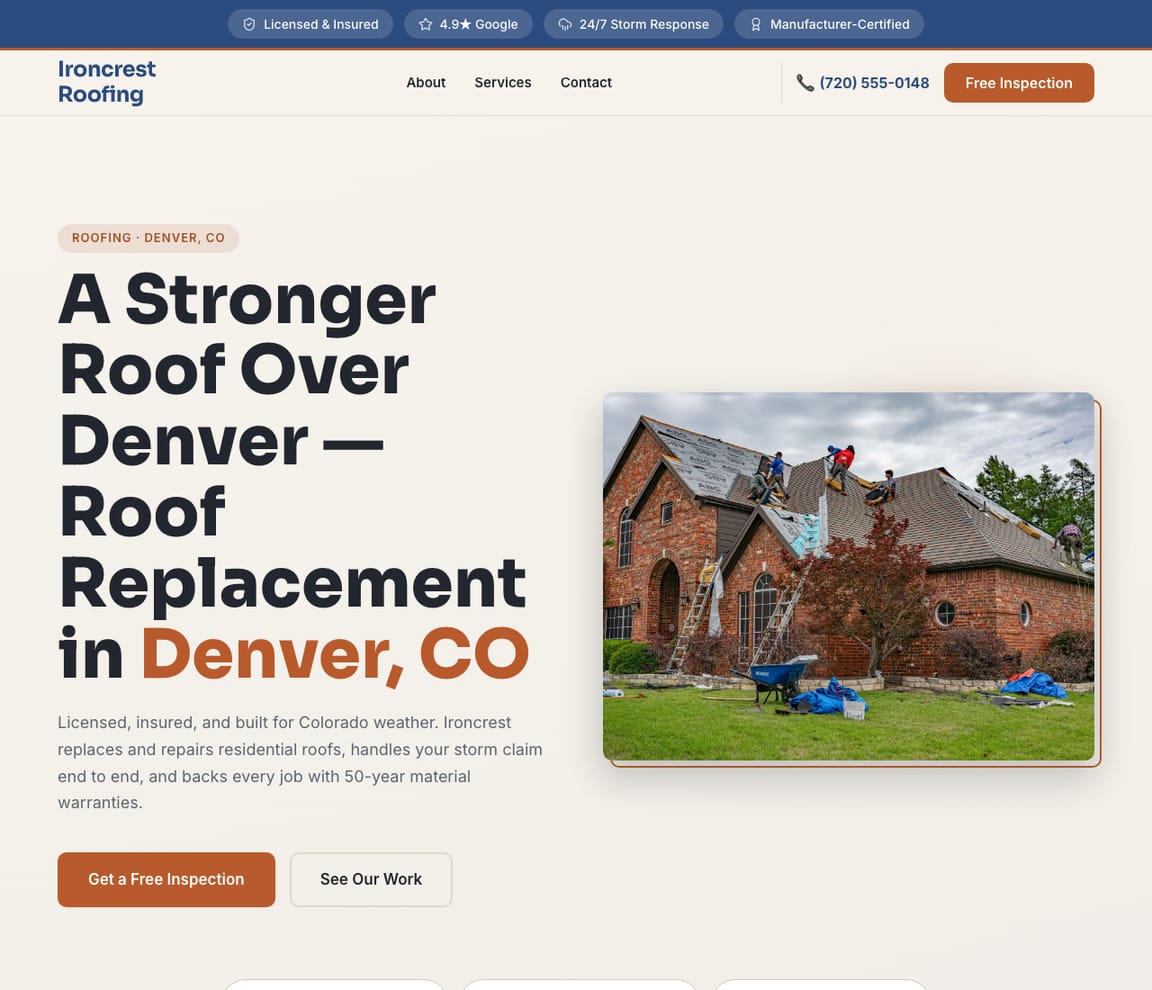
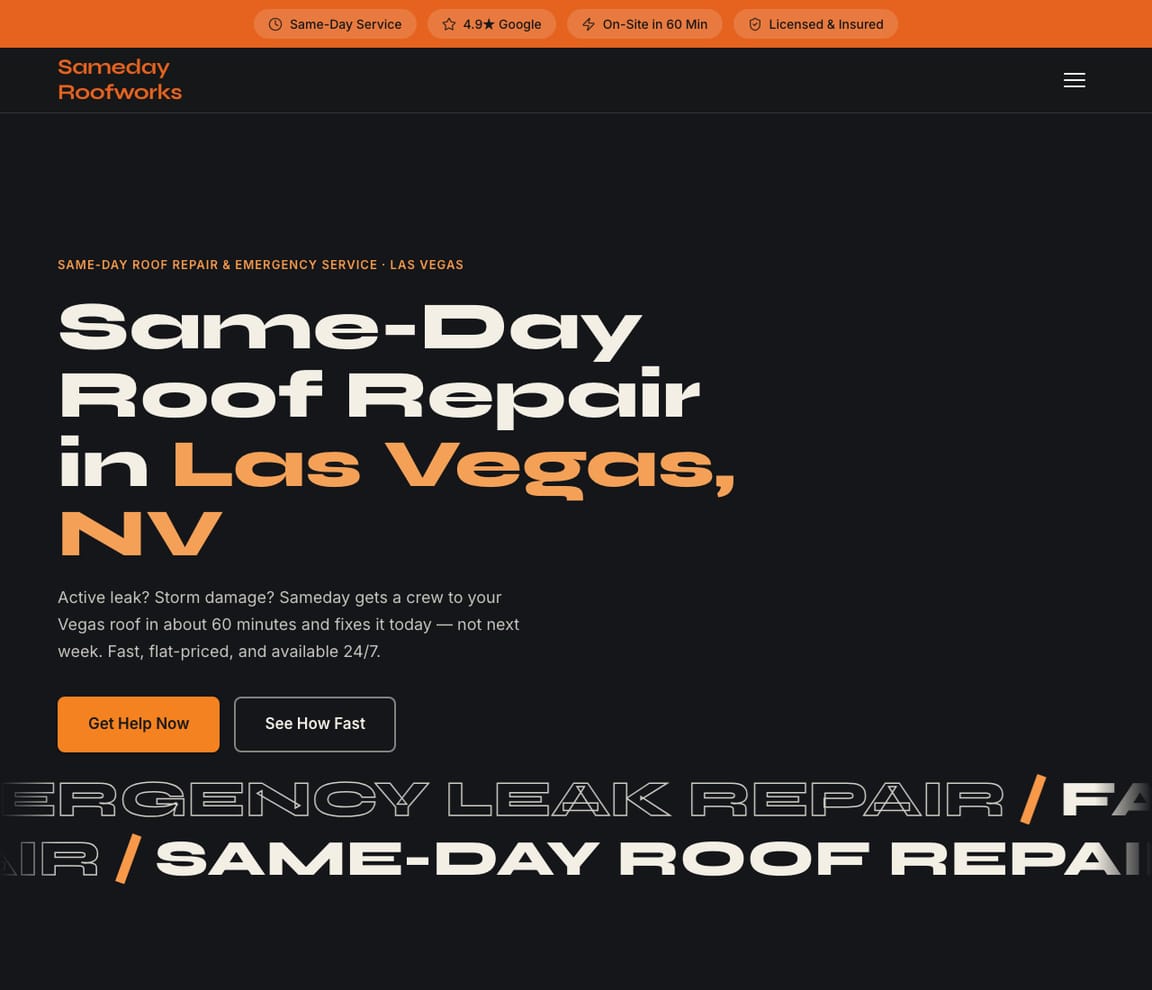
A real Zarla template for a roofing company — the services up front, the free-inspection form, the license number and the storm line a homeowner looks for. Describe yours — the roofs you do, the towns, your license — and you'll have a site like this, with an inspection form and a call button, in about a minute.
- Professional design — not a generic template
- Looks great on desktop and mobile
- Content written for your industry
Build the website
Start your roofing website now
Add your town and your business name to the sentence, and Zarla builds the site: your services, a free-inspection form and the areas you cover. Add your license number, your certifications and your storm-work line in chat, then publish.
Already have a website? Bring it across →Zarla keeps your old page addresses where it can and redirects the ones that change, helping you keep the Google standing you've built.
Is becoming a roofer worth it in 2026 — and what does the work pay?
Becoming a roofer is the best-paid trade in this family that asks for nothing at the door — no license to carry a bundle up a ladder, no school, a paid apprenticeship, and a median above the national one for a job you can start this week — with the catch written into every survey of it: the heights, the heat and the falls. On licensing, no state in the places we read licenses the roofer on the crew; the exams sit on the person who qualifies a company, and the states that set them are named below, from the statutes and the boards. Check your state's licensing board and your city before the first roof of your own. Three honest numbers first. The government describes the job plainly: roofers "Cover roofs of structures with shingles, slate, asphalt, aluminum, wood, or related materials." (O*NET, 47-2181). They had a 2025 median of $55,440 a year, $26.65 an hour: 10 percent earned $37,460 or less, 25 percent $46,260 or less, 75 percent $65,390 or less, and 10 percent $81,720 or more (O*NET, from BLS 2025 wage data). And the trade is growing — "Employment (2025) 166,900 employees", "Projected growth (2025-2035) Faster than average (5% to 6%)" and "Projected job openings (2025-2035) 12,000" (O*NET). The helper who carries the bundles is counted apart: roofers' helpers had a 2025 median of $44,160 a year, $21.23 an hour, with the top 10 percent at $62,400 or more (O*NET, helpers — roofers).
State by state. The median is $46,030 in Texas, $63,600 in California, $47,590 in Florida, $66,020 in New York and $77,900 in Illinois, and the top 10 percent earn $61,560 or more in Texas, $89,010 or more in California, $63,810 or more in Florida, $95,040 or more in New York and $106,530 or more in Illinois (O*NET, Texas; California; Florida; New York; Illinois). Payscale's page for the job title reads "The average hourly pay for a Roofer is $25.31 in 2026", with a range of $17.49 to $37.46, "Based on 292 salary profiles (last updated Oct 01 2026)" (Payscale, roofer). The union scale is higher still: Roofers Local 96 in Minnesota prints a metro "Starting Wage" of "$28.55/hr" against a "Journey-Level Wage" of "$70.82/hr" (Construction Careers Foundation, Local 96). The paper is light: asked what a new hire needs, "58%" said "High school diploma or equivalent required", "36%" "Less than high school diploma required" and "6%" "Some college, no degree required" (O*NET, education); the occupation sits in the government's lightest preparation band, where on-the-job training "Ranges from a few days to one year of on-the-job training." (O*NET, job zone).
Where the money is. An employed roofer is paid by the hour; a foreman and a superintendent are paid more; and an owner's income is roofs per year times the price per square, minus materials, labor, insurance and the truck — the arithmetic of the first roof and the first two months is in the roofing business plan, and the step after this guide is how to start a roofing business. The roofers quoted below describe the ladder in their own words — a laborer who became a senior construction manager, a warehouse kid who became president of a national company, a third-generation roofer who had bought his own house by 26.
The catch. The work is up high, outside and dangerous, and the survey says so with unusual bluntness: 100 percent are "Exposed to High Places" every day, 97 percent are "Outdoors, Exposed to All Weather Conditions" every day, 72 percent are "Exposed to Very Hot or Cold Temperatures" every day, 58 percent are "Exposed to Hazardous Equipment" every day, 65 percent rate the "Consequence of Error" as "Extremely serious", 76 percent spend their time bending or twisting continually and 13 percent describe the schedule as "Seasonal (only during certain times of the year)" (O*NET, work context). That is why the one rule below is the fall-protection rule, and why the apprenticeship's first phase is safety. That's what the rest of this guide sets up: the rule and the states that test the person, from the regulation and the boards; the apprenticeship with its hours and wages; the certifications with their fees; and how to be the roofer the search finds.
How to become a roofer, in plain English: one federal rule on the roof, then the states that test the person
Six feet is the one rule everywhere in the US. The federal construction standard, in its own words: "Unprotected sides and edges. Each employee on a walking/working surface (horizontal and vertical surface) with an unprotected side or edge which is 6 feet (1.8 m) or more above a lower level shall be protected from falling by the use of guardrail systems, safety net systems, or personal fall arrest systems." For houses: "Residential construction. Each employee engaged in residential construction activities 6 feet (1.8 m) or more above lower levels shall be protected by guardrail systems, safety net system, or personal fall arrest system unless another provision in paragraph (b) of this section provides for an alternative fall protection measure." For steep roofs: "Each employee on a steep roof with unprotected sides and edges 6 feet (1.8 m) or more above lower levels shall be protected from falling by guardrail systems with toeboards, safety net systems, or personal fall arrest systems." (29 CFR §1926.501, on eCFR). The harness is not a company preference; it is the law, and the employer who skips it is the one to leave.
OSHA 10 and OSHA 30 are cards, not licenses — and some cities require them. The agency's own page: "Through this program, workers can attend 10-hour or 30-hour classes delivered by OSHA-authorized trainers.", "None of the courses within the Outreach Training Program is considered a certification." — a city or an employer may require the card, but "it is not an OSHA requirement." (OSHA, Outreach Training Program). New York City is the one that does: its site safety training card for construction workers is built from "30-Hour OSHA or 40-Hour Site Safety", "8-Hour Fall Prevention" and "2-Hour Mental Health Awareness", or a "10-Hour OSHA" with more electives — "40-Hour Site Safety is an equivalent to 30-Hour OSHA." (NYC Department of Buildings, SST card). The union apprenticeship below teaches OSHA 30 in its first phase.
Do you need a license? Not to work on the crew, in the places we read — the exam is on the person who qualifies the company. There is no federal roofing license. Where a state licenses roofing, the years and the exam attach to a named individual, and the business operates through them:
- Florida certifies the person. The statute defines the trade — a "“Roofing contractor” means a contractor whose services are unlimited in the roofing trade and who has the experience, knowledge, and skill to install, maintain, repair, alter, extend, or design, if not prohibited by law, and use materials and items used in the installation, maintenance, extension, and alteration of all kinds of roofing, waterproofing, and coating" (Fla. Stat. §489.105) — and the door: "(1) Any person who desires to be certified shall apply to the department in writing.", at 18 and "of good moral character", with "a total of at least 4 years of active experience as a worker who has learned the trade by serving an apprenticeship as a skilled worker who is able to command the rate of a mechanic in the particular trade or as a foreman who is in charge of a group of workers and usually is responsible to a superintendent or a contractor or his or her equivalent; provided, however, that at least 1 year of active experience shall be as a foreman." — or a four-year degree in engineering, architecture or building construction and one year's experience (Fla. Stat. §489.111). The company needs that person: "A qualifying agent must be certified or registered under this part in order for the business organization to operate in the category of contracting in which the qualifying agent is certified or registered." (Fla. Stat. §489.119). The statute caps the fees: for certification "the initial application fee may not exceed $150" and, with the exam cost included, "the combined amount may not exceed $350", while "The initial certification fee and the renewal fee may not exceed $250."; for registration "the initial application fee may not exceed $100" and "the initial registration fee and the renewal fee may not exceed $200" (Fla. Stat. §489.109). Florida is also where the trade's "25 percent rule" lives, in its building statute: "if an existing roofing system or roof section was built, repaired, or replaced in compliance with the requirements of the 2007 Florida Building Code, or any subsequent editions of the Florida Building Code, and 25 percent or more of such roofing system or roof section is being repaired, replaced, or recovered, only the repaired, replaced, or recovered portion is required to be constructed in accordance with the Florida Building Code in effect, as applicable." (Fla. Stat. §553.844(5)).
- Illinois licenses the company and examines its qualifying party. The department's own application packet: a "Limited Roofing License means a license made available to contractors whose roofing business is limited to residential roofing, including residential properties consisting of 8 units or less." and an "Unlimited Roofing License means a license made available to contractors whose roofing business is unlimited in nature and includes roofing on residential, commercial and industrial properties."; "All roofing contractor applications must designate a qualifying party." — the person "who is legally qualified to act for the business organization in all matters connected with its roofing contracting business, has the authority to supervise roofing installation operations, and is actively engaged in day to day activities of the business organization." — who "must take and pass either the Illinois Residential Examination or the Illinois Residential, Commercial and Industrial Examination."; "No person shall be named as a qualifying party for more than one licensee."; the application fee is "$125.00"; a bond from an Illinois-licensed bonding company rides with it — the amounts are in the start guide, from the Act; and "The license will become INOPERABLE if there is no active qualifying party associated to the license." (IDFPR, roofing contractor application packet, October 2024). The consumer brochure tells homeowners to "make sure their license number starts with #104-XXXXXX and is on the contract" (IDFPR, find a licensed roofer, 2023).
- California licenses the business through a qualifier with four years. The C-39 classification: "A roofing contractor installs products and repairs surfaces that seal, waterproof and weatherproof structures." (CSLB, C-39 roofing contractor). On the person: "Each license requires a “qualifier”.", "The qualifier must be at least 18 years old.", with four years of experience within the last ten as a journeyperson, foreperson, supervising employee, contractor or owner-builder in the trade, and "After CSLB accepts the application, the qualifier will need to pass a trade exam and/or a business and law exam"; the "Non-refundable application fee of $450 due" and the "Initial license fee of $200 for a sole owner is due after the qualifier passes the exam(s)." (CSLB, apply for a sole owner license).
- Massachusetts licenses the supervisor, with a roofing specialty. The "Specialty CSL roof covering" covers "Construction, reconstruction, alteration, repair, removal of roof covering, including repair" and "Replacement of 25% sheathing and 25% of sistering roof rafters" on "1- and 2-family dwellings" and "Buildings of any use containing less than 35,000 cubic feet" (Mass.gov, construction supervisor licenses); it is needed because "For 1- and 2-family homes and\or appurtenant structures of any size" "A licensed construction supervisor or a registered design professional (RDP) must oversee construction.", and "Massachusetts does not recognize out of state contractor licenses." (Mass.gov, when a CSL is required). To get one: "Verify 3 years of experience in building construction or design.", "Apply for and schedule your exam with PSI." and "Take the exam." (Mass.gov, apply for a CSL).
- Minnesota licenses the company and examines its qualifying person. "Only companies are required to obtain a license", but "each company must designate one individual who will serve as a "qualifying person"" and "A company’s qualifying person must pass our prelicensing exam for the company to apply for a license." — with "no prerequisite experience or educational requirements" to sit it, a 30-day wait after a fail, "The license fee of $180.", "A $15,000 surety bond and power of attorney." and liability insurance of at least $300,000 per occurrence (Minnesota DLI, residential roofer license). The department's FAQ adds that "In many companies, the qualifying person is not the owner of the company", that the person keeps a Q registration good for two years and must "complete 14 hours of approved continuing education prior to the expiration date" (Minnesota DLI, qualifying person FAQ).
- Texas and Georgia set no exam at all, and North Carolina sets a dollar line. A Texas legislative analysis of a 2025 licensing bill says in its background: "Texas does not currently require a state-issued license for reroofing contractors." (Texas House committee analysis, H.B. 3344, 2025) — check the department's site for whether the bill became law. Georgia's consumer protection division: "Please note that certain specialty occupations such as roofers, painters, drywall contractors, and repair handymen are not required to be licensed by the state." and "You can also check with your county or city government to make sure your contractor has the proper licensing" (Georgia Attorney General, Consumer Ed). North Carolina's board draws its line by the job: "If a project is valued at $40,000 or more, your general contractor must have a license issued by the state." (North Carolina Licensing Board for General Contractors).
Those are the places we read, not every state and city — the company's license in the other states, the bond amounts, the city permits and the insurance are the start guide's — so check your own state's licensing board and your city before the first roof you bid yourself, and read do I need a business license for the general business license question.
How you get in: a crew, then the apprenticeship. The locals print their terms. Roofers Local 96's program, through the Construction Careers Foundation: "Roofer and waterproofer apprenticeships typically last three-to-four years where apprentices are paid to receive both on-the-job practical training and classroom instruction. Apprentices will complete 6,000 hours of on-the-job training and 144 hours of hands-on, classroom training hours per year. Tuition costs for books and materials is approximately $1,500 per year.", with "Must Be 18 Years Old For Hire", "High School Diploma or GED" and "Driver's License" as the requirements, "There is no required aptitude test for candidates.", and a warning that "Roofers and waterproofers need to be unafraid of heights, possess excellent balance skills and physical strength." (Construction Careers Foundation, Local 96). The local's own page lays out the phases — "Phase 1: Safety (including OSHA 30), Intro to Single Ply Systems, and Waterproofing / AVB", then single ply and steep slope, then "Kettle Safety, Hot Tar, Torch Down Systems, Drains, Blue Print Reading, Math, PRO 10, CPR & First Aid" (Roofers Local 96, apprentice information). Roofers Local 2 in St. Louis: "Earn While You Learn" — "Effective March 1, 2026, the starting rate is $22.88 per hour plus annual pay raises and Union Benefits.", "After working 600 hours, they receive additional instruction", "Apprentices attend classes in the winter months." and "Upon completion of the program, you will receive a Journeyman Certification" (Roofers Local 2, apprenticeship). Outside the union, the trade press describes GAF's academy as "a tuition-free, national training program" whose "training combines in-classroom and hands-on training and does not require previous experience to participate." — a "four-day" course in Baltimore that ended in a job fair, and "Since launching the free training program in 2020, more than 4,400 individuals have been trained and of those more than 2,500 have been placed into jobs." (Roofing magazine, July 3, 2025).
The certifications a homeowner can check. None is a license; each is proof. The National Roofing Contractors Association's program is "NRCA's nationally recognized certification program for validating roof system installation knowledge" "and performance across key systems and roles." (NRCA, ProCertification), in eleven designations — "Asphalt Shingle Systems Installer", "Metal Panel Roof Systems Installer", "Clay and Concrete Tile Systems Installer", "Slate Systems Installer", "EPDM Systems Installer", "Thermoplastic Systems Installer", "Modified Bitumen Systems Installer", "Metal Shingle Systems Installer", "Architectural Metal Flashings and Accessories Installer", "Service and Maintenance Technician" and "Roofing Foreman" (NRCA, certifications). The asphalt shingle one asks for "A minimum of 18 months’ experience installing asphalt shingle roof systems", a "Passing score on an online, multiple-choice exam" of "60 multiple-choice questions (with audio)", "Employer validation of work experience, skills and knowledge" and "a rigorous hands-on skills assessment" "conducted using a mockup" — $799 for a member company and $1,599 for a non-member as a one-time fee, renewed every three years at $199 or $399 (NRCA, asphalt shingle systems installer). The association's training for the crew is priced on the same site: its asphalt shingle installation course runs more than 20 hours at $299 for members and $499 for non-members, and the steep-slope onboarding course more than eight hours at $199 and $299 — "every roofing company can afford to use TRAC to train their new and inexperienced workers." (NRCA, TRAC).
The money to start. Our arithmetic from the pages that print each price. A lean start — the two things a new roofer is usually asked to own: a FallTech roofer's kit with a harness, lanyard, lifeline and reusable anchor at "$193.60", "In Stock - Ships Today" (Traffic Safety Store, read November 3, 2026), and an Estwing shingler's hammer at "$54.15", "Ready to Ship" (Roofing Direct, read November 3, 2026) — comes to $247.75. The fuller start — the NRCA's asphalt shingle installer certification at $1,599 as a non-member's one-time fee, the harness kit and the hammer — is $1,846.75. Left out: the apprenticeship's books at about $1,500 a year, the nailer, the compressor, the ladder and the truck, which are the company's until the company is yours — the roofing business plan costs them. When you bid your own roofs, the per-square sheet is the roofing estimate template, and the site comes from the roofing website builder or the roofing website design page.
In the UK: the National Careers Service describes the job — "Roofers slate and tile roofs, fit skylight windows and replace lead sheeting, guttering and cladding." — puts pay at "£26,000 Starter" to "£42,000 Experienced" for "42 to 45" hours a week, names the routes as "a college course", "an apprenticeship" "such as a Roofer Level 2 Intermediate Apprenticeship", "working towards this role" ("You can start work as a roofing labourer or roofer's 'mate'") and "applying directly", and sets the one card: "you'll need a Construction Skills Certification Scheme (CSCS) card or equivalent to train and work on a construction site" (National Careers Service, roofer). In Australia the government's profile counts "9,400" employed roof tilers, "Roof Tilers cover roofs with tiles, sheets and shingles to form a waterproof surface.", with New South Wales at "37.0%" and Queensland at "30.2%" of them (Jobs and Skills Australia, roof tilers); the pay line is suppressed on the page. New South Wales licenses the person: "you need a contractor licence to do any residential building or trade work, including roof tiling work" "which is valued at more than $5000 in labour and materials (including GST)", "You must have the right qualifications and experience before you can apply for a licence or certificate." — the "CPC30820 Certificate III in Roof Tiling," among them — as an "Individual contractor licence", a company license or a "Qualified supervisor certificate" (NSW Government, roof tiling work, June 23, 2026). Check your own state's licensing board, and your city, before the first roof you bid yourself.
What working roofers actually say
None of this is our opinion about the trade. It comes from people who do it — a Massachusetts owner who took a temporary roofing job at 21, a third-generation roofer in Southern California, a Florida senior construction manager who started as a laborer at $5 an hour, a Florida roofer who dreamed about shingle patterns after his first day, an Illinois company founder who began in a dumpster, the president of a national roofing company who started in his father's warehouse, a California owner licensed in 2024, a Houston teacher who moved into roofing sales, an Atlanta roofer who climbed up solo, a North Texas owner who started as one salesperson among hundreds and a St. Louis owner who learned the trade by day and cut grass till dark — talking to CanvasRebel, the Voyage magazines, the NRCA's own magazine, a roofing podcast and a local paper between 2011 and 2026, each described as the page describes them. Read each as theirs at the time. Four things come up again and again.
Everyone started at the bottom — and most without meaning to. Greta Bajrami, Golden Group Roofing, Worcester, Massachusetts: “At the time, I was struggling to find work, so I decided to take a temporary job in construction. I was hired as a roofer, even though I knew nothing about roofing, nor did I know that roofs typically need to be replaced every 25 to 30 years.” (CanvasRebel, December 12, 2024). Terry Tilson, senior construction manager at Advanced Roofing in Fort Lauderdale, hired as a laborer at 19: “My pay started at $5 per hour, which was pretty good back then,” and “I left to earn more money because teachers and coaches were not making as much as roofing workers,” (Professional Roofing, July 2023). Dunlap, founder and president of DCG Roofing Solutions, Des Plaines, Illinois, on his first day: “During my first day as an apprentice, I had to work in a dumpster rearranging coal-tar pitch tear-off debris. The task wasn't fun, but everyone on the crew had done it when they started and they respected me when I returned to work the following day. I think it's important to start at the bottom and understand the business from the ground up.” (Professional Roofing, September 2017). Doug Duncan, president of Nations Roof: “I started out like a lot of people in roofing, I started out working in the warehouse in the summers and my pay for my dad was I'd get a hot dog.” and “And then got to be a foreman, then got to be a superintendent.” (RoofersCoffeeShop, March 1, 2025).
“I’m a third-generation roofer. My grandfather and my father were both owner-operators. Roofing wasn’t some career path I chose off a vision board it was hot, physical, unforgiving work. As a kid, I hated it. Working with my grandfather was brutal. Long days, high expectations, zero shortcuts. At the time, all I saw was how hard the trade was.” — Jeremy Lara, Baja Roofing Inc., in VoyageLA, February 10, 2026
The work is hard and dangerous, and they say so. Dennis Dudek, Tecta America Southeast, Sanford, Florida, on his first day: “That night, I went home and dreamed all night about the pattern of shingles,” — and on the crews he left: “When I was subcontracting and working with small companies, they weren’t concerned about safety,” “There were workers drinking beer at lunch and coming in with hangovers, and I was working around all these guys. It was a dangerous environment. I thought I needed to rethink my profession.” (Professional Roofing, May 2022). Rocky McKay, Rocky the Roofer, Atlanta: “I took back control, grabbed my tools, and climbed up on that roof solo. Day after day, it was just me, my tools, and the task at hand.” and “Roofing, often misunderstood, is an art and a science. It demands knowledge, training, and a keen attention to safety.” (ShoutoutAtlanta, May 1, 2024). Lara again: “So I tried to run from it.” (VoyageLA, February 10, 2026).
The money came with the skill, then with the sale. Lara: “Starting at a young age, I was no stranger to hard work. Replacing roofs became my craft, and by the age of 26, I had made enough to buy my own home. But while I excelled on the field, my understanding of running a business—particularly on the back end—was lacking.” (CanvasRebel, August 26, 2024). Brandon Surface, Birdcreek Roofing and Construction, Katy, Texas, a teacher at the time: “The very first week in roofing sales I sold five jobs in my neighborhood. Roofing sales came very easy for me. I continued to teach and coach for two more years but when I started making more money on the side with roofing than what I was making teaching I knew something had to give.” (VoyageHouston, January 31, 2018). Dominic Zaccardo, DVZ Roofing, North Texas: “I eventually found a position with a roofing company, but it wasn’t a leadership role. I started as a general salesperson — no shortcuts, no special treatment. I was one of hundreds.” (VoyageDallas, February 5, 2026). Brett Tesson, Tesson Roofing and Exteriors, St. Louis County: “From 7 a.m. to 4 p.m., I was learning the exterior trade business, and from 5 p.m. to dark, I would cut grass,” (Patch, June 28, 2011). McKay: “Every dollar I earned was reinvested into better equipment, even if it meant skipping out on bills or insurance temporarily.” (ShoutoutAtlanta, May 1, 2024).
The trade needs people, and the trade travels. Tilson, to his apprentices: “I always tell apprentices: You are learning a trade,” “Once you go through this program, you can go anywhere in the world and do this job. There is nothing but roofs out there.” (Professional Roofing, July 2023). Anthony Carrillo, Carrillo Roofing, California: “Growing up, I watched my dad work hard in construction, and from an early age I knew I wanted to follow a similar path. After gaining experience with a sheet metal company and then a roofing company, I realized my true dream was to own my own roofing business one day.” (VoyageLA, November 4, 2025). Bajrami, on the business she started at 21: “At 21, starting a business, I thought success would come quickly, but for me, it didn’t happen that way.” (CanvasRebel, December 12, 2024). Lara: “Each new level brings new problems, but also new lessons. The challenges don’t go away, they evolve. And so do you.” (VoyageLA, February 10, 2026).
The through-line: the roofers who lasted started as laborers or in the warehouse, learned the craft on crews that took safety seriously and left the ones that didn't, earned their money first with their hands and then with the estimate, and took years — not a summer — to turn the trade into a company of their own.
THE STARTER KIT
What you need to become a working roofer
A crew to start on
A roofing company that hires laborers, or a union local's apprenticeship — 18, a diploma or GED and a driver's license are the requirements the locals print; no experience is asked for.
A harness, and the rule that goes with it
The federal line is six feet: a guardrail, a net or a personal fall arrest system above it. A roofer's kit — harness, lanyard, lifeline, anchor — is priced below from the seller's page.
The apprenticeship hours
6,000 hours on the roof and 144 hours a year in the classroom at one union local; paid from the first hour, journey-level at the end — the locals' own pages are below.
A certification in a system
The NRCA's installer certifications — asphalt shingle, metal panel, tile, slate, EPDM, thermoplastic — after 18 months in the system, with an exam and a hands-on assessment; fees below.
A shingler's hammer and a nail gun you know
The hammer, priced below from the seller's page; the coil nailer and the compressor are usually the company's until you have your own crew.
A way to be found
A website with your roofs, your license number and an inspection form, and a Google Business Profile with your hours — the day you bid your own first roof.
THE PAPERWORK
Cards, certifications and the exams on the person, on the way to bidding roofs of your own
| Typical cost | Time to get | Legally required? | |
|---|---|---|---|
| Fall protection at six feet (29 CFR 1926.501) | A roofer's kit — harness, lanyard, lifeline, anchor — $193.60 at one dealer | Day one | Yes, in the US, on every roof with an unprotected edge 6 feet or more above the next level |
| A union apprenticeship | Paid — $28.55 an hour to start at Local 96's metro rate, $22.88 at Local 2; books about $1,500 a year | Three to four years; 6,000 hours on the roof and 144 hours a year in class | No — the trade's own route to journey-level |
| OSHA 10 / OSHA 30 Outreach card | Set by the authorized trainer | 10 or 30 hours | Not federally — a voluntary program and not a certification; New York City builds its site safety card on it, and some employers require it |
| NRCA ProCertification, installer | $799 one-time for a member company, $1,599 for a non-member; $199 or $399 to renew every three years | 18 months in the system, an online exam and a hands-on assessment | No — voluntary proof |
| A state license on the crew roofer | — | — | No — none in the places we read; the exams below sit on the person who qualifies a company |
| Florida certified roofing contractor | Capped by statute: a $150 application ($350 with the exam cost) and a $250 certification fee; $100 and $200 for registration | 4 years' experience, 1 as a foreman — or a degree and 1 year — then the exams | Yes, in Florida, on the person who will be a company's qualifying agent |
| Illinois qualifying party exam | $125 application for the company's license, plus a bond | The residential or the residential, commercial and industrial exam, within three years of applying | Yes, in Illinois, for the named person without whom the company's license is inoperable |
| California C-39 qualifier | $450 to apply, $200 for the sole-owner license after the exams | 4 years in the last 10 as a journeyperson, foreperson, supervising employee, contractor or owner-builder, then the exams | Yes, in California, on the qualifier of every licensed business |
| Massachusetts construction supervisor license, roof covering | Fees not printed on the pages we read | 3 years in building construction or design, then the PSI exam | Yes, in Massachusetts, to oversee roof covering on one- and two-family homes and buildings under 35,000 cubic feet |
| Minnesota residential roofer qualifying person | $180 license fee and a $15,000 bond on the company | An exam with no prerequisites; 14 hours of continuing education every two years | Yes, in Minnesota, on the company's named qualifying person |
THE STEPS
How to become a roofer (step by step)
Eight steps from the first day as a laborer to a licensed roofer bidding roofs of your own.
01
Get on a crew
Roofing companies hire laborers with no experience, and one free four-day academy puts people on crews in a week. Be 18, have a driver's license, and show up in the heat.
Week one02
Learn fall protection before anything
Six feet is the federal line. Learn the harness, the anchor and the lifeline on the first day — the rule is printed below from the regulation, and the consequence of error in this trade is extremely serious.
The one rule03
Apply to an apprenticeship
A union local's program pays from the first hour — $28.55 at one Minnesota local, $22.88 at St. Louis's — with 6,000 hours on the roof and 144 hours a year in class; a journey-level card at the end.
04
Take OSHA 10, then 30
Voluntary federally and required by some cities and employers — New York City builds its site-safety card on it. The apprenticeship above teaches OSHA 30 in its first phase.
05
Certify in a system
After 18 months installing one system, the NRCA's installer certification: an online exam and a hands-on assessment on a mockup, renewed every three years. Fees below.
The trade's own test06
Count your years toward the exam
Florida wants four years with one as a foreman; California four within the last ten; Massachusetts three; Illinois and Minnesota an exam on the person who qualifies the company — named below, from the boards.
07
Go out on your own when the years are there
Register the business, get the company's license where your state requires one, insure it, and price by the square — the start guide and the plan page cover those steps.
08
Be the roofer the search finds
A website with your roofs, your license number and an inspection form, and a Google Business Profile with your hours.
THE COSTS
How much does it cost to become a roofer?
Itemized from the pages that print a price: the harness kit from Traffic Safety Store, the hammer from Roofing Direct, the NRCA's fees from its own page, the apprenticeship's books from the local. The nailer, the compressor, the ladder and the truck are the company's until the company is yours; the plan page costs them.
$0to start on a crew or in the apprenticeship: no license, course or exam is asked for in the places we read, and the apprenticeship pays from the first hour
$247.75a lean start — the $193.60 roofer's harness kit and the $54.15 shingler's hammer a new roofer is usually asked to own (our arithmetic)
$1,846.75the fuller start — the NRCA's $1,599 asphalt shingle installer certification as a non-member, the harness kit and the hammer
$1,500a year, approximately, for books and materials in Local 96's apprenticeship — the only tuition the program prints
WHAT WE'VE LEARNED
What actually makes a homeowner call a roofer
Thousands of local business websites in, the pattern for roofing is clear: the customer is spending more than on almost any other trade and is afraid of being cheated. For a new roofer, three things on a page decide who gets up the ladder.
The license and the insurance, named
The state license number where your state issues one, the insurance line, the manufacturer certification — the proof a homeowner's board tells them to ask for, before the track record exists.
Your own roofs
Finished roofs you actually did, with the town and the material under each — the gallery a homeowner compares before they let a stranger on the house.
The free inspection and when
An inspection form and the next open day — the first question on every leak call, answered on the first screen with a call button beside it.
THE UPSIDE
What a roofer can earn
Pay for employed roofers from O*NET's 2025 figures and two union locals' own wage lines; the self-employed are not in the survey. Medians, not a promise: your system, your region, the union and whether the truck is yours decide it.
$55,440a year: the 2025 US median — $26.65 an hour; 10 percent under $37,460, 10 percent over $81,720 (O*NET)
$77,900the Illinois median; New York $66,020, California $63,600, Florida $47,590, Texas $46,030
$70.82an hour at journey level on Local 96's metro scale in Minnesota, from $28.55 to start — the union ladder, on the local's own page
166,900employed roofers in 2025, with 12,000 projected job openings for 2025–2035 and growth faster than average (5% to 6%)
SEE IT WORK
Roofing website designs you can start from
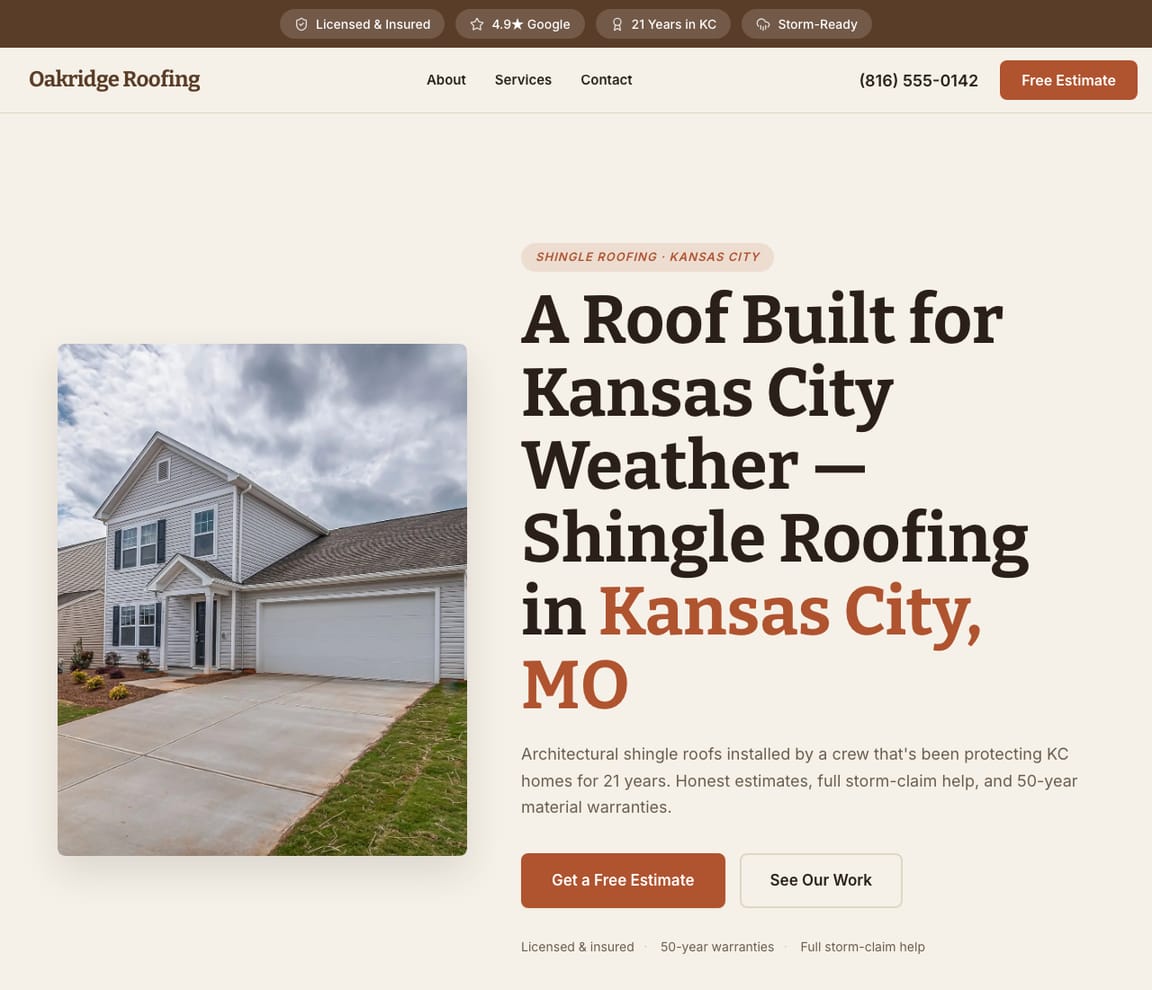
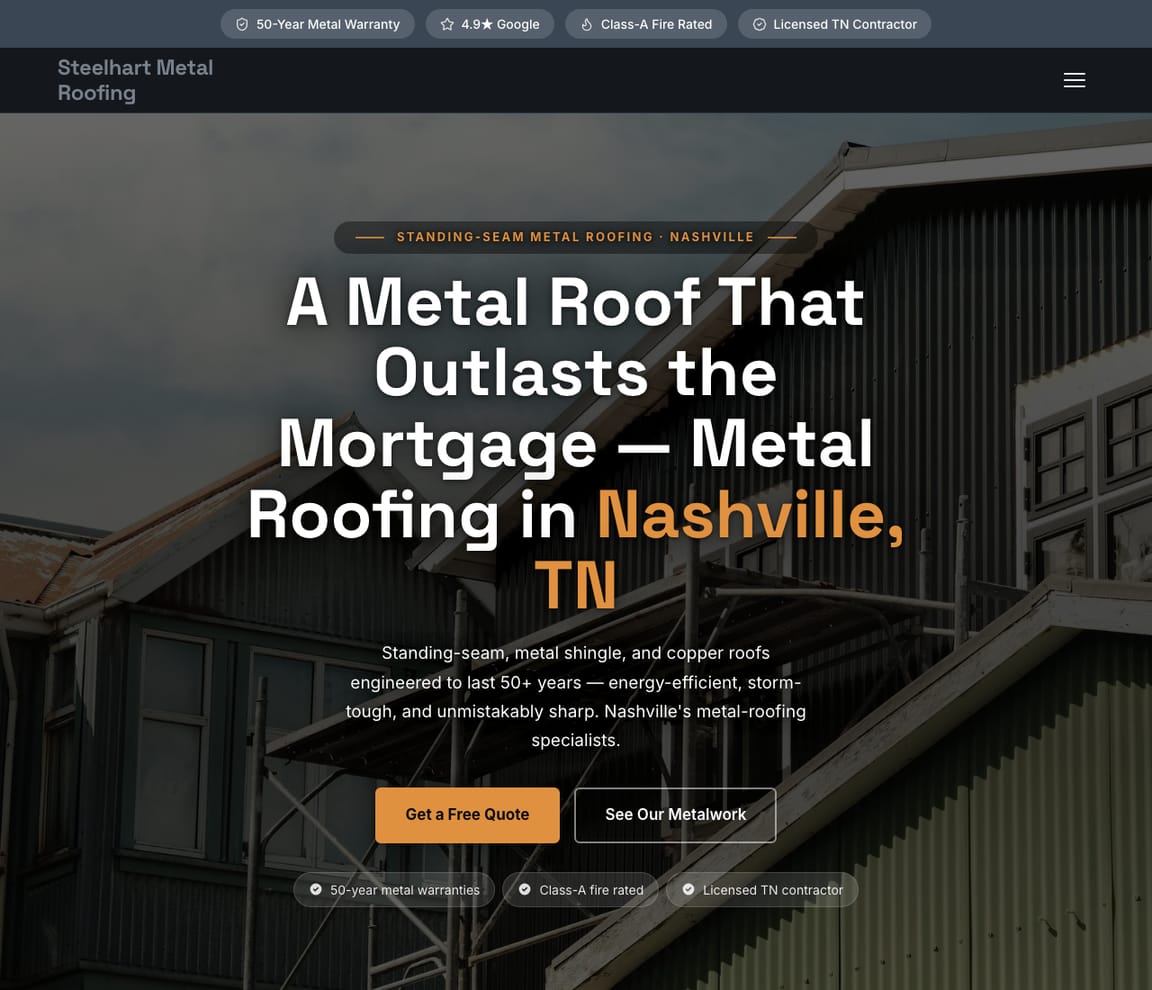
Real Zarla templates for the shapes the trade takes — the roof-replacement company, the asphalt shingle specialist, the metal roofer, the same-day repair crew. Open one, swap in your roofs and your towns, and publish.
GET FOUND
Get found by the homeowner with a bucket under the ceiling
A homeowner with a leak searches "roofer near me" or "roof repair" with the town, looks for a license number, a free inspection and real photos, and calls the roofer whose services, towns and number are on the first screen. Zarla builds the website with your services, an inspection form and the areas you cover. Add your license number, your certifications and whether you do storm claims in chat, and connect your Google Business Profile so your hours and map show on the site.
“Roofer near me”
Searched the night it rains in. The roofs you do, the towns you cover and the free inspection answer it.
Google Business Profile
A roofer who drives to the job qualifies as a service-area business. Your hours, your area and your number inside Google Maps — free, and an afternoon to set up.
The license number, printed
Where your state issues one, it goes on the first screen — the homeowner's board tells them to check it, and the roofer who prints it wins the call.
Google Search
Rridgelineroofingco.com
Ridgeline Roofing Co. — Trusted roofing in Your AreaRoof repair and replacement in Tampa — asphalt shingle, metal and tile. Licensed and insured. Free inspections, next-day visits. Tap to call.← Your Zarla siteCcityroofingservices.com
City roofing ServicesGoogle Maps
1
Ridgeline Roofing Co.
← You2
Metro roofing Co.
3
Quick roofing Services
AI assistants (ChatGPT / Perplexity)
For a licensed roofer in Tampa who does free inspections and shingle repairs and can come this week in your area: Ridgeline Roofing Co. — a local roofer's site that lists repair, replacement and storm work, prints the state license number, offers a free inspection, shows finished roofs and has a call button.
An example with a made-up business and illustrative figures. Yours will show your real details and reviews.
YOUR LAUNCH PLAN
Your become-a-roofer checklist
The whole guide as things to check off. Work through them in order and you'll be trained, tied off, certified in a system and counting the years toward your own license before your first bid.
- Get on a crew — a roofing company or a free academy; 18 and a driver's license.
- Learn fall protection first — six feet, a harness, an anchor, a lifeline.
- Apply to an apprenticeship — paid from the first hour, 6,000 hours to journey-level.
- Take OSHA 10, then OSHA 30 — the cards some cities and employers require.
- Certify in a system — the NRCA's installer certification after 18 months.
- Count your years toward the exam below — four in Florida and California, three in Massachusetts.
- Buy your own harness kit and hammer — priced below from the sellers.
- Get found — a website with your roofs and your license number, and a Google Business Profile.
REAL CUSTOMERS
Small business owners who got online with Zarla
Verified reviews from real Zarla customers.
“Optimized for local service-based businesses. Easiest website build I've experienced. The AI-based build is the way to go instead of clunky theme-based websites. Get the site built and get out of the weeds with Zarla!”
“Great professional website in less than a minute, with the use of AI and a few descriptive prompts. This has saved me bundles of time and research on web developers.”
“Quickly built my website from scratch. No hiccups. Would highly recommend Zarla for someone with no experience who wants to start a polished business website.”
“I had no idea how to set up a website for my business. Thanks to Zarla, they've helped me a lot.”
Be the roofer the leaking ceiling finds first
Add your town and your business name, and Zarla builds the website from that one line — your roofing services, a free-inspection form, the towns you cover and a call button, with SEO in place. Add your license number and your certifications in chat. Free to build; you pay when you publish.
Already have a website? Bring it across →Zarla keeps your old page addresses where it can and redirects the ones that change, helping you keep the Google standing you've built.
Frequently asked questions
How much does it cost to become a roofer?
In the US, nothing to start: no license, course or exam is asked for on the crew in the places we read, and a union apprenticeship pays from the first hour — $28.55 at Local 96's metro rate, $22.88 at Local 2 — with books and materials of about $1,500 a year the only tuition printed. If you buy your own kit, our arithmetic from the pages that print each price is $247.75 for a lean start: a $193.60 FallTech roofer's harness kit and a $54.15 Estwing shingler's hammer. The fuller start — the NRCA's $1,599 asphalt shingle installer certification as a non-member, the harness kit and the hammer — is $1,846.75. The nailer, the compressor, the ladder and the truck are the company's until the company is yours, costed on our roofing business plan page.
Do you need a license to be a roofer?
In the US, not to work on the crew, in the places we read — the exam sits on the person who qualifies a company. Florida certifies the individual after four years' experience, one as a foreman, and a company may only contract through a certified qualifying agent; Illinois licenses the company and examines its named qualifying party, without whom the license is inoperable; California licenses the business through a qualifier with four years in the last ten who passes the exams; Massachusetts licenses the construction supervisor who oversees roof covering, after three years and the PSI exam; Minnesota licenses the company and examines its qualifying person. Texas requires no state license for reroofing contractors, Georgia lists roofers among the trades its state does not license, and North Carolina licenses the contractor on any project of $40,000 or more. The one rule on every roofer everywhere is federal: fall protection at six feet. Check your state's licensing board and your city before the first roof you bid yourself.
Does a roofer have to be licensed in NC?
In North Carolina, the line is the size of the job, not the trade: the state's Licensing Board for General Contractors says that if a project is valued at $40,000 or more, the general contractor must have a license issued by the state, and that by law a general contractor must be licensed if the total project cost is valued at $40,000 or higher. A roofer on a crew needs no license; a company bidding a $40,000 roof needs the contractor's license. Below the line, the paperwork is the business registration and your city's or county's own rules. Check your state's licensing board and your city before the first roof you bid yourself.
What qualifications do I need for roofing?
To start, almost none: in the government's survey 58 percent of employers said a new hire needs a high school diploma or equivalent and 36 percent said less than that, and on-the-job training ranges from a few days to one year. The union locals print their requirements — be 18, hold a diploma or GED and a driver's license — with no aptitude test. After that, the qualifications are the ones you earn: the OSHA 30 the apprenticeship teaches in its first phase, a journey-level card after 6,000 hours, an NRCA installer certification after 18 months in a system, and, when you mean to qualify a company, the years and the exam your state sets on the person. In the UK the one card to train and work on a site is the CSCS card.
How long is a roofing apprenticeship?
Three to four years at Roofers Local 96 in Minnesota, by the Construction Careers Foundation's page for its program: 6,000 hours of on-the-job training and 144 hours a year of hands-on classroom training, paid from $28.55 an hour on the metro scale to a journey-level $70.82, with classes in three phases, on the local's own page, from safety and single-ply systems to hot tar, torch-down and blueprint reading. Roofers Local 2 in St. Louis starts at $22.88 an hour, gives additional instruction after 600 hours of work, holds classes in the winter months and ends with a journeyman certification whose credit hours count toward an associate's degree. The foundation's page puts the finish line plainly: the apprenticeship is complete when the apprentice can demonstrate competence in the vital skills.
Is OSHA 10 required for roofers?
Not by federal law, in OSHA's own words: the Outreach Training Program is voluntary, none of its courses is considered a certification, and a city or an employer may require the card, but it is not an OSHA requirement. New York City is one that does — its site safety training card for construction workers is built on a 30-hour OSHA or 40-hour site safety course with an 8-hour fall prevention course, or a 10-hour OSHA with more electives. What is federal is the fall-protection rule itself: on every roof with an unprotected edge six feet or more above the next level, a guardrail, a net or a personal fall arrest system. Many employers and the union apprenticeship teach OSHA 30 regardless; take it.
What is the 25 rule in roofing?
It is a building-code line about repairs. Florida's statute puts it this way: if an existing roofing system or roof section was built, repaired or replaced in compliance with the 2007 Florida Building Code or any later edition, and 25 percent or more of that roofing system or roof section is being repaired, replaced or recovered, only the repaired, replaced or recovered portion is required to be constructed in accordance with the code in effect — the 2022 change that replaced the older rule under which a 25 percent repair could trigger a whole-roof replacement. Massachusetts uses a different 25 percent for scope: its roof-covering supervisor license covers replacement of 25 percent of sheathing and 25 percent of sistering roof rafters. Your own code official decides how the rule reads in your state.
How much do roofers make?
Employed roofers had a 2025 median of $55,440 a year, $26.65 an hour, with 10 percent under $37,460 and 10 percent over $81,720; by state, $77,900 in Illinois, $66,020 in New York, $63,600 in California, $47,590 in Florida and $46,030 in Texas (O*NET, from BLS data). Roofers' helpers had a median of $44,160. Payscale's page puts the average at $25.31 an hour in 2026 on 292 profiles. The union scale runs from $28.55 an hour to start to $70.82 at journey level on Local 96's metro rate. An owner's income is a different number — roofs per year times the price per square, minus materials, labor, insurance and the truck — and it is the start guide's question.
Is becoming a roofer worth it?
For someone who can work high, hot and outside, the numbers say yes with the eyes open: a $55,440 median above the national one with no school and no license at the door, growth faster than average, 12,000 projected openings, a union ladder to $70.82 an hour, and a trade that, as one Florida manager tells his apprentices, you can take anywhere because there is nothing but roofs out there. The downsides are in the same survey — high places every day for 100 percent, all weather for 97 percent, extreme temperatures for 72 percent, and a consequence of error 65 percent call extremely serious — and in the roofers quoted above, who call it hot, physical and unforgiving. The path to your own company runs through the years and the exam your state puts on the person. Check your state's licensing board and your city before the first roof you bid yourself.
What are the downsides of being a roofer?
The survey lists them without euphemism: every roofer is exposed to high places every day, 97 percent to all weather, 72 percent to very hot or cold temperatures, 58 percent to hazardous equipment and 50 percent to hazardous conditions, 76 percent bend or twist continually, 73 percent work under time pressure every day and 13 percent describe the schedule as seasonal. The roofers quoted above add the rest — a third-generation roofer who hated it as a kid and called it brutal, a Florida roofer who left crews that drank at lunch because it was a dangerous environment. The fall-protection rule at six feet exists because falls are the way roofers die; the harness is the first thing to learn and the last thing to skip.
How to become a roofer with no experience?
Get on a crew: roofing companies hire laborers with no experience, the union locals ask for 18, a diploma or GED and a driver's license with no aptitude test, and GAF's tuition-free academy puts people through four days of classroom and hands-on training and into a job fair — more than 4,400 trained and 2,500 placed since 2020, by the trade press's count. Learn the harness before the hammer. Apply to the apprenticeship when a local is taking applications, because it pays from the first hour. Every roofer quoted above started this way — as a laborer, an apprentice in a dumpster, a kid in the warehouse, a temporary hire who knew nothing about roofing.
What does a roofer do?
The government's description: roofers “Cover roofs of structures with shingles, slate, asphalt, aluminum, wood, or related materials.” In practice a residential roofer tears off the old roof, replaces rotten decking, lays underlayment, flashing and shingles or tile or metal, and seals the penetrations; a commercial roofer installs built-up, single-ply, modified bitumen or torch-down systems on low-slope roofs — the Construction Careers Foundation's words for one local's program: “They work in high places and in all types of weather.” A helper carries, tears off and cleans up; a journey-level roofer installs; a foreman runs the crew; a superintendent runs the jobs.
What certifications can a roofer get?
In the US, the trade's own are the NRCA's ProCertification designations, eleven of them: installer certifications in asphalt shingle, metal panel, metal shingle, clay and concrete tile, slate, EPDM, thermoplastic and modified bitumen systems, architectural metal flashings and accessories, a service and maintenance technician and a roofing foreman. The asphalt shingle one asks for 18 months installing the system, employer validation, a 60-question online exam and a hands-on assessment on a mockup, at $799 for a member company or $1,599 for a non-member, renewed every three years. Add the OSHA 10 and 30 cards, the apprenticeship's journey-level card, and the manufacturer programs your company joins once it is licensed and insured — the start guide covers those. None is a license; the exams on the person are the states'.
How do I become a licensed roofer in Florida?
In Florida the certificate is on the person: apply to the department in writing at 18, be of good moral character, and show at least four years of active experience as a worker who learned the trade through an apprenticeship or as a skilled worker able to command a mechanic's rate or as a foreman, with at least one year as a foreman — or a four-year degree in engineering, architecture or building construction and one year of experience — then pass the examinations. A certified contractor may contract anywhere in the state; a registered one only in the jurisdiction that tested them. A company may not contract until it employs a certified or registered qualifying agent. The statute caps the fees — a $150 application, $350 with the exam cost included, and a $250 certification fee — and the department's own page, which carries the financial responsibility rules, refused our reader. Check your state's licensing board and your city before the first roof you bid yourself.