ROOFING ESTIMATE TEMPLATE
Free roofing estimate template
A roofing estimate priced by the square, with the takeoff shown — footprint × pitch factor, the waste, the bundles — then tear-off, shingles, underlayment, ice and water shield, flashing, ridge vent and labor, the steep-pitch line, decking as an if-needed line, the permit, and a place for the insurance claim. Free in Word and PDF, with every line explained.
Word and PDF · Free · No email, no sign-up
The short answer
A roofing estimate prices the roof by the square — 100 square feet of roof surface — and shows the measurement first: the house footprint times the pitch factor, divided by 100, is the squares; the waste (10% to 15%, up to 20% on a cut-up roof) goes on the shingles; three bundles cover a square. Then each part of the roof on its own line with its quantity: tear-off and disposal by the layers, the shingles with the brand and line named, underlayment, ice and water shield at the eaves and valleys, drip edge and flashing, ridge ventilation, and the labor to install, each priced per square.
US roofers charge about $340 to $595 a square for an asphalt shingle roof installed — RoofingCalculator's $3.40 to $5.95 per square foot, times 100 (read November 2026) — and the labor alone is $150 to $300 a square (SquareDash, April 2026). The lines that stop the argument later: the steep-pitch labor line when the roof is 8/12 or more, decking replacement as an if-needed line with a per-sheet price, and the permit.
On an insurance job, match the adjuster's scope line for line and show the homeowner's deductible as their share. Around it all go your business and license details, the estimate number, the dates, the deposit and how to pay.
FREE TEMPLATE · WORD AND PDF
The roofing estimate template, filled in
Below is the template filled in for Ridgeline Roofing Co., a fictional roofing business, so you can see every line in use. The downloads are the same estimate with [bracketed] lines to replace — free, no email address, no sign-up.
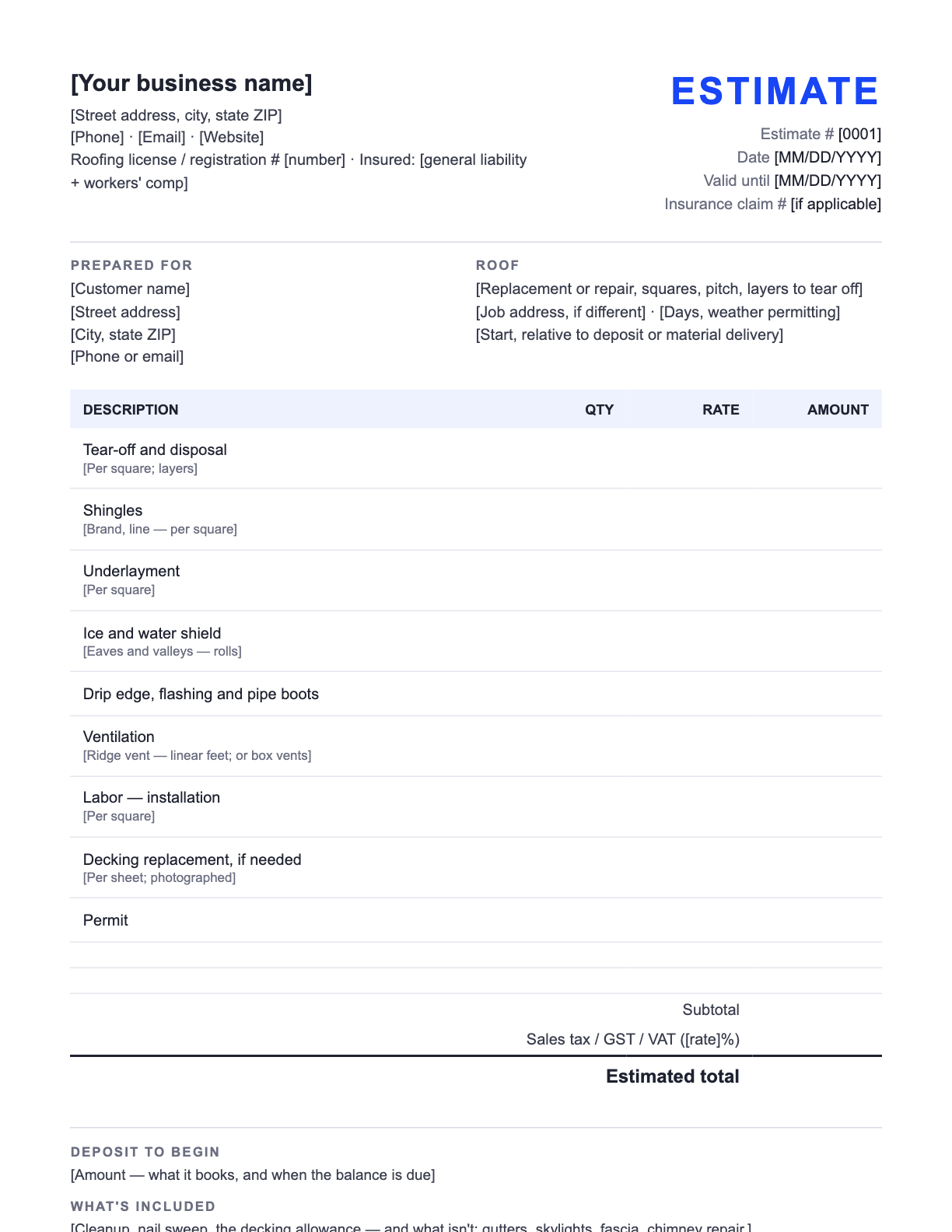
Example · fictional business
Ridgeline Roofing Co. Tulsa, OK (918) 555-0152 · estimates@ridgelineroofing.example Roofing contractor reg. # 000000 (example) | ESTIMATE |
Prepared for Denise Okafor 4812 S Yale Ave Tulsa, OK | Roof Full replacement — 28 squares (2,330 sq ft footprint × 1.202 at 8/12 pitch), one story, one layer to tear off Same address · 2 days, weather permitting Insurance claim # 0000000 (example) — scope matched |
| Description | Qty | Rate | Amount |
|---|---|---|---|
| Tear-off and disposal One layer of 3-tab shingles, 28 squares, dumpster and dump fees | 28 | $85.00 | $2,380.00 |
| Architectural shingles Brand and line named here, color to be chosen — 28 squares plus 10% waste, 93 bundles | 31 | $125.00 | $3,875.00 |
| Synthetic underlayment | 28 | $22.00 | $616.00 |
| Ice and water shield Eaves and valleys, 4 rolls | 4 | $110.00 | $440.00 |
| Drip edge and flashing New drip edge, step and chimney flashing, pipe boots | 1 | $520.00 | $520.00 |
| Ridge vent 60 linear feet, with ridge cap | 60 | $9.00 | $540.00 |
| Labor — installation | 28 | $165.00 | $4,620.00 |
| Labor — steep pitch, 8/12 Harness and toe-board work, per square | 28 | $60.00 | $1,680.00 |
| Decking replacement, if needed Per sheet of ½ in. plywood, only where rotted — we'll photograph it | 8 | $95.00 | $760.00 |
| Permit City of Tulsa, pulled by us | 1 | $150.00 | $150.00 |
| Subtotal | $15,581.00 | ||
| Sales tax, 8.5% on materials (example) | $573.84 | ||
| Estimated total | $16,154.84 | ||
Deposit to begin
$3,500.00 books the job; the balance is due when the work is finished.
What's included
Everything above, with magnetic nail sweep and cleanup both days. The squares are from our measurement of the roof, with 10% waste on the shingles only. Decking is priced at up to 8 sheets; beyond that we'll show you photos and confirm the count with you before continuing. Gutters, skylights and fascia repair are not included. Insurance claim: this estimate matches the adjuster's scope line for line; your deductible is your share of the cost.
How to pay
Deposit by card, check or bank transfer to book the date and the material delivery; the balance when the roof is finished. We schedule within two weeks of the deposit.
Every figure on the example is an example, not a price guide — use your own rates. The Word file is a standard .docx you can edit in Word or any app that opens Word documents; the PDF prints as-is if you'd rather fill it in by hand.
Quotes and a website, one place
Start your roofing website — quoting is built in
Add your business name and your town, and Zarla builds your roofing website from this one line. The same dashboard sends quotes like this one as a link your customer accepts online, and drafts the invoice when they do.
Already have a website? Bring it across →Zarla keeps your old page addresses where it can and redirects the ones that change, helping you keep the Google standing you've built.
THE TAKEOFF
Measure the roof: squares, pitch, waste and bundles
The arithmetic behind the first line of the estimate — footprint × pitch factor ÷ 100 — worked for the example roof.
| Step | How | The example roof |
|---|---|---|
| Footprint | Measure the house eave to eave from the ground or the plans, overhangs included, and multiply length by width for each rectangle of roof. | 2,330 sq ft, one rectangle |
| Pitch factor | Rise over 12 inches of run. The factor is √(1 + (rise ÷ 12)²): 4/12 = 1.054 · 5/12 = 1.083 · 6/12 = 1.118 · 7/12 = 1.158 · 8/12 = 1.202 · 9/12 = 1.250 · 10/12 = 1.302 · 12/12 = 1.414. | 8/12, so 2,330 × 1.202 = 2,801 sq ft of roof surface |
| Squares | Divide by 100: a roofing square is 100 square feet of roof surface, and tear-off, underlayment and labor are priced per square. | 28 squares |
| Waste | Add 10% to 15% on the shingles for the cuts at hips, valleys and edges, up to 20% on a complex roof (Jobber's shingle calculator, read November 2026). The tear-off and the labor stay at the measured squares. | 10% on a plain gable: 30.8, so order 31 squares |
| Bundles | Three bundles cover a square (Jobber), so the order is squares × 3 — the number the supplier quotes against. | 93 bundles |
| Layers, stories and pitch | Count the layers coming off (each extra layer is its own tear-off line), the stories, and whether the pitch is 8/12 or more — harness and toe-board work that goes on its own labor line. | One layer, one story, 8/12 — the steep-pitch line is on the estimate |
The pitch factors are geometry, not a price; the waste and bundle rules are Jobber's. The example house is fictional — measure every roof.
BY JOB
Line items by job: replacement, repair and storm claim
The same sheet, three ways — what changes on the lines, and the published US figures to check your own price against.
| The job | The lines | The US figures to check against |
|---|---|---|
| Full replacement | Tear-off per square by the layers; shingles per square with the waste shown; underlayment; ice and water shield; drip edge and flashing; ventilation; labor per square; the steep-pitch line at 8/12 and up; decking if needed; the permit. | About $340 to $595 a square installed for asphalt shingles — RoofingCalculator's $3.40 to $5.95 per square foot times 100 (read November 2026); Housecall Pro's band is $4.50 to $9 per square foot (February 2026). The labor alone is $150 to $300 a square, about $200 (SquareDash, April 2026). The permit is typically $100 to $500 (Fixr, February 2026). |
| Repair | The leak or the damage described in one line; materials by the piece — shingles by the bundle, a pipe boot, a length of step flashing, a sheet of decking; labor by the hour or a flat price for the repair; your minimum charge if you have one. | Priced flat: $200 to $800 for a minor repair, $800 to $1,500 moderate, $1,500 to $3,000 or more major; decking $70 to $120 a sheet; a chimney, skylight or flashing item $300 to $1,200 (Housecall Pro, February 2026). |
| Storm or insurance claim | The replacement lines, matched to the adjuster's scope line for line; the claim number on the estimate; code items — ice and water shield where your code requires it, drip edge — on their own lines; the deductible shown as the homeowner's share; a supplement with photos for anything the scope missed. | Price it as a replacement. The lines a scope most often leaves out: ice and water shield $250 to $750 a section, a ridge vent $300 to $900 (Housecall Pro, February 2026). |
| A second layer, or a steep roof | One extra tear-off line per extra layer, and the steep-pitch labor line on its own — never folded into the per-square rate, so the homeowner sees why this roof costs more than the neighbor's. | Tear-off $1 to $3 per square foot per extra layer (Housecall Pro, February 2026); removal averages $50 a square with the dump fees, up to $150 for heavy or layered roofs (Fixr, February 2026); a pitch of 8/12 and up adds $50 to $100 a square of labor (SquareDash, April 2026). |
Published US ranges to check a price against, not prices to quote — your material quote, your crew's wages and your overhead make the price yours.
LINE BY LINE
What goes on a roofing estimate
Every line on the template, in order, and what to write on it.
| The line | What to put there |
|---|---|
| Business name, license and insurance | Your trading name and contact details, your roofing license or registration where your state has one, and that you're insured — homeowners and insurers both ask. |
| Estimate number, date and valid-until date | A number that never repeats, the date, and a short validity — 14 to 30 days, because shingle prices move. |
| Prepared for, the roof and the claim number | The homeowner and the address; the roof in one line — the squares with the arithmetic (footprint × pitch factor ÷ 100), the pitch, the stories, the layers to tear off; and the insurance claim number when there is one. |
| Tear-off and disposal | Priced per square at the measured squares, one line per layer coming off, with the dumpster and dump fees inside it. |
| Shingles, underlayment, ice and water | The shingle brand and line named, priced per square with the waste shown and the bundle count; the underlayment per square at the measured squares; ice and water shield at the eaves and valleys by the roll, or by the section where your code requires it. |
| Flashing, drip edge and ventilation | New drip edge, step and chimney flashing and pipe boots on one line; ridge vent by the linear foot or box vents by the unit. |
| Labor, the steep-pitch line, decking and permit | Installation labor per square; a second labor line per square when the pitch is 8/12 or more, or the house has a second story; decking replacement as an if-needed line with a per-sheet price and a cap; the permit and who pulls it. |
| Tax, total and deposit | Sales tax where your state charges it on materials, the estimated total, and the deposit that books the date and the material delivery. |
| Included, the insurance line and how to pay | Scope in and out, the deductible as the homeowner's share on a claim, the deposit, and how to pay. |
STEP BY STEP
How to write a roofing estimate
From the takeoff to a document the homeowner — or their adjuster — can approve.
Do the takeoff
Footprint × the pitch factor ÷ 100 is the squares; add 10% to 15% waste on the shingles, more on a cut-up roof, and count the bundles at three a square. Write the squares, the pitch, the stories and the layers in the roof line at the top, so the homeowner can see where the number came from.
Price the tear-off and the materials per square
Tear-off at the measured squares, one line per layer; shingles (brand and line named) at the squares plus waste; underlayment, ice and water, flashing and ventilation — each line with its quantity, so the homeowner can compare like with like.
Put labor, the steep line and decking on their own lines
Installation labor per square; a second labor line per square when the pitch is 8/12 or more or there's a second story; and decking replacement as an if-needed line with a per-sheet price and a cap. Say you'll photograph it.
Add the permit, tax and the deposit
The permit and who pulls it, sales tax on the materials where your state charges it, the estimated total, and the deposit that books the date.
Match the insurance scope, if there is one
Line up your estimate with the adjuster's scope, note the claim number, put the code items on their own lines, and show the deductible as the homeowner's share — never as something you'll absorb.
State the deposit and how to pay
The deposit that books the date and the material delivery, when the balance is due, and how to pay. Send it the same day.
How roofing estimates win the job
Show the squares, not just the price. “28 squares (2,330 sq ft × 1.202 at 8/12)” tells the homeowner comparing three estimates that yours was measured. The estimate that shows the arithmetic is the one that doesn't get a “why is this one more?” call.
Name the shingle. “Architectural shingles” means nothing to a homeowner; the brand and the line do. The estimate that names the product is the one they trust to install it.
Put the steep pitch on its own line. A roof at 8/12 and up is harness and toe-board work — $50 to $100 a square more in labor (SquareDash, April 2026). Folded into the per-square rate it makes your whole price look high; on its own line it explains itself.
Make decking an if-needed line with a cap. Rotted decking is the roofing job's surprise. A per-sheet price, a stated cap and “we'll photograph it” turns the surprise into a line they already approved.
Keep the validity short. Shingle prices move more than almost any other material in home services. A 14-to-30-day validity protects you, and the date on the estimate is what lets you re-price without an argument.
Handle the insurance claim honestly. Match the adjuster's scope line for line and show the deductible as the homeowner's share. In the US, offering to waive, absorb or rebate a homeowner's insurance deductible is illegal in several states, including Texas and Florida, and can be treated as insurance fraud elsewhere — put the deductible on the estimate and leave it there. Check your state's insurance department for the exact rule.
Tax. In the US, sales tax on roofing depends on your state — materials only, the whole job, or different rules for repair and replacement — so keep materials and labor on separate lines and check your state's revenue department or your accountant. Outside the US the rule is the other way around: in Australia and New Zealand a GST-registered business gives a consumer a price that includes GST, and in the UK and EU a VAT-registered business shows the VAT and quotes consumers a price with it included. Confirm the details with your accountant.
Where the figures on this page come from. RoofingCalculator (the per-square-foot price by shingle, read November 2026), SquareDash (labor per square by roof type, April 2026), Housecall Pro (repairs and the add-on lines, February 2026), Fixr (the permit and the tear-off, February 2026) and Jobber's shingle calculator (bundles and waste, read November 2026). They are ranges to check your price against; the price is yours.
Send it from Zarla and get it accepted online
A Word estimate is a fine way to start. The slow part is everything after you send it: waiting for a reply, wondering whether they opened it, and retyping every line into the invoice when they say yes.
If you build your roofing website with Zarla, quotes are in the same dashboard. Build the quote from your own price book — one price, or up to three options side by side with the one you'd pick marked Recommended, and any line as a checkbox extra. Send it as one link, by email. Your customer picks an option, ticks any extras, types their name to accept, and gets a copy; Zarla drafts the invoice for exactly what they chose, with any deposit you asked for, and the job moves to Won. The quote template is already in your brand: your website's logo, colors and fonts, set once for every quote and invoice. On a paid plan, with your Stripe account connected, that invoice carries a pay-now button, so the deposit comes in as soon as you send it.
Want to see the website first? Browse roofing website templates or see how Zarla builds roofing websites. Still setting up? Read how to start a roofing business and write your roofing business plan. Setting your rates? See roofing cost per square for 2026.
The whole paper trail of a job, step by step: how to write a quote, then the roofing invoice template, then how to write a receipt — with a free receipt template. For any other trade, start from the free estimate template.
Roofing estimates: common questions
Your business, license and insurance details; the homeowner, the address and the roof in one line (the squares with the arithmetic, pitch, stories, layers); an estimate number, the date and a short valid-until date; tear-off, shingles (brand and line, waste shown), underlayment, ice and water shield, flashing, ventilation and labor each priced per unit; the steep-pitch labor line when the roof is 8/12 or more; decking as an if-needed line; the permit; subtotal, tax where it applies, the estimated total and the deposit; the insurance line where there's a claim; and how to pay.
100 square feet of roof surface — not floor area. A house with a 2,000-square-foot footprint and a 6/12 roof has about 2,236 square feet of roof (2,000 × the 1.118 pitch factor), which is 22.4 squares, so 23 to measure and price. Tear-off, underlayment and labor are priced per square at the measured number; the shingles are ordered at the measured squares plus the waste, three bundles to a square (Jobber's shingle calculator, read November 2026).
Measure the footprint eave to eave, overhangs included, multiply by the pitch factor and divide by 100. The pitch factor is √(1 + (rise ÷ 12)²): 1.054 at 4/12, 1.118 at 6/12, 1.202 at 8/12, 1.302 at 10/12 and 1.414 at 12/12. A 2,330-square-foot footprint at 8/12 is 2,801 square feet of roof — 28 squares — which is the example on this page. Hips and valleys add cuts, not squares — that's what the waste on the shingles is for; dormers add roof surface of their own, so measure their faces and add them.
An estimate is your best calculation of what the job will cost, given what you can see today; the final price can move if the work turns out different. A quote (or a fixed price) is the price you will charge for the work described. A bid is a quote submitted against someone else's specification, usually in construction. Say which one your document is in its title.
Thirty days is the common choice for a home-services estimate, and shorter when material prices move (roofing, lumber, copper). Print the date on the estimate: a customer who comes back after it can be re-quoted at today's prices without an argument, and one who accepts inside it knows the price holds.
Match the adjuster's scope line for line, write the claim number on the estimate, put the code items (ice and water shield where your code requires it, drip edge) on their own lines, and show the homeowner's deductible as their share of the cost. In the US, waiving, absorbing or rebating the deductible is illegal in several states, including Texas and Florida, and can be treated as insurance fraud elsewhere — so the deductible goes on the estimate and stays there. If the adjuster's scope missed something (ventilation, decking, flashing), send a supplement with photos rather than quietly adding it.
Enough to cover the shingle delivery and the days blocked out — 10% to a third of the price is the usual range. Some US states cap the deposit a contractor may take before work starts; check your state's licensing board.
Yes. The roofing estimate template on this page downloads free as a Word document and a PDF — no email address, no sign-up. Edit it in Word or any app that opens Word documents, or print the PDF and fill it in by hand.
Not from a Word file — the customer replies by email or phone, and you type the job into an invoice later. To get a yes in one tap, send it from quoting software. If your roofing website is on Zarla, the quote tool is in the same dashboard: your customer opens one link, picks an option, ticks any extras and types their name to accept, and Zarla drafts the invoice for what they chose — which, on a paid plan with Stripe connected, carries a pay-now button. Jobber, Housecall Pro, Wix and Squarespace send quotes customers accept online too.
Send estimates from your own roofing website
Add your town and your business name, and Zarla builds the site from that one line — with quoting in the same dashboard.
Already have a website? Bring it across →Zarla keeps your old page addresses where it can and redirects the ones that change, helping you keep the Google standing you've built.