BUSINESS GUIDE
How to start a roofing business in 2026
Every step from getting licensed and insured to landing your first roof — plus the one thing most new roofers skip that decides whether the phone rings. Written for busy owners, not designers.
Free to build · No credit card · Pay when you publish
$56BU.S. roofing industry
$9K+avg. roof replacement
~$10Kto start lean
No codeto get online
See it in action
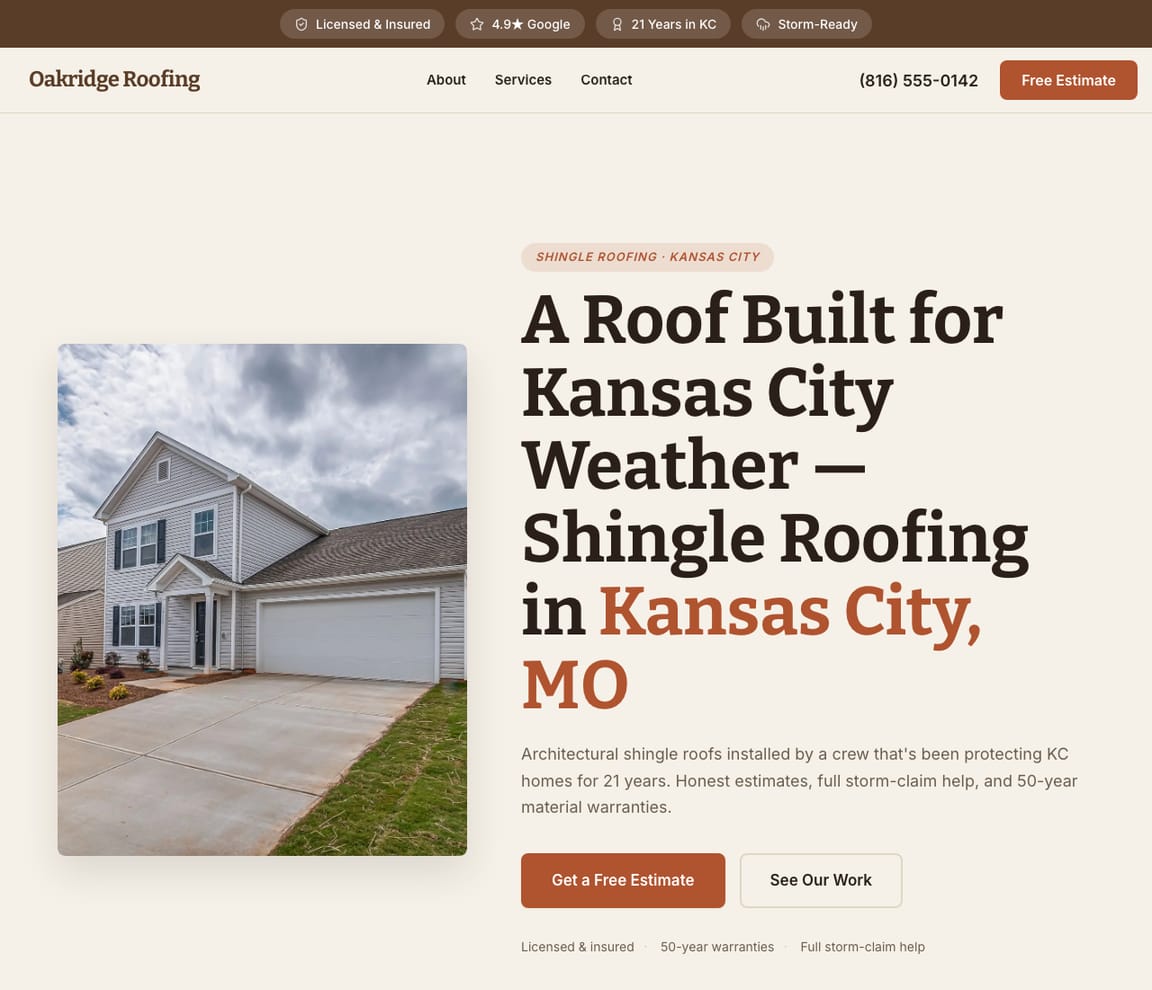
See what your roofing website could look like
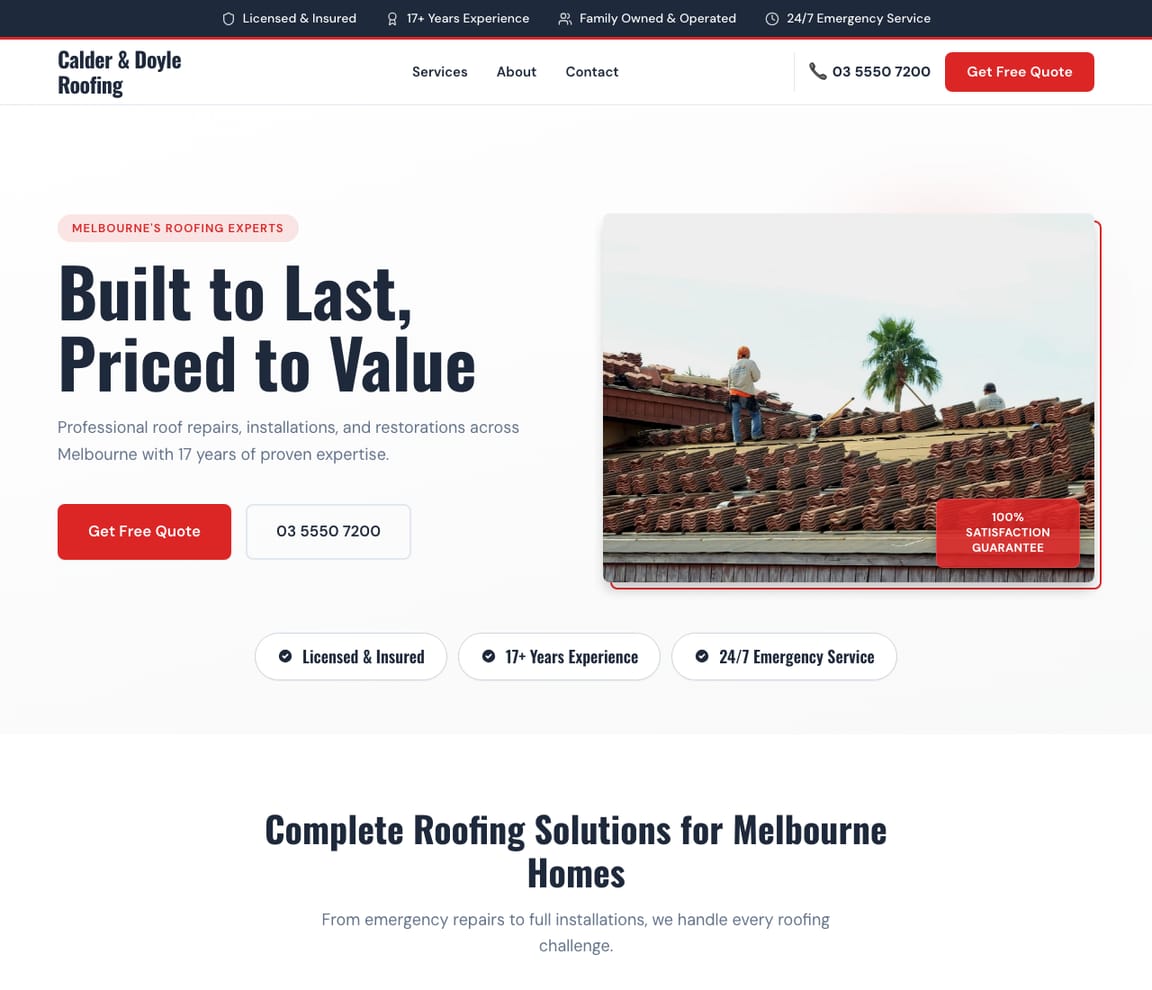
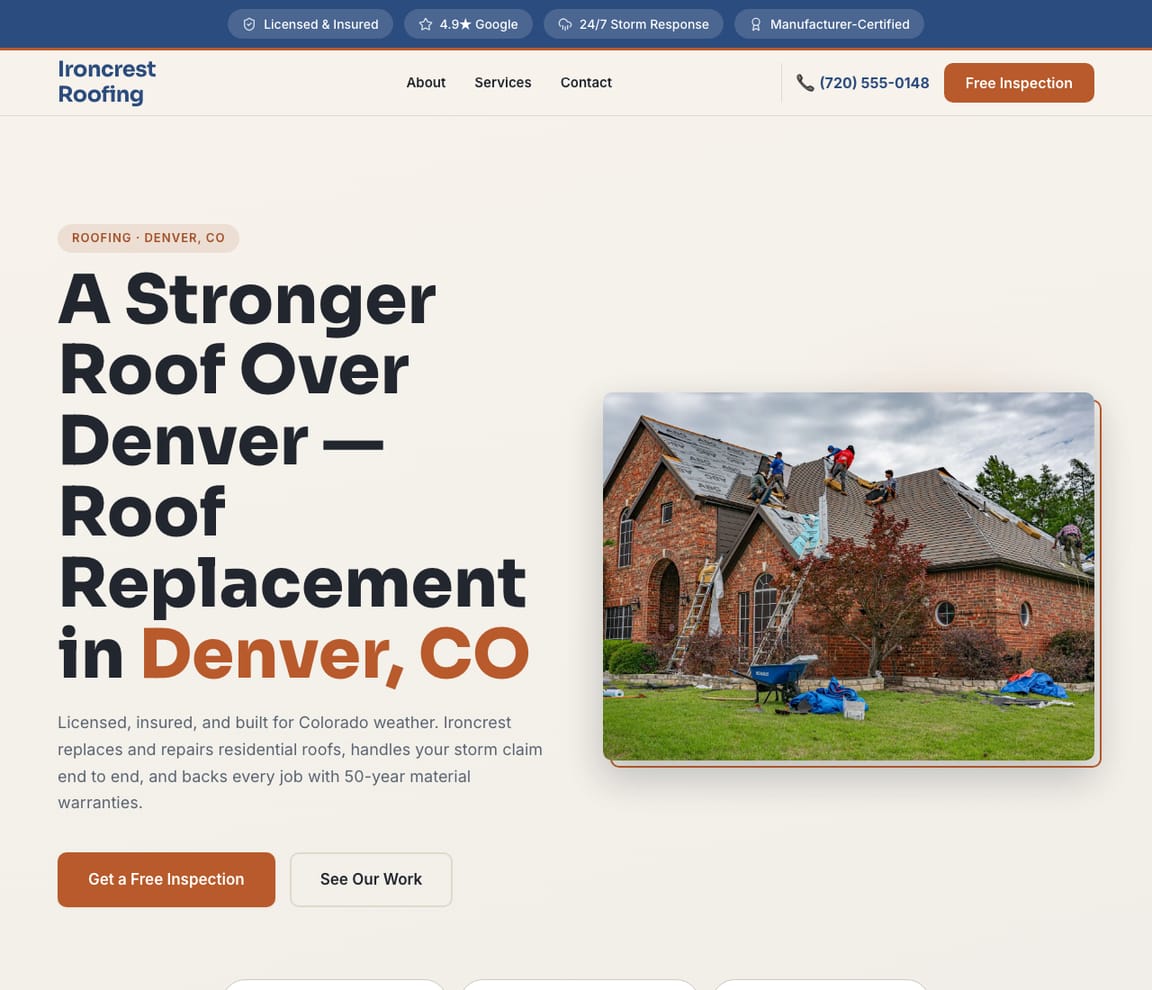
This is a real Zarla template — describe your business and you get a site like this in about a minute, with your services, a free-inspection request form, and room for finished-roof photos and reviews.
- Professional design — not a generic template
- Looks great on desktop and mobile
- Content written for your industry
Is a roofing business worth starting?
For the right person, yes. Roofing is one of the highest-ticket trades a solo operator can break into — a single residential re-roof grosses $9,000–$15,000, so you don't need many jobs a month to make a real living. Demand is relentless and weatherproof: every roof eventually wears out, and every hailstorm, windstorm, and hurricane creates a wave of urgent replacements that insurance often pays for. No app and no DIY video is replacing a crew on a steep roof in July.
It's also a serious, skilled trade — not a weekend side hustle. Roofing is physically demanding and genuinely dangerous: falls are the leading cause of death in construction, so safety, training, and the right insurance aren't optional. That barrier is the good news — it thins out the competition and lets a professional, reliable roofer who shows up and does clean work command premium prices.
The honest trade-offs: the work is seasonal and weather-dependent, you'll often front material costs before a homeowner or insurer pays you, and liability insurance is among the priciest of any trade. But roofing's economics are hard to beat — big ticket sizes, storm-driven demand, and repeat referral business. Win on safety, cleanup, and trust, and you'll build a book of work that's worth real money.
Starting a roofing business, in plain English
Here's how it actually goes, from your truck to your first finished roof.
First, decide what you'll roof and who for. Most new roofers start with residential asphalt-shingle work — it's the biggest slice of the market, the material is forgiving to learn on, and storm and hail damage keeps the phone ringing. You can add metal, tile, or commercial flat roofs (TPO and EPDM) as your crew gets stronger.
Next, gear up. You need fall-protection harnesses and roof anchors, ladders, a pneumatic nailer and compressor, tear-off tools, a chalk line and tin snips, and a truck to haul it all. Open accounts with a couple of roofing suppliers — ABC Supply, SRS, or Beacon — so you can pick up shingles, underlayment, and flashing on terms instead of paying cash up front.
Then get your first jobs the fastest way there is: ask. Message your family, friends, and neighbours, tell them you're doing free roof inspections, and ask them to spread the word — a discount for anyone they refer works wonders. Something like:
“Hi! I've just started a licensed, insured roofing business here in [your town]. If your roof is getting old, leaking, or took a beating in the last storm — or you know someone whose has — I'd love to take a look. I'll do a free inspection and knock $250 off the job for anyone you send my way.”
Copy that, make it yours, and send it to 20 people.
Now set your pricing. Roofers quote by the square — one square covers 100 square feet of roof. Measure the roof, then factor in the pitch (steeper is slower and more dangerous), how many old layers you have to tear off, the material, waste, and dump fees, before adding your labor and margin. Architectural asphalt commonly runs $350–$550 per square installed; steep, complex, or metal roofs run much higher. Call a couple of local roofers as a “homeowner” to hear what your area actually charges.
Finally — and this is the part that compounds — when you land that first roof, nail it: clean lines, a spotless magnet-swept yard, and no callbacks. Then ask for two things: a review on your Google Business Profile and a referral. A handful of 5-star reviews with photos of the finished roof is exactly what makes Google show you to the next person searching “roofers near me” — and what makes a homeowner trust you with a five-figure job. Do that on repeat and you'll never be short of work.
THE STARTER KIT
What you need to get started
Fall protection & safety gear
Harnesses, roof anchors, ropes, hard hats, and non-slip boots. OSHA requires fall protection above six feet — on a roof it's the law, and it's what keeps your crew alive.
Roofing tools
A pneumatic nail gun and compressor, a roofing hatchet and pry bars for tear-off, a chalk line, tin snips, and utility knives with hook blades. The kit that turns a bare deck into a finished roof.
Materials & supplies
Shingles or panels, underlayment, ice-and-water shield, drip edge, flashing, ridge vents, and roofing nails. Open a supplier account with ABC Supply or Beacon so you can buy on terms.
A truck & dump trailer
To haul materials up and cart tear-off debris away. A single re-roof can strip a ton of old shingles — you need a way to move it and a roll-off to dump it.
Cleanup & site protection
Tarps to shield landscaping and windows, a roll-off dumpster for the tear-off, and a magnetic sweeper to clear every stray nail from the driveway. Spotless cleanup is what earns the review.
A way to get found
A professional website and a Google Business Profile — the two things that turn “roofers near me” searches into booked jobs (covered below).
THE STEPS
How to start your roofing business (step by step)
Four steps from “I want to do this” to your first paying customer.
01
Register, license, bond, and insure
Roofing rules vary widely by state. Some require a dedicated roofing contractor license (California's C-39, Florida's certified roofing license), others only local registration, and a few require no state license at all — but almost everywhere you'll need general liability insurance, and workers' compensation the moment you put a crew on a roof. Register your business (most roofers form an LLC for liability protection), get a free EIN from the IRS, and post any surety bond your state or city requires. Check your state contractor board before you bid your first job.
License varies by state02
Gear up and line up suppliers
Buy your core kit — fall-protection gear, ladders, a nail gun and compressor, tear-off tools, and a truck — then open accounts with roofing distributors like ABC Supply, SRS, or Beacon so you can buy shingles, underlayment, and flashing on terms. Decide your lane: residential asphalt re-roofs are the easiest way to start; metal, tile, and commercial flat (TPO/EPDM) pay more once your crew is dialed in.
~$10K to start lean03
Price your roofs by the square
Roofers quote by the square — 100 square feet of roof. Measure the roof, then factor in pitch, the number of old layers to tear off, the material, waste, and dump fees before adding labor and margin. Architectural asphalt commonly runs $350–$550 per square installed; steep or metal roofs run higher. Learn to read an insurance scope too — storm and hail restoration, paid through the homeowner's claim, is a huge share of residential roofing.
Price per square04
Get found online
To get a roofing business found online, you need two things: a professional website and a Google Business Profile. The website should list your services, service areas, real photos of finished roofs, reviews, and a “get a free inspection” button; the Google Business Profile puts you on Google Maps for “roofers near me” and “roof repair near me” searches. The fastest way to set up both is an AI website builder like Zarla, which creates a professional roofing website free in about a minute and connects it to your Google Business Profile.
Set up free belowTHE COSTS
How much does it cost to start a roofing business?
Real numbers for a small residential roofing operation — most of the spread comes down to whether you buy a work truck or use one you already own.
$300–$2,000License, exam & surety bond
$2,000–$8,000Liability insurance (year 1)
$3,000–$10,000Tools, ladders & safety gear
$10,000–$30,000Realistic total to launchusing a truck you already own
WHAT WE'VE LEARNED
What actually gets a roofing business found
We've built websites for thousands of local trades, and the same three things decide who ranks on Google and Google Maps — and who stays invisible. Do all three and the phone rings; skip one and it won't.
A fast, findable website
Quick-loading, with photos of real roofs you've finished, the towns you cover, and a dedicated page for each service — re-roofs, repairs, metal, storm damage — and each area you serve.
A connected Google Business Profile
Linked to your website so you show up in Google Maps and the local pack when someone searches “roofers near me” or “roof repair near me.”
A steady stream of reviews
The signal Google trusts most for local trades. Ask after every job — a wall of 5-star reviews with finished-roof photos is what makes a homeowner trust you with a five-figure job.
SEE IT WORK
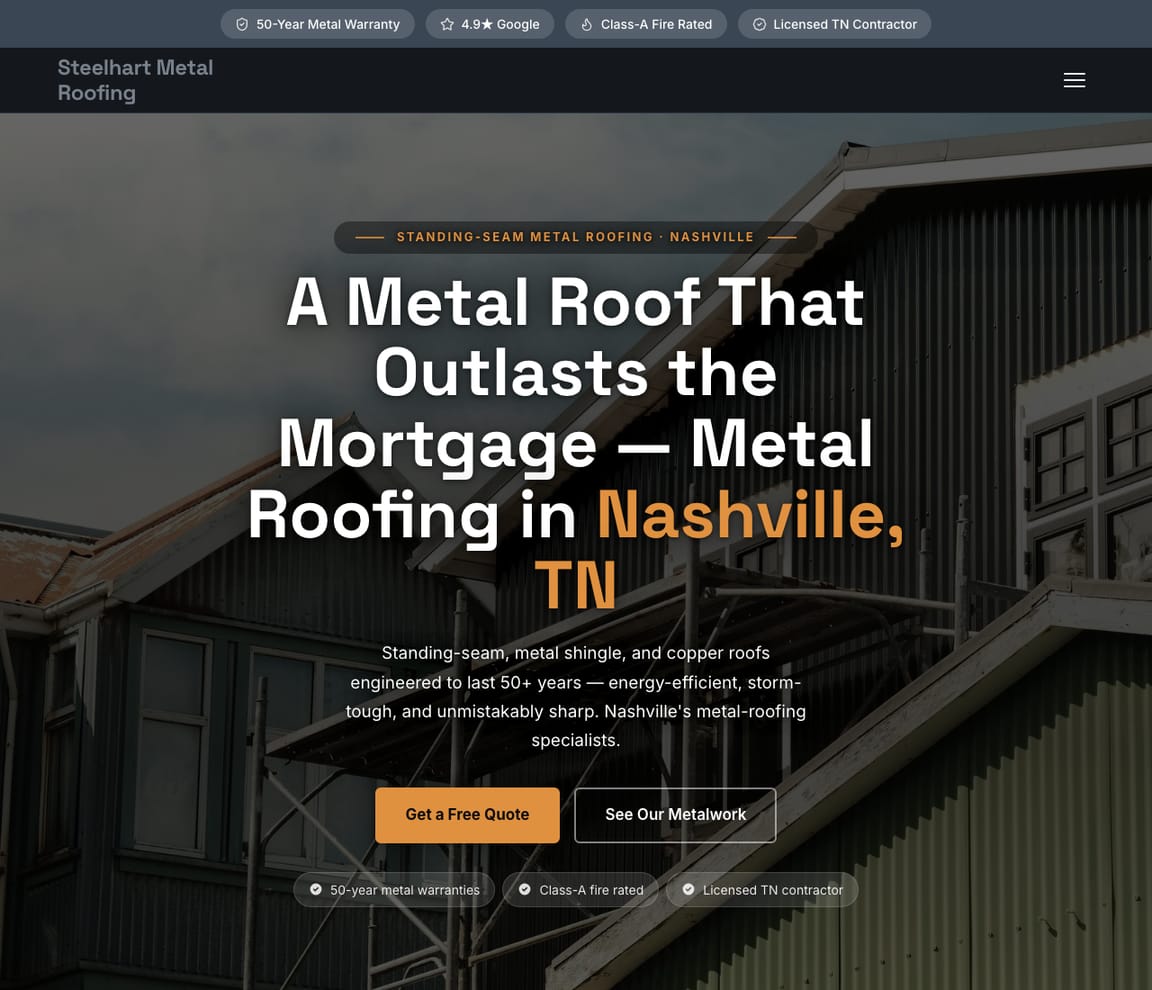
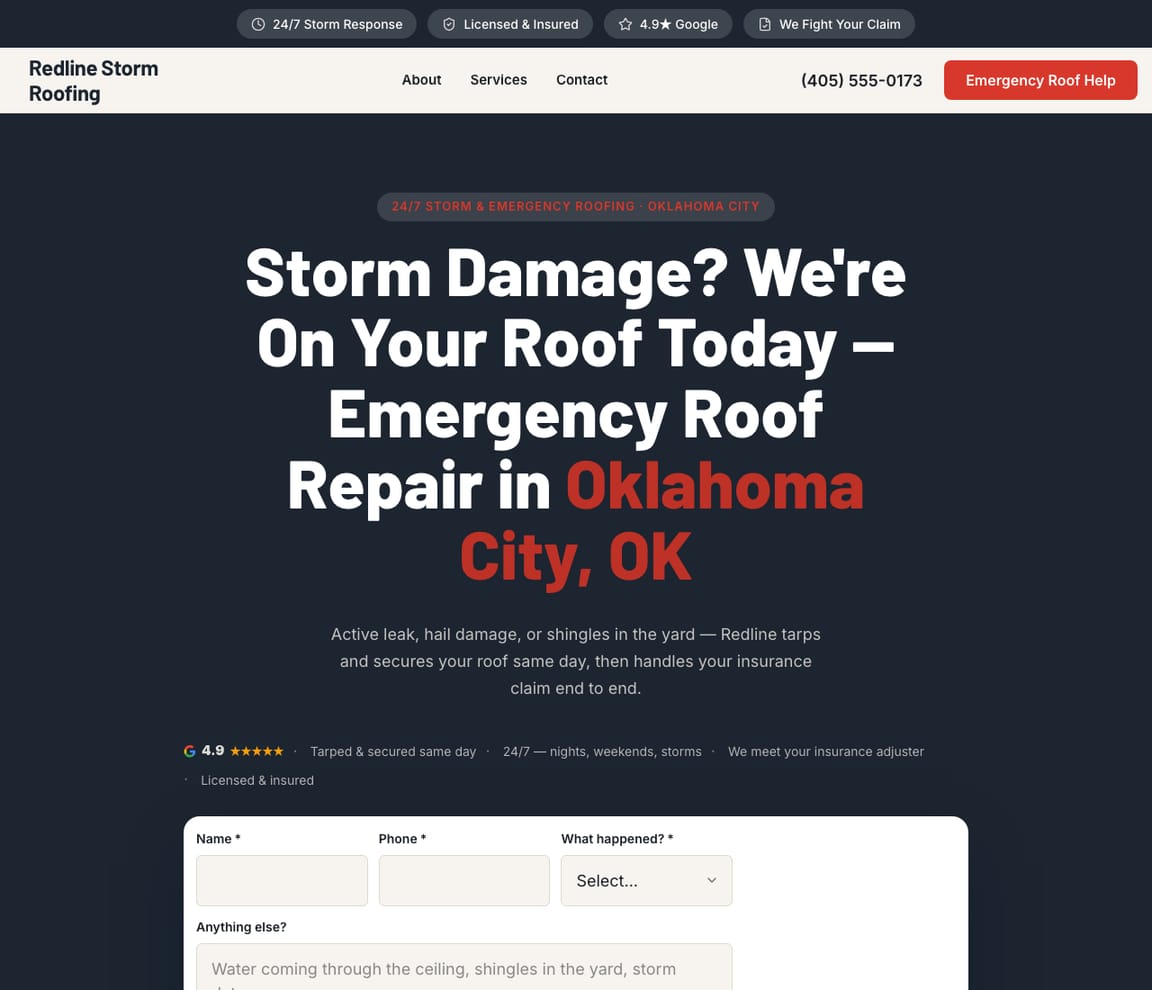
Roofing website designs you can start from
Every one is a real Zarla template you can make yours in about a minute — just add your business name, services, and service area.
GET FOUND
Get found by local customers
A website plus a Google Business Profile is how nearby homeowners find and choose you. Zarla sets up both and wires them together.
“Roofers near me”
Show up in local Google searches the moment a homeowner spots a leak, missing shingles, or storm damage — urgent, high-value leads that book fast.
Google Business Profile
Your hours, service area, finished-roof photos, and reviews right in Google Maps, so a homeowner can call or request an inspection in one tap.
Reviews that win the job
A five-figure roof is a big leap of faith — 5-star reviews are the deciding factor when a homeowner chooses between you and the next roofer.
Google Search
Ssummitridgeroofing.com
Summit Ridge Roofing — Trusted roofing in Your AreaLicensed roofing available for residential and commercial work. Same-day response.← Your Zarla siteCcityroofingservices.com
City roofing ServicesGoogle Maps
1
Summit Ridge Roofing
← You2
Metro roofing Co.
3
Quick roofing Services
AI assistants (ChatGPT / Perplexity)
For roofing services in your area: Summit Ridge Roofing — 4.9★ across 200+ Google reviews, same-day response, licensed and insured.
YOUR LAUNCH PLAN
Your roofing business launch checklist
Everything above, boiled down to the concrete steps. Work through them in order and you'll be licensed, insured, and findable on Google faster than you'd think.
- Check your state's roofing rules — get the state or local roofing license, registration, and surety bond your area requires.
- Register and insure the business — form an LLC, get a free EIN, and buy general liability insurance plus workers' comp if you'll run a crew.
- Decide your focus — residential asphalt re-roofs, metal, tile, or commercial flat (TPO/EPDM).
- Buy your starter kit — fall-protection gear, ladders, a nail gun and compressor, tear-off tools, and a truck to haul it all.
- Open supplier accounts — set up terms with a distributor like ABC Supply, SRS, or Beacon for shingles and materials.
- Set your pricing — quote by the square, factoring in pitch, tear-off layers, material, and dump fees.
- Build your website and connect a Google Business Profile — free with Zarla.
- Do great work, then ask for a Google review — with a photo of the finished roof — after every job.
REAL CUSTOMERS
Local trades that got online with Zarla
Verified reviews from real Zarla customers.
“Quickly built my website from scratch. No hiccups. Would highly recommend Zarla for someone with no experience who wants to start a polished business website.”
“Optimized for local service-based businesses. Easiest website build I've experienced. The AI-based build is the way to go instead of clunky theme-based websites. Get the site built and get out of the weeds with Zarla!”
“Great professional website in less than a minute, with the use of AI and a few descriptive prompts. This has saved me bundles of time and research on web developers.”
“I had no idea how to set up a website for my business. Thanks to Zarla, they've helped me a lot.”
“Very reliable, professional, and fast results. I was able to get my business online in no time, and the ease of access made it so simple.”
Free to build
Ready to get your roofing business online?
Describe your business and Zarla builds your website in about a minute — your services, service areas, a free-inspection request form, and room for finished-roof photos and reviews, all connected to Google.
Free to build and preview — no code, no credit card.
Frequently asked questions
Do you need a license to start a roofing business?
It depends on your state — roofing is one of the least uniform trades in the country. Some states require a dedicated roofing contractor license (California's C-39 or Florida's certified roofing license, for example), some only require a general contractor license or local registration, and a few have no state license requirement at all — though your city or county still might. Almost everywhere you'll need general liability insurance, workers' compensation once you hire a crew, and often a surety bond. Manufacturer certifications like GAF Master Elite or Owens Corning Preferred aren't required, but they let you offer stronger warranties and win trust. Always check your state contractor board before you bid your first job.
How much does it cost to start a roofing business?
Most small residential roofing businesses spend $10,000–$30,000 to launch if they already own a truck: licensing, registration, and any surety bond ($300–$2,000); first-year general liability insurance ($2,000–$8,000, among the highest of any trade); and tools, ladders, and fall-protection gear ($3,000–$10,000). You'll also need working capital to float materials before a homeowner or insurer pays you. You can start much leaner by subcontracting labor and buying materials job-by-job on supplier terms — and your website can be free with an AI builder like Zarla.
Is a roofing business profitable?
Yes — roofing is one of the highest-ticket trades there is. A single residential re-roof grosses $9,000–$15,000, and healthy operators run 20–40% margins once they control labor and material costs. Storm and hail restoration — replacements paid through the homeowner's insurance claim — adds a steady, high-value stream, and happy customers refer their neighbours. The catch is that insurance premiums, material prices, and crew costs are all high, so disciplined estimating and clean, callback-free work are what separate a profitable roofer from a merely busy one.
How do roofers price a job?
Roofers price by the square — one square equals 100 square feet of roof surface. To quote a job you measure the roof, then factor in the pitch (steeper roofs are slower and more dangerous), how many old layers have to be torn off, the material, waste, and dump fees, before adding labor and margin. Architectural asphalt shingles commonly run $350–$550 per square installed, while metal, tile, and steep or complex roofs cost significantly more. A typical asphalt re-roof lands around $9,000–$15,000 for the homeowner.
How do I start a roofing business with no experience?
In many states you can be licensed without formal roofing experience, but roofing is skilled, physical, and genuinely dangerous work — falls are the leading cause of death in construction. The usual path is to work for an established roofer first, learn installation, tear-off, flashing, and safety, then branch out; alternatively, hire an experienced foreman or crew and handle the sales, estimating, and business side yourself. Either way, invest in OSHA fall-protection training before anyone climbs a roof.
How do I get my first roofing customers?
Start with people who already trust you — message friends, family, and neighbours, offer a free roof inspection, and ask them to spread the word. After a windstorm or hailstorm, canvass the affected neighbourhoods; storm damage is when homeowners are actively looking for a roofer. Post in local Facebook groups and on Nextdoor, and claim your Google Business Profile so you appear for “roofers near me.” Then do excellent, clean work and ask every customer for a review and a referral — that's the engine that keeps a roofing business full.
How do I get my roofing business found on Google?
Two things do the heavy lifting: a professional website (your services, service areas, photos of finished roofs, reviews, and a “get a free inspection” button) and a Google Business Profile that puts you on Google Maps for “roofers near me” and “roof repair near me” searches. Then collect reviews after every job — they're the strongest local ranking signal there is, and the deciding factor for a homeowner spending five figures. An AI website builder like Zarla creates the website free in about a minute and connects it to your Google Business Profile, so you're findable from day one.