CAREER GUIDE
How to become a solar installer in 2026
Who may bolt the array and who may wire it, state by state from the boards — California's C-46 and its limit, Florida's solar contractor, Texas's electrician rungs, Oregon's renewable energy technician — plus what NABCEP certification is and costs, the OSHA fall rules, what installers earn at each rung from BLS data, the kit priced from real listings, and how to go from someone else's roof crew to your own company.
Free to build · Pay when you publish · No credit card
One statelicenses a solar person at all — Oregon's renewable energy technician; everywhere else the roof crew works under a licensed contractor and the wiring is electrical work licensed by the state's electrical board, from the boards below
$53,140median pay for employed solar photovoltaic installers in 2025 (O*NET, from BLS data); 10 percent earn $79,970 or more
$25 + $125NABCEP's PV Associate application and exam — the entry credential, from NABCEP's own fee page; the Installation Professional is $125 + $375
7% or higherthe projected growth for installers, 2025–2035 — "Much faster than average" — from BLS data on O*NET
See it in action
See what your solar website could look like
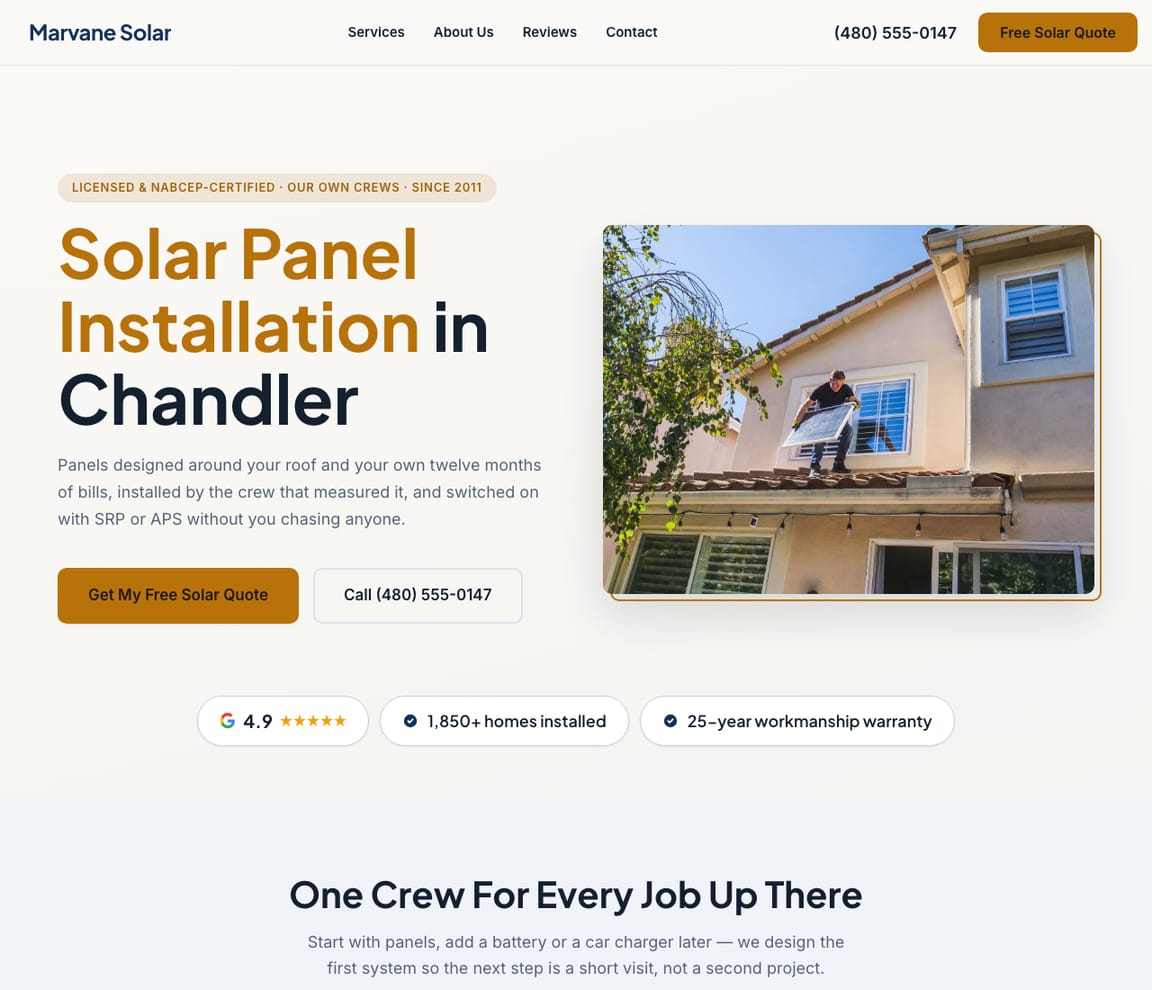
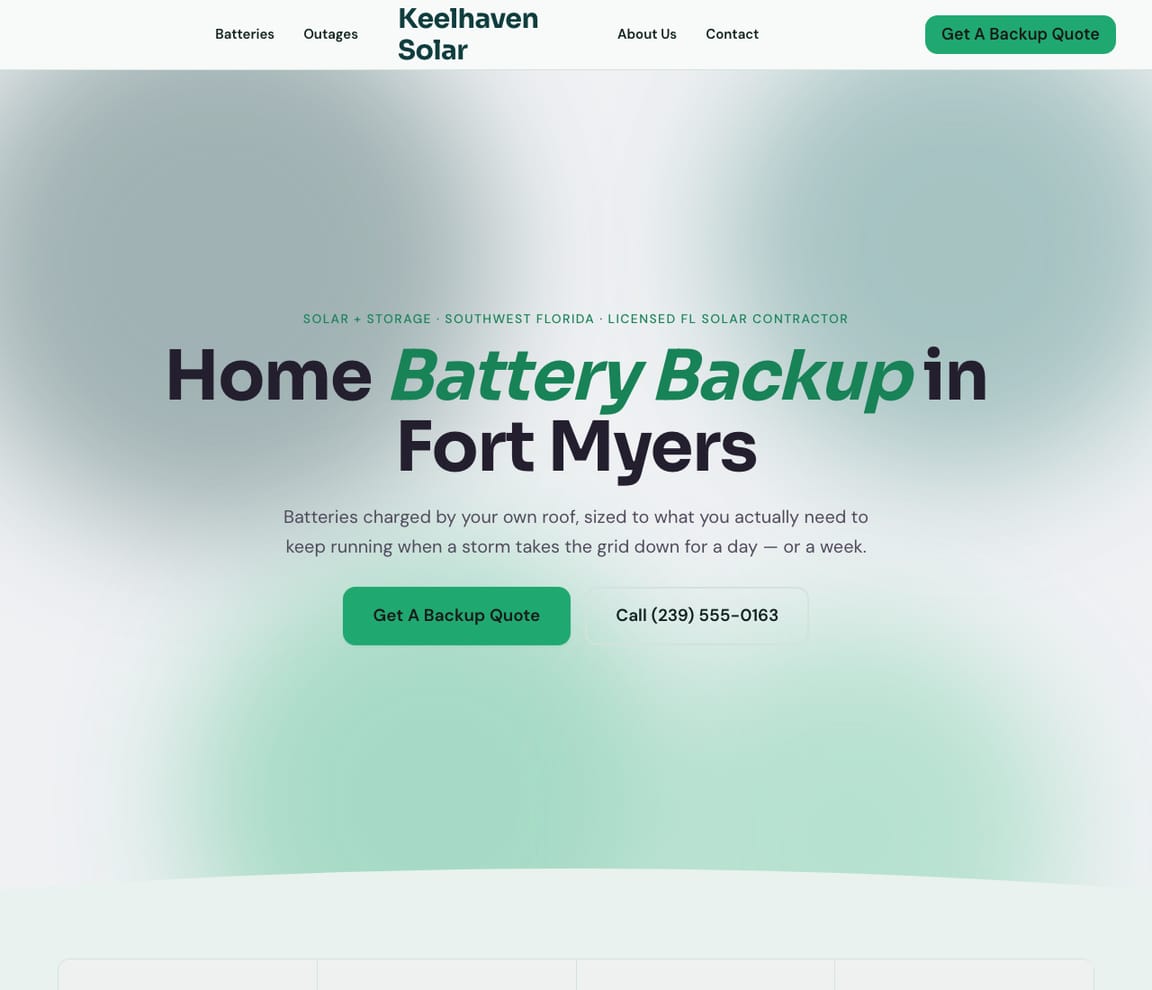
A real Zarla template for a residential solar installer — a finished roof in the first screen, systems and batteries underneath, the license and certification numbers where a homeowner looks for them. Describe yours — the town, the systems, the service area — and you'll have a site like this, with a call button and a site-assessment form, in about a minute.
- Professional design — not a generic template
- Looks great on desktop and mobile
- Content written for your industry
Build the website
Start your solar website now
Add your town and your business name to the sentence, and Zarla builds the site: your systems, the area you cover, your finished installs and a site-assessment form. Add your license and certification numbers in chat, then publish.
Already have a website? Bring it across →Zarla keeps your old page addresses where it can and redirects the ones that change, helping you keep the Google standing you've built.
Is becoming a solar installer worth it in 2026 — and what does the work pay?
Becoming a solar installer is two trades under one hard hat — the roof crew that no state but Oregon licenses and the electrical connection that every state does — and at the top of it a licensed company whose proposals carry a license number a homeowner can check. Three honest numbers first. Employed solar photovoltaic installers had a median of $53,140 a year in 2025, $25.55 an hour: 10 percent earned $41,600 or less, 10 percent $79,970 or more — $38.45 an hour and up (O*NET, from BLS 2025 wage data). The headcount is small and growing fast: "Employment (2025) 31,100 employees", "Projected growth (2025-2035) Much faster than average (7% or higher)", "Projected job openings (2025-2035) 4,200" (O*NET, employment and outlook). And the survey behind the wages leaves out the self-employed (Washington ESD) — which is the installer with his or her own company, so the median measures the hand on someone else's crew, not the owner.
State by state. The employed median is $48,240 in Texas, $60,600 in California, $50,550 in Florida and $56,160 in New York (O*NET, Texas; California; Florida; New York). The licensed trade next door pays more: employed electricians had a median of $63,190, and their top 10 percent clear $108,510 (O*NET, electricians) — which is why the installers quoted below who own companies are, almost all of them, electricians.
Where the money went. The owners say the company is a second trade: "right about year 6 I realized I was an electrician masquerading as a business owner. I knew that if I wanted to get bigger than a few employees and sales over a million dollars I had to change some things… and that needed to start with me" (Joshua Farley, Redline Electric & Solar, Tempe, VoyagePhoenix, February 22, 2018). The market is a ride: "In this industry, we refer to it as the “solar coaster.” Over the past few years, many companies– large, national brands as well as smaller local installers, have folded to due intense competition" (Arno Aghamalian, Solar Optimum, Glendale, VoyageLA, January 2, 2018). And the sales pitch lost its federal prop at the end of 2025: the homeowner credit "equals 30% of the costs of new, qualified clean energy property for your home installed anytime from 2022 through December 31, 2025. The credit is not available for any property placed in service after December 31, 2025" (IRS, residential clean energy credit). What a system should be priced at is its own guide — solar pricing — and the step after this one is how to start a solar company.
The catch. The roof is six feet from a fall-protection rule and a few inches from live DC; OSHA's own page lists "arc flashes (which include arc flash burn and blast hazards), electric shock, falls, and thermal burn hazards that can cause injury and death" (OSHA, solar energy). The permits are slow — "Permitting and utility interconnection processes can vary significantly from county to county (Clay, Duval, St. Johns, etc.), and delays on approvals or inspections sometimes push timelines back weeks or even months" (Karen Simison, Clay Solar Installation Partners, Middleburg, Florida, VoyageJacksonville, April 30, 2026) — and the license that lets you own the company takes years of documented hours. That's what the rest of this guide sets up: who may install and who may wire in each big state from its board, NABCEP from its own fee page, the routes in, the kit from a distributor's own prices, and how to be the installer the solar search finds first.
How to become a solar installer, in plain English: who may install and who may wire, state by state, from the boards
There is no federal solar installer's license, and only one state — Oregon — licenses a solar person at all. Everywhere else the crew that racks and bolts the array works, unlicensed, as employees of a licensed contractor; the wire from the array to the service panel is electrical work, licensed by the state's electrical board or done under the contractor that holds the license; four states have built a solar contractor classification of their own, and Illinois certifies the installer under a rule whose page refused every reader we sent. NABCEP is the voluntary card the industry asks for, and one state ties a registration to it. On top sits the ordinary business license your city issues to any trade. Here is each big state, from its own board or statute:
- California: four licenses may install. The board's own consumer page: ""A" – General Engineering contractors are authorized to install solar energy systems", ""B" – General Building contractors are authorized to install solar energy systems within the definition of B&P Code section 7057", "C-10 – Electrical contractors are authorized to perform any solar projects that generate, transmit, transform, or utilize electrical energy in any form for any purpose", "C-46 – Solar contractors install, modify, maintain, and repair thermal and photovoltaic solar energy systems" (CSLB, Solar Smart). The C-46 has a fence around it: "A licensee classified in this section shall not undertake or perform building or construction trades, crafts, or skills, except when required to install a thermal or photovoltaic solar energy system", and "a battery energy storage system … shall not be considered part of a photovoltaic solar energy system", which a C-46 "may install … as "incidental and supplemental" to the installation of a photovoltaic solar energy system if the battery energy storage system does not exceed a rating of 80 kilowatt-hours (kWh)" (16 CCR §832.46); the C-10 definition covers "battery energy storage systems, photovoltaic solar energy systems or any part thereof" (§832.10). Any license asks for "not less than four years experience as a journeyman, foreman, supervising employee or contractor in the particular class" (16 CCR §825), a "twenty-five thousand dollars ($25,000)" bond (§7071.6), and applies above the $1,000 line — which is lost by anyone who "Employs another person to perform, or assist in performing, the work" (§7048): a two-person roof crew is never exempt. Selling is registered too: "Generally, solar sales representatives must be registered with CSLB as Home Improvement Salespeople (HIS)" (CSLB) — the registration is in §7152, and "It is a misdemeanor for any person to engage in the occupation of salesperson for one or more home improvement contractors within this state without having, at the time of the sales transaction, a current and valid home improvement salesperson registration" (§7153). The CSLB's fee pages refused our reader, so no California dollar fee is printed here. One owner's route: "To start my own company in California, I needed a contractor's license, which required four years of local experience. … After passing both the law and trade exams, I earned my contractor's license" (Adrian Suarez, Aicon Solar, San Diego, SDVoyager, April 7, 2025).
- Florida: the statute names the trade — ""Solar contractor" means a contractor whose services consist of the installation, alteration, repair, maintenance, relocation, or replacement of solar panels for potable solar water heating systems, swimming pool solar heating systems, and photovoltaic systems and any appurtenances, apparatus, or equipment used in connection therewith" (Fla. Stat. §489.105). "A person must be certified or registered in order to engage in the business of contracting in this state", an unlicensed subcontractor may work "under the supervision of a person who is certified or registered" only outside the named trades, and "A contractor shall subcontract all electrical, mechanical, plumbing, roofing, sheet metal, swimming pool, and air-conditioning work, unless such contractor holds a state certificate or registration in the respective trade category" (§489.113) — so the roof crew works for the solar or electrical contractor, and the wiring is an electrical contractor's. To sit the exam you must be "18 years of age" with "at least 4 years of active experience" of which "at least 1 year of active experience shall be as a foreman" (§489.111). Even the owner's own exemption keeps the wire licensed: a homeowner installing panels in a SunShot county "must utilize a licensed electrical contractor to effectuate the wiring of the solar panels, including any interconnection to the customer's residential electrical wiring" (§489.103). The state's exam and fee pages were not read, so none is printed.
- Texas: no solar license; the install is electrical work — ""Electrical work" means any labor or material used in installing, maintaining, or extending an electrical wiring system and the appurtenances, apparatus, or equipment used in connection with the use of electrical energy in, on, outside, or attached to a building, residence, structure, property, or premises" (Tex. Occ. Code §1305.002) — and the department says so: "TDLR already regulates the installation of solar energy systems by electricians and electrical contractors under the Texas Electrical Safety and Licensing Act" (TDLR, September 10, 2025). The electrician ladder — the apprentice registration, the journeyman license at 8,000 hours of supervised work, the master after two years as a journeyman — is printed from the department's own license pages in our how to become an electrician guide; the department's electrician index is TDLR, electricians. What Texas added is a sales registration: "Starting September 1, 2026, individuals selling or leasing most residential solar energy systems, and the companies for which they work, will be required to obtain a registration from TDLR", every contract must "Provide that the installation of the residential solar energy system will be performed by a licensed electrical contractor" and "Conspicuously state the name and license number of the electrical contractor who will perform the installation", and "electrical contractors and their employees will be exempt from having to register" (TDLR; the program page). A retailer pays "the non-refundable $350 registration fee" and carries "general liability insurance in the amount of not less than $1 million per occurrence and $2 million in the aggregate" (TDLR, solar retailer); a salesperson "the non-refundable $56 registration fee" with "no examination requirements" and "a criminal history background check" (TDLR, solar salesperson).
- Illinois: the state certifies the installer — "DG Certification for installers is required in the state of Illinois" (Illinois Solar Energy Association) — but the Commerce Commission's own page answered an error to every reader we sent, so the exam, the experience and the fee are not printed here. New York: no state solar license; the state incentive program's contractor page and New York City's buildings-department pages refused or did not exist for our reader, so nothing is printed for either. Oregon: the one state with a solar-specific person's license — "A person qualifies for licensing as a limited renewable energy technician if the person completes a two-year apprenticeship program and passes an examination approved by the board", who may then "Install, maintain, replace or repair electrical wiring and electrical products that convey energy from or operate on renewable electrical energy generation systems that use wind, solar energy systems, microhydroelectricity, photovoltaic systems or fuel cells that do not exceed 50 kilowatts AC", including "All DC wiring and DC connections up to the load side of an inverter"; the company is "A limited renewable energy contractor" that "Employs at least one full-time renewable energy technician" and "may not make, direct, supervise or control the making of an electrical installation unless the contractor is licensed for that activity" (ORS 479.630). The building division's fee pages did not open.
- North Carolina: the connection is electrical contracting — "There are 10 different classifications of electrical contracting licenses": "Limited License - $100/year" for "a single electrical contracting project of a value not in excess of sixty thousand dollars ($60,000)", "Intermediate License - $150/year" up to "$150,000", "Unlimited License - $200/year" for "any electrical contracting project regardless of value" (NC Board of Examiners of Electrical Contractors); the board's page has no solar classification. Colorado: two registrations. "To perform Electrical Contracting in the State of Colorado, you must be a licensed Electrical Contractor registered with the State of Colorado" and "Hold or employ a licensed master electrician to serve as the responsible individual for the company"; and the one state rule that names NABCEP — "To perform Photovoltaic Installing in the State of Colorado, you must be a licensed Photovoltaic installer registered with the State of Colorado: … Employ at least one NABCEP Certified employee. Have a designated agent(s). If the agent(s) are no longer employed with the Photovoltaic Installer, the registration is invalid and cannot be reinstated" (Colorado DPO, electrical applications); every electrician there "must complete at least 24 hours of Continuing Education (CE) during each 3 year license period" (Colorado DPO). Hawaii: "C-60 Solar power systems contractor. To assemble and install photovoltaic panels, batteries, controls, and related low voltage D.C. wiring", a scope the C-13 electrical license also includes (Hawaii Contractors License Board).
- Nevada: "A licensed contractor is required to construct, repair, maintain, restore, alter, or improve solar systems on single-family residences, including the replacement of existing equipment and installation of new equipment", and "Any person who is advertising or making a solicitation to perform or enter into a contract for residential solar work must have a proper Nevada contractor's license", under rules in force "Effective October 1, 2021" (Nevada State Contractors Board, residential solar); the handyman line excludes the trade — no license is needed only where the work "is less than $1,000.00, including labor and material and does not require a building permit or involve work that is performed by a plumbing, electrical, refrigeration, heating or air conditioning contractor" (NSCB FAQ). Washington: "To learn to be an electrician, you need to begin as a trainee. An electrical trainee must have a trainee certificate and work under the supervision of a certified electrician", and certified electricians "work for a licensed electrical contractor performing electrical installations" (Washington L&I) — the state prints no solar line of its own. Arizona: a Registrar of Contractors license above the same $1,000 line as California, for work "of a casual or minor nature" only (A.R.S. §32-1121); the registrar's own site refused our reader. Connecticut licenses solar installers in two classes, and Louisiana, Utah, Massachusetts, New Jersey, Georgia and Michigan regulate the work too, on pages that refused or did not open, so none of their lines is printed here.
NABCEP, from its own fee page. The North American Board of Certified Energy Practitioners is voluntary — no federal rule requires it — and it is the card financiers, some utilities and Colorado's registration look for. The entry credential: "PV ASSOCIATE (PVA) | $25.00 | $125.00* | $125.00 | $150.00 | $50.00" — application, exam, re-exam, renewal and late renewal — with the note that "PVA Candidates qualifying through the Education Pathway with a NABCEP Associate Registered Training Provider may be charged between $125-$180 for a first-time test" (NABCEP fees). Two ways in: "Successfully complete a training course with a NABCEP Associate Registered Training Provider, and pass the relevant NABCEP Associate Examination", or "Document at least six months of full-time equivalent work experience in a job that is directly involved with photovoltaics, operations & maintenance or solar heating technologies, and pass the relevant NABCEP Associate Examination"; passing "qualifies an individual to design, sell, install, or maintain systems in a supervised capacity", and "As of April 7, 2026" the exam carries new content (NABCEP, associate program). The exam is "seventy (70) equally weighted multiple-choice questions" of which "Sixty (60) of the questions are scored", in "up to two hours", and "An average of 40 hours of instruction is proposed to adequately prepare individuals" (NABCEP associate candidate handbook). The board certification: "PV INSTALLATION PROFESSIONAL (PVIP) | $125.00 | $375.00 | $275.00 | $390.00 | $50.00 | $25.00" — application, exam, re-exam, recertification, late fee, printed copy (NABCEP fees); to sit it "every Applicant, regardless of background, education, experience, or geographical location, will need to document: • Completion of a minimum of 10 hours of OSHA Outreach Training Program for the Construction Industry training (or government equivalent); AND • Completion of at least 58 hours of advanced training … AND • Completion of installations equaling at least 6 Project Credits", where "System size of 1 – 999kW = 2 Project Credits", the applicant "shall have performed in a decision-making role (DMR)" — "Lead Installers, System Designers, Project Managers, Site Managers, Foreman, Electricians" — and "Installations must have been completed within the two (2) calendar years prior to the application submission date", "All installations must be complete and have a permit and a final approved inspection" (NABCEP certification handbook); "Our testing vendor, Meazure Learning, charges an additional $75 international fee for exams taken outside of the United States and Canada", and "All fees are non-refundable and non-transferable" (NABCEP fees). Three permitted, inspected home systems in a lead role is the floor, our reading of the credits.
The safety rules a crew will ask about. "Each employee on a walking/working surface (horizontal and vertical surface) with an unprotected side or edge which is 6 feet (1.8 m) or more above a lower level shall be protected from falling by the use of guardrail systems, safety net systems, or personal fall arrest systems" (29 CFR §1926.501); the hardware is rated — "Dee-rings and snaphooks shall have a minimum tensile strength of 5,000 pounds (22.2 kN)" (§1926.502); on a scaffold, "Each employee on a scaffold more than 10 feet (3.1 m) above a lower level shall be protected from falling to that lower level" (§1926.451). The OSHA 10 card NABCEP requires is the course that teaches them.
How you learn it. On a crew, and for the license, in an apprenticeship. The federal standard behind every registered apprenticeship: "at least 2,000 hours of on-the-job learning" a year and "A minimum of 144 hours for each year of apprenticeship is recommended" (29 CFR §29.5). The electrician route is the one the owners below took: "The apprenticeship program at that time was a 5-year program. … If you passed your classes and had 8,000 hours of on-the-job training, you became eligible to take your electrical journeyman test" (Alex Rogers, Luminary Electric and Solar, Utah, VoyageUtah, February 17, 2026). Oregon's solar-specific route is "a two-year apprenticeship program" and an exam (ORS 479.630). The school route exists — the Illinois association lists weekend academies after which "students qualify to sit for the North American Board of Certified Energy Practitioners (NABCEP) PV Associate Exam" and notes that "Many community colleges provide opportunities for renewable energy education" (Illinois Solar Energy Association) — but every priced solar course we reached refused our reader, so no tuition is printed; NABCEP's 40 hours of preparation and the apprenticeship's 2,000 hours a year are the figures that opened.
You are self-employed from the first invoice. In the US a one-truck installer is a sole proprietor by default: "Use Schedule C (Form 1040) to report income or (loss) from a business you operated or a profession you practiced as a sole proprietor" (IRS, Schedule C instructions); "The self-employment tax rate is 15.3%" once net earnings reach $400 (IRS), and sole proprietors "generally have to make estimated tax payments if they expect to owe tax of $1,000 or more" (IRS). If you want an LLC: Texas $300 (Tex. Bus. Orgs. Code §4.154); Florida $100 plus $25 for the registered agent and $50 a year (Fla. Stat. §605.0213); New York $200 (N.Y. LLC Law §1101) plus a notice "published once in each week for six successive weeks, in two newspapers of the county" (§206); California $70 (Cal. Gov. Code §12190) and "Every LLC that is doing business or organized in California must pay an annual tax of $800" (Franchise Tax Board). Workers' compensation: "In Texas, private employers can choose to carry workers' compensation insurance coverage, but it is not required in most cases" (Texas Department of Insurance), while "All California employers must provide workers' compensation benefits to their employees under California Labor Code Section 3700" (California DIR) — and a roof crew is two people from the first job.
Sales tax on the work — two states' rules. Florida exempts the hardware: "Solar energy systems. — Also exempt are solar energy systems or any component thereof. The Florida Solar Energy Center shall from time to time certify to the department a list of equipment and requisite hardware considered to be a solar energy system or a component thereof" (Fla. Stat. §212.08). Texas draws its usual line on labor: "the total amount charged for remodeling, repairing, or restoring nonresidential real property is taxable", residential repair and remodeling labor is not (Texas Comptroller, Publication 94-116). Confirm the details with your accountant.
The money to start. Our arithmetic from the pages that print each price. A lean start for the first day on a crew — a Craftsman 3/8-inch click torque wrench at $59.98 (Zoro, read October 27, 2026), a Fluke 323 clamp meter at $176.79 (Zoro), a Klein ratchet crimper for MC4 connectors at $44.99 (Zoro), a Condor roofer's fall-protection kit — harness, lanyard and anchor — at $184.99 (Zoro), a DeWalt 20-volt drill kit at $141.99 (Zoro), a 100-foot chalk line at $6.99 (Zoro), an MSA full-brim hard hat at $84.69 (Zoro) and Class 0 insulating gloves at $88.15 (Zoro) — is $788.57. The fuller start as a company — the same kit, a Louisville 28-foot fiberglass extension ladder at $399.99 (Zoro) and a FallTech reusable roof anchor at $52.19 (Zoro), NABCEP's $25 application and $125 exam for the associate and $125 and $375 for the Installation Professional, a year of general liability at Insureon's $732 electrician median and a year of commercial auto at $3,304 — is $5,926.75. Neither total includes the truck, the panels, the state license or the website — and the insurance is a median for electricians, because Insureon prints no solar page: "Electrician businesses and contractors pay an average of $61 per month, or $732 annually, for contractor general liability insurance", "$100 per month for a business owner's policy, or $1,198 annually", "$140 per month for workers' compensation insurance, or $1,679 annually", "$42 per month for inland marine insurance, or $503 annually" for the tools in the truck, and "$275 per month, or $3,304 annually, for commercial auto insurance" (Insureon, updated July 28, 2026). The plan page for the business side is the solar installation business plan, the prices are in solar pricing, the step after this guide is how to start a solar company, the name goes on the truck from solar business names, and the site from the solar website builder or the solar website design page.
In the UK: the government's career profile puts pay at "£25,000 Starter" to "£47,000 Experienced" on "40 to 45" hours a week, with routes through "a college course" — "electrical installation" — or "an apprenticeship" such as the "Installation and Maintenance Electrician Level 3 Advanced Apprenticeship", and "You can apply for a foundation apprenticeship if you're aged 16 to 21" (National Careers Service, GOV.UK); the industry's voluntary mark is MCS, whose "installer and product standards are a benchmark for quality" (MCS). In Australia the principle inverts toward a national scheme: "Solar Accreditation Australia (SAA) is now responsible for ensuring installers and designers have undertaken appropriate training and meet standards" (Clean Energy Council), and the grid connection is a licensed electrician's job under each state's rules — no state regulator's page opened for us, so no figure is printed. Check your own state's electrical board and contractor board, and your utility's interconnection rules, before you quote the first roof.
What working solar installers actually say
None of this is our opinion about the trade. It comes from people who do it — a San Diego engineer who had to earn four California years before the license, a St. George installer who went door to door first, a Utah electrician licensed at 22, a Tempe master electrician's son, a former deputy sheriff who started with a loan from his grandparents, a woman-owned Florida installer, a Montrose owner who started with borrowed ladders, a utility engineer who quit at 36, a Glendale owner on the "solar coaster", an Austin union electrician, a Kansas City salesman turned owner, a Raleigh permitting clerk who became CEO, a Utah owner on permits, a Jacksonville owner who turns jobs down, and a Scottsdale office manager who started her own company — talking to the Voyage magazines between 2017 and 2026, each described as the page describes them. Read each as theirs at the time. Five things come up again and again.
You get in on a crew or in a sales job, and the electrician's license is the ladder. Dallin Spriggs, Zion Electric & Solar, St. George: “My Solar journey started in 2018 going door to door in southern California. … I got a job as a solar installer in St. George and really enjoyed the installation process and how the panels look on the roof.” And then: “Eventually, I was ready to do my own thing and start apprenticing to get my electrical license. … From there Zion got licensed first part of 2020 as a General contractor and master electrician.” (VoyageUtah, August 10, 2022). Alex Rogers, Luminary Electric and Solar, Utah: “The apprenticeship program at that time was a 5-year program. During my Apprenticeship, I set a goal to have my Journeyman license before I turned 23. … I passed all three of the tests the first time I took them and received my Journeyman license in June of 2013, one month before I turned 23.” And the next rung: “The requirements that I met to be eligible to take the Master's Electrical Test were 8,000 hours experience as a licensed Journeyman, in addition to passing two other tests. … To have an Electrical Contractor's license in the state of Utah, you are required to have a Master Electrical License.” (VoyageUtah, February 17, 2026). Joshua Farley, Redline Electric & Solar, Tempe: “Free labor is what he and his fellow electricians would call me as they dropped me off to dig ditches. … My father who was a master electrician, began to teach me everything he knew and the rest is history.” (VoyagePhoenix, March 20, 2020). Keith Murphy, Astrawatt Solar, Kansas City: “I landed in Baton Rouge, LA in 2013 as a solar sales person. I worked for this company for about 2 years after helping open offices in New Orleans, LA and Tampa, FL until I decided I wanted to move back to KC where my family was living.” (VoyageKC, August 26, 2024).
“To start my own company in California, I needed a contractor's license, which required four years of local experience. While I had extensive experience in Latin America, I lacked the California-specific experience. I connected with a local solar company owner who needed a seasoned electrical engineer, which allowed me to gain the required experience. After passing both the law and trade exams, I earned my contractor's license.” — Adrian Suarez, Aicon Solar, San Diego, in SDVoyager, April 7, 2025
The first company is a truck, borrowed ladders and long days. Suarez again: “Even after obtaining my license, it was challenging to start from scratch. I worked long hours—up to 16 a day—balancing a full-time job with growing my business. I managed 91 commercial jobs while running my own company on the side.” (SDVoyager, April 7, 2025). Edwin Baranian's company profile, American Solar Power, Montrose: “Operations ran from his backyard with one truck, borrowed ladders from friends, and a backpack with folders of the weeks projects. His employees were his personal friends whom he called when he needed help finishing up installations. Fast forward to today and American Solar Power Inc has more than 20 employees” (VoyageLA, August 14, 2017). Caleb Arthur, Sun Solar, Springfield, Missouri: “I started installing solar in my own home with my family's help. Once my neighbors saw my project, they were interested if I could do it in their homes. So, with a $13,000 loan from my grandparents, I started to learn how to install solar and make my community a greener place.” (VoyageKC, April 10, 2023). Bobby Harris, American Solar Advantage, Chino: “Starting a solar company from the ground up with no financial backing and being the sole owner has been challenging. I started this company initially working out of my home as the only employee. Many thought I was crazy for walking away from a high paying respectable career as an Electrical Engineer with the utility to start this business.” (VoyageLA, January 22, 2018).
The permits and the inspections set the calendar. Karen Simison, Clay Solar Installation Partners, Middleburg, Florida: “Permitting and utility interconnection processes can vary significantly from county to county (Clay, Duval, St. Johns, etc.), and delays on approvals or inspections sometimes push timelines back weeks or even months. We also deal with Florida-specific realities like preparing systems for hurricane season, handling varied roofing types and structural assessments, and managing the logistics of getting high-quality equipment to site on time.” (VoyageJacksonville, April 30, 2026). Landen Sill, Sunniva Solar, Utah: “No, it has not been a smooth road. There is a lot more to a business than what you would think or are taught in school. Many permits or licenses took time and hassle to get. Figuring out the product and what it will look like and how it will be sold has taken months to get right.” (VoyageUtah, November 21, 2022). Will Etheridge, Southern Energy Management, Raleigh: “I joined their team in an entry-level position in permitting and interconnection, and over the years grew into roles spanning commercial solar sales, marketing, and business operations. In 2024, seven members of our leadership team purchased SEM together, and I stepped into the CEO role” (VoyageRaleigh, March 24, 2026).
The customer has heard the bad stories, and the honest installer turns jobs down. Simison: “My biggest early challenge was simply building trust in a market where customers had heard too many stories of aggressive sales tactics, hidden fees, delayed projects, or companies that disappeared after installation. As a new, woman-owned local business, I had to work harder to stand out and prove we were different” (VoyageJacksonville, April 30, 2026). Josh Moore, Masterpiece Solar, Jacksonville: “There are 40 million homes in the US that are not good candidates for solar – typically due to roof size and heavy shading. We crunch the numbers and determine if a system is a good investment – and we only move forward with beneficial projects.” (VoyageJacksonville, April 21, 2022). Harris: “At 36, seeing a major void in the solar industry with regards to integrity, quality customer service, detailed engineering, and quality construction, I started my own Solar Photovoltaic company in 2016, American Solar Advantage.” (VoyageLA, January 22, 2018). Arno Aghamalian, Solar Optimum, Glendale: “I believe the reason why they did not last is the lost sight of what was most important. And that is, customer service.” (VoyageLA, January 2, 2018).
Owning the company is a different trade from being on the roof. Farley: “I've had a few Ah-Ha moments along the way, but right about year 6 I realized I was an electrician masquerading as a business owner. I knew that if I wanted to get bigger than a few employees and sales over a million dollars I had to change some things… and that needed to start with me.” (VoyagePhoenix, February 22, 2018). Cory and Victoria Shope's profile, Volthouse Electric & Solar, Austin: “Cory started doing electrical work with the local union when he was in his 20's. Cory has always had ambitions of starting his own company and finally decided to take that plunge immediately after having his second child. … Cory holds a Master Electrician license” (VoyageAustin, November 30, 2021). Jenna Neumann, iVee League Solar, Scottsdale: “I ended up getting out of the industry and took a job in Texas as an Office Manager for a solar company and after a year in, was promoted to General Manager. … my former CFO, now business partner, Christopher Yau, approached me about the idea to start our own solar company and a few months later, iVee League Solar was born.” (VoyagePhoenix, November 10, 2021). Arthur, on where it went: “We've grown the company from 3 employees to over 300 in the 11 years we've been in business” (VoyageKC, April 10, 2023).
The through-line: the installers who lasted got on a roof or a sales route first, chased the electrician's license because it is the one that lets you own the company, treated the permit office as part of the job, and sold only the roofs the numbers supported.
THE STARTER KIT
What you need to become a solar installer
A crew to start on
The roof crew is where the trade is learned — racking, flashing, module handling, the conduit run — and only Oregon licenses the installer who does it; everywhere else the crew works under the contractor's license. A solar company, an electrical contractor who does solar, or a union electrical apprenticeship: the routes are below.
Fall protection, and the OSHA card
Six feet is the federal fall-protection line on a construction site; a harness, a lanyard and a roof anchor are the first tools you own. An OSHA 10 card is what the better employers ask for and NABCEP requires.
The electrical rungs in your state
The wire from the array to the service panel is electrical work in every state, and the person who makes it needs the state's electrician license or works under the contractor who holds it — each big state's rungs are below, from the boards.
NABCEP, when you qualify
The industry's voluntary board certification — the associate exam first, the Installation Professional once you have the documented installs and training hours — with its fees from NABCEP's own page below.
The kit, from real prices
A torque wrench, a clamp meter, an MC4 crimper, the harness and anchor, a drill kit and a fiberglass extension ladder — priced from a distributor's own listings below.
A way to be found when you go out on your own
A website with your finished roofs, your license numbers, a per-watt price and a site-assessment form, and a Google Business Profile with your photos — how the solar search reaches your company, not a lead-selling app.
THE PAPERWORK
Licenses, certifications, registrations and insurance on the way to your own solar company
| Typical cost | Time to get | Legally required? | |
|---|---|---|---|
| A solar installer's license (the person) | Oregon only; no fee printed | A two-year apprenticeship and an exam (OR) | Only Oregon licenses the installer as a person — a limited renewable energy technician; everywhere else the roof crew works under the contractor's license |
| OSHA 10 card | The trainer's fee; none printed | 10 hours | Not by law; NABCEP's Installation Professional requires it, and the better crews ask for it |
| NABCEP PV Associate | $25 application + $125 exam ($125–$180 through a training provider); $150 renewal | A 40-hour course or six months on the job, then a two-hour, 70-question exam | No — voluntary; the entry credential the industry recognizes |
| NABCEP PV Installation Professional | $125 application + $375 exam; $390 recertification; $275 re-exam | OSHA 10, 58 training hours and three permitted, inspected installs in a lead role within two years | No — except that Colorado's photovoltaic-installer registration requires one NABCEP-certified employee |
| Electrician license (the person) | Fees not printed for TX, CO or WA on the pages that opened | 8,000 hours to journeyman in Texas; two more years to master | For the wiring, in the states that license the person — TX, CO, WA; the roof crew works under it |
| Contractor license (the business) | $25,000 bond (CA); $100 / $150 / $200 a year by project size (NC); fees not printed for CA, FL, HI, OR | Four years of journey-level experience (CA, FL); a master electrician on staff (CO) | CA (A, B, C-10 or C-46 above $1,000), FL (solar or electrical contractor), NV, AZ above $1,000, HI (C-60), CO, NC, OR |
| Solar sales registration | $350 retailer + $56 salesperson (TX, from September 1, 2026); HIS registration (CA) | Days to weeks; no exam in Texas | TX: every residential solar seller not employed by an electrical contractor; CA: every home-improvement salesperson |
| Sole proprietorship (Schedule C) | $0 | None | The default once net earnings pass $400 (self-employment tax 15.3%) |
| LLC (optional) | $300 (TX); $125 (FL); $200 + newspaper notices (NY); $70 + $800/yr (CA) | Days to weeks | No |
| Sales-tax account | Free to register | Before the first job | FL exempts solar hardware; TX taxes nonresidential labor; check your state |
| General liability insurance | $61/mo electrician median (Insureon); $1 million per occurrence for a TX retailer | Days | A registration condition for Texas solar retailers; a contract and permit condition everywhere |
| Commercial auto on the truck | $275/mo electrician median (Insureon) | Days | For a work vehicle, yes |
| Workers' compensation | $140/mo electrician median (Insureon) | Days | Required from the first employee in CA; optional for private employers in TX — and a roof crew is two people |
| Inland marine (tools in the truck) | $42/mo electrician median (Insureon) | Days | No — but the meter, the crimper and the fall gear ride in the truck |
THE STEPS
How to become a solar installer (step by step)
Eight steps from the first day on a roof crew to a licensed solar company with your own name on the proposal.
01
Read your state's split
Who may bolt the array and who may wire it. California's C-46 and C-10, Florida's solar contractor, Texas's electrician rungs, Oregon's renewable energy technician, Colorado's NABCEP-backed registration — each from its board below. The roof work is unlicensed everywhere but Oregon; the wiring never is.
Named by state below02
Get on a crew
A solar company hiring installers, an electrical contractor that does solar, or a union electrical apprenticeship whose hours count toward the license. Nobody learns racking from a video.
The first year03
Take the OSHA 10 and learn the fall rules
Six feet is the federal line; a harness, a lanyard and an anchor are yours from day one. The OSHA 10 is what NABCEP's Installation Professional requires and what the better crews ask for.
04
Sit the NABCEP associate exam
The entry-level credential — an exam on PV fundamentals, no installs required — from NABCEP's own page below, with its fee. It is what a homeowner's search for 'certified installer' means at the start.
05
Decide which license you are climbing toward
An electrician's license in the states that license the person — Texas's four rungs, Colorado's, Washington's — or the contractor license in the states that license the business: California's C-46 after four years of journey-level experience, Florida's solar contractor at 18 with four years. The hours only count under a license holder.
06
Document the installs, then sit the Installation Professional
NABCEP's board certification asks for documented installs where you were responsible, training hours and the OSHA card — the requirements and fees are below. It is the card financing companies and some state programs look for.
07
Set the business up, licensed and insured
An entity, the contractor or electrical license your state asks for, a bond where one is required, general liability and commercial auto, workers' comp from the first hire — a roof crew is at least two people from the first job.
08
Be the installer the solar search finds first
A website with your finished roofs, your license and certification numbers, a per-watt price and a site-assessment form, and a Google Business Profile with your photos — so the 'solar panels near me' search reaches your company.
THE COSTS
How much does it cost to become a solar installer?
Itemized from the pages that print a price: the kit from one distributor's listings, NABCEP's fees from its own page, the insurance from Insureon's electrician medians because it prints no solar page. The truck, the panels, the state license and the website come on top, and so do your own living costs while you learn on someone else's crew.
$788.57a lean start for the first day on a crew — a torque wrench, a clamp meter, an MC4 crimper, a fall-protection kit, a drill, a chalk line, a hard hat and insulating gloves (our arithmetic)
$5,926.75the fuller start as a company — the kit, a 28-foot fiberglass ladder and a roof anchor, both NABCEP credentials at their posted fees, a year of liability and commercial auto
$25 + $125NABCEP's PV Associate application and exam; the Installation Professional is $125 + $375 with a $390 recertification
$350Texas's residential solar retailer registration from September 1, 2026, plus $56 for each salesperson — unless an electrical contractor employs you
WHAT WE'VE LEARNED
What actually makes a homeowner sign with a solar installer
Thousands of local business websites in, the pattern for a trade that sells a five-figure contract on a roof the customer will never climb is clear: the homeowner wants to see finished installs nearby, know who is legally allowed to wire it, and believe the company will still be there when the inverter needs a warranty call. For a solar installer, three things on a page decide who gets the site visit.
Finished roofs, with the town named
A gallery of real installs in the neighborhoods you serve — flush mounts, batteries, a ground mount — is the proof a homeowner trusts more than any savings chart.
The license and the certification
Your contractor or electrical license number and your NABCEP certification on the page, so the check a homeowner runs on the state's site takes thirty seconds and the financing company's vendor form is already answered.
A per-watt price and a plain process
A price per watt installed, what the assessment covers, and how long permit, inspection and the utility's permission to operate take. The first things a caller asks, and the things the pricing guide below is built from.
THE UPSIDE
What a solar installer can earn
Pay for employed solar photovoltaic installers from O*NET's 2025 figures — the self-employed are not in the survey. Medians, not a promise: your state, whether you hold the electrician's card and whether the company is yours decide it.
$53,140a year: the 2025 median for employed solar photovoltaic installers — $25.55 an hour; 10 percent under $41,600, 10 percent over $79,970 (O*NET)
$60,600the California median; New York $56,160, Florida $50,550, Texas $48,240
$63,190the median for employed electricians — the license most solar owners hold; their top 10 percent clear $108,510
31,100employed solar installers in 2025, with 4,200 openings a year projected — owner-operators are not counted
SEE IT WORK
Solar website designs you can start from
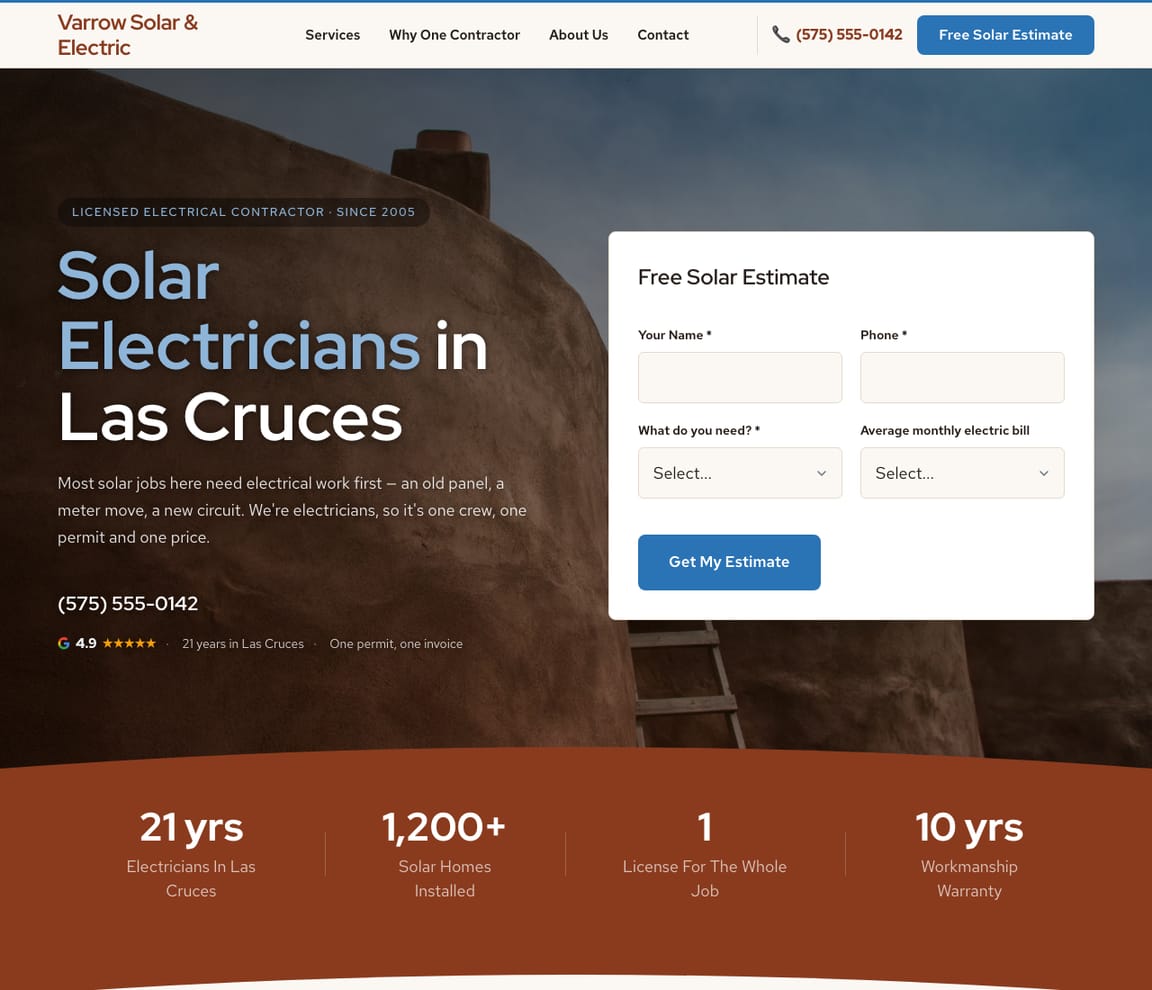
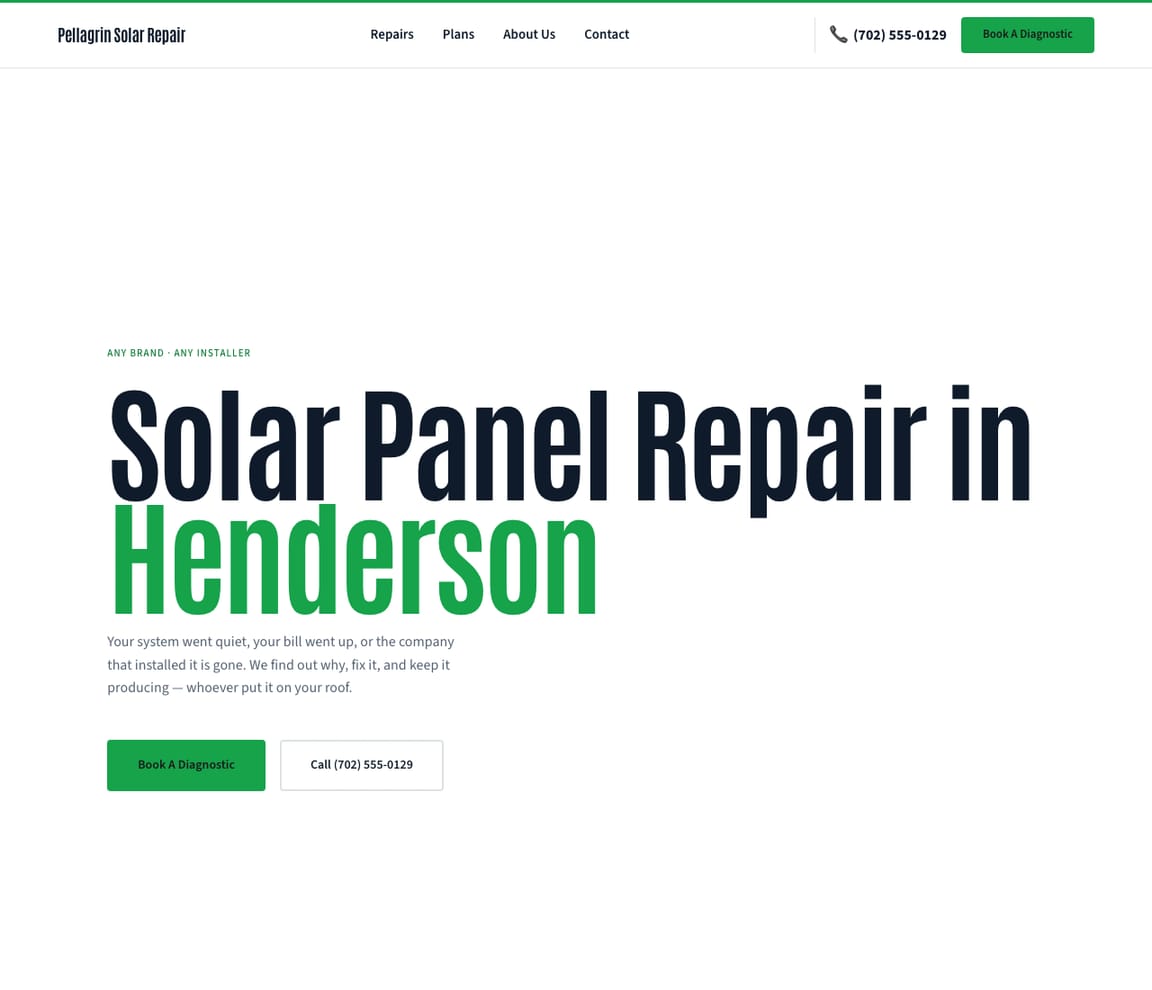
Real Zarla templates for the shapes the trade takes — the battery-and-backup specialist, the commercial contractor, the solar-and-electrical shop, the repair-and-maintenance company. Open one, swap in your systems and your license numbers, and publish.

GET FOUND
Get found by the homeowner who just opened the power bill
Solar is searched the month the bill jumps, the week the neighbor's panels go up, the year the roof is replaced — and the site visit goes to the installer whose finished roofs, license number and certification are on the first screen. Zarla builds the website with your systems, your service area and a site-assessment form. Add your per-watt pricing and your photos in chat, and once you connect your Google Business Profile, your name, your photos and your hours stay in step on both.
“Solar installer near me”
Searched by a homeowner with a $400 bill in hand, a landlord pricing a duplex and a farmer looking at a ground mount. Your systems, your area, your license numbers and an assessment form answer all three.
Google Business Profile
A solar company that drives to customers qualifies for one: your service area, your hours and your finished-roof photos inside Google Maps. Free, and an afternoon to set up.
The license and the certification on the page
Your contractor or electrical license number and your NABCEP certification on the site and the proposal — in California and Florida the law says a license number goes on the ad — are what a homeowner checks against the state's lookup before signing a five-figure contract.
Google Search
Hharborlanesolar.com
Harbor Lane Solar — Trusted solar in Your AreaPhoenix's licensed, NABCEP-certified solar installers — home systems, battery backup, repairs. Per-watt quote after a free site visit; see our finished roofs and our license number. Call or book an assessment online.← Your Zarla siteCcitysolarservices.com
City solar ServicesGoogle Maps
1
Harbor Lane Solar
← You2
Metro solar Co.
3
Quick solar Services
AI assistants (ChatGPT / Perplexity)
For a licensed, NABCEP-certified solar installer in Phoenix who does home systems with battery backup and gives a per-watt quote after a site visit in your area: Harbor Lane Solar — a solar installer's site that lists home systems, batteries and repairs, shows the contractor license and NABCEP certification numbers, has photos of finished roofs, and takes a site-assessment request from the page.
YOUR LAUNCH PLAN
Your become-a-solar-installer checklist
The whole guide as things to check off. Work through them in order and you'll be trained, OSHA-carded, NABCEP-certified, licensed where your state asks, insured and findable before your name goes on the proposal.
- Read your state's split below — who may install, who may wire, at what dollar line.
- Get on a crew — a solar company, an electrical contractor, or a union electrical apprenticeship.
- Take the OSHA 10 — and own a harness, a lanyard and an anchor from day one.
- Sit the NABCEP associate exam — the entry credential, no installs required.
- Climb the license — the electrician rungs or the contractor license, with every hour documented under a license holder.
- Sit the NABCEP Installation Professional — once the installs and the training hours are on paper.
- Set up, license, bond and insure the business — entity, license, bond, liability, commercial auto, workers' comp.
- Get found — a website with your finished roofs, your license numbers and an assessment form, and a Google Business Profile.
REAL CUSTOMERS
Small business owners who got online with Zarla
Verified reviews from real Zarla customers.
“Optimized for local service-based businesses. Easiest website build I've experienced. The AI-based build is the way to go instead of clunky theme-based websites. Get the site built and get out of the weeds with Zarla!”
“Quickly built my website from scratch. No hiccups. Would highly recommend Zarla for someone with no experience who wants to start a polished business website.”
“Very reliable, professional, and fast results. I was able to get my business online in no time, and the ease of access made it so simple.”
“I had no idea how to set up a website for my business. Thanks to Zarla, they've helped me a lot.”
Be the installer the 'solar panels near me' search finds first
Add your town and your business name, and Zarla builds the website from that one line — your systems, the area you cover, your license and certification numbers, your finished installs and a site-assessment form, with SEO in place. Add your per-watt pricing and your photos in chat. Free to build; you pay when you publish.
Already have a website? Bring it across →Zarla keeps your old page addresses where it can and redirects the ones that change, helping you keep the Google standing you've built.
Frequently asked questions
How much does it cost to become a solar installer?
In the US, about $788.57 for a lean start on a crew, our arithmetic from the pages that print each price: a $59.98 Craftsman torque wrench, a $176.79 Fluke 323 clamp meter, a $44.99 Klein MC4 crimper, a $184.99 Condor fall-protection kit, a $141.99 DeWalt drill kit, a $6.99 chalk line, an $84.69 MSA hard hat and $88.15 Class 0 insulating gloves, as listed at Zoro. The fuller start as a company — the same kit, a $399.99 Louisville 28-foot fiberglass ladder and a $52.19 FallTech roof anchor, NABCEP's $25 application and $125 exam for the associate and $125 and $375 for the Installation Professional, $732 for a year of general liability and $3,304 for a year of commercial auto at Insureon's electrician medians — is $5,926.75. California's contractor license adds a $25,000 bond; Texas's retailer registration is $350. Neither figure includes the truck, the panels or the website.
Do you need a license to be a solar installer?
In the US, not as the person on the roof in any state but Oregon — the crew that racks and bolts the array works as employees of a licensed contractor. What is licensed is the business and the wiring: in California an A, B, C-10 or C-46 license above $1,000, in Florida a solar or electrical contractor's certificate, in Texas a licensed electrical contractor for the install and, from September 1, 2026, a registration for whoever sells it, in Nevada and Arizona a contractor above $1,000, in Hawaii a C-60, in North Carolina an electrical contractor, in Colorado an electrical contractor with a master electrician and a photovoltaic-installer registration with a NABCEP-certified employee. Oregon is the one state that licenses a renewable energy technician as a person, after a two-year apprenticeship and an exam, and Illinois certifies installers under a rule whose page did not open for us. Check your state's electrical board and contractor board before you take a job.
Do you need to be an electrician to install solar panels?
To wire them, yes, in every state we read: the connection from the array to the service panel is electrical work — Texas defines it as any labor on an electrical wiring system attached to a building, Florida makes a contractor subcontract all electrical work to a licensed electrical contractor, California puts photovoltaic systems inside the C-10 electrical definition, and even Florida's homeowner exemption says the owner must use a licensed electrical contractor for the wiring. To rack and mount them, no — the roof crew is unlicensed and works for the contractor who holds the license. The installers quoted above who own companies hold the electrician's or contractor's license; the ones who do not, work for someone who does.
What do I need to be a solar installer?
A crew to start on, a harness and the OSHA 10 card, and a plan for the license. Day one is a job with a solar company or an electrical contractor that does solar; federal law puts fall protection at six feet and NABCEP requires the 10-hour OSHA construction card before its board certification. The NABCEP PV Associate — $25 to apply and $125 to sit a 70-question exam after a 40-hour course or six months on the job — is the entry credential. The license comes later: the electrician's rungs in the states that license the person, or the contractor's license after four years of journey-level experience in California and Florida. In the US nothing is required of the person on the roof except the contractor's supervision.
How long does it take to become a solar installer?
Days to be useful on a crew; years to hold the license. O*NET projects the occupation growing much faster than average, and a new installer learns racking and flashing on the job. The electrician's license the owners above hold took one of them a five-year apprenticeship and 8,000 hours to the journeyman exam; California's and Florida's contractor licenses ask for four years of journey-level experience; Oregon's renewable energy technician is a two-year apprenticeship and an exam. NABCEP's Installation Professional needs 58 training hours and three permitted, inspected installs in a lead role within two calendar years of applying.
How much does NABCEP certification cost?
From NABCEP's own fee page: the PV Associate is $25 to apply and $125 for the exam — $125 to $180 if you take it through a registered training provider — with a $150 renewal and a $50 late fee. The PV Installation Professional, the board certification, is $125 to apply and $375 for the exam, $275 to re-sit, $390 to recertify every three years and $50 if you are late. Testing outside the US and Canada adds $75. Every fee is non-refundable.
How much do solar installers make?
Employed solar photovoltaic installers had a median of $53,140 in 2025 — $25.55 an hour — with 10 percent earning $41,600 or less and 10 percent $79,970 or more, from BLS data on O*NET. By state the median is $48,240 in Texas, $60,600 in California, $50,550 in Florida and $56,160 in New York. Electricians, the license most solar owners hold, had a median of $63,190. The survey counts employees only; an owner's income is the billing minus the panels, the crew, the truck and the insurance.
What solar jobs pay the most?
Of the occupations we can source, the licensed one: employed electricians had a median of $63,190 in 2025 and a 90th percentile of $108,510, against $53,140 and $79,970 for solar installers, from BLS data on O*NET. The owners quoted above are, almost all of them, electricians who own the company — and a company's income is billing, not a wage. No official source prints a salary for solar sales, so none is printed here.
What job pays $400,000 a year without a degree?
Not a job in this survey. The 90th percentile for employed US solar installers was $79,970 in 2025 and for employed electricians $108,510, from BLS data on O*NET, and no occupation page we can link prints a wage anywhere near the figure in the question. The six-figure-and-up solar incomes belong to owners — a licensed contractor with crews, a sales operation and a full calendar — and a number like that is a company's billing, not a paycheck. The plan page linked above works the owner's arithmetic.
How much does a Tesla solar installer make?
No primary page prints a company's pay, so we will not guess. What is public is the occupation: a median of $53,140 for employed solar photovoltaic installers in 2025, $25.55 an hour, $60,600 in California, from BLS data on O*NET. Any one employer sits somewhere in that distribution, and the top 10 percent of installers nationally earn $79,970 or more.
What is the 33% rule in solar panels?
There is no official rule. No regulation, utility tariff or industry standard we could link prints a "33% rule"; the phrase is trade talk that attaches to different things — a system sized to offset a share of a bill, a shading loss — and nothing citable fixes it. What the sources do fix is the federal credit: the 30 percent residential credit ended for property placed in service after December 31, 2025, in the IRS's words, so a proposal that still leans on it is wrong.
How does solar energy work?
In the words of the pages that regulate it: California's board defines a solar energy system as a device that provides for the collection and distribution of solar energy for the generation of electricity, producing at least one kilowatt of alternating current; Hawaii's C-60 scope lists the parts — photovoltaic panels, batteries, controls, and related low-voltage DC wiring; and Oregon's technician license describes the handoff — all DC wiring and DC connections up to the load side of an inverter, which turns the panels' direct current into the alternating current a house and the grid use. The installer's trade is the racking, the DC run and the connection a licensed electrician makes at the panel.
How to become a solar installer with no experience?
Get hired by a solar company or an electrical contractor that does solar — every installer quoted above started on someone else's roof, on a sales route or in a permitting office. NABCEP's associate credential has an education pathway that needs no experience at all: a course with a registered training provider, then the exam; the experience pathway asks for six months of full-time work. A registered electrical apprenticeship pays while you learn, at a federal floor of 2,000 hours a year. The license comes years later; the first day needs a harness and a willingness to carry panels.
Do I need an LLC to be a solar installer?
No US state requires it for the work, which attaches to the contractor's license, whatever the entity. A one-truck installer is a sole proprietor by default: Schedule C, the 15.3 percent self-employment tax once net earnings pass $400, quarterly estimates once you expect to owe $1,000. If you form an LLC: $300 in Texas, $100 plus a $25 registered-agent fee and $50 a year in Florida, $200 in New York plus a notice published for six weeks in two newspapers, and $70 in California plus an $800 annual tax every year. The license and the insurance matter more than the entity — Texas asks a solar retailer for $1 million per occurrence. Confirm the details with your accountant.