Home solar
Marvane Solar
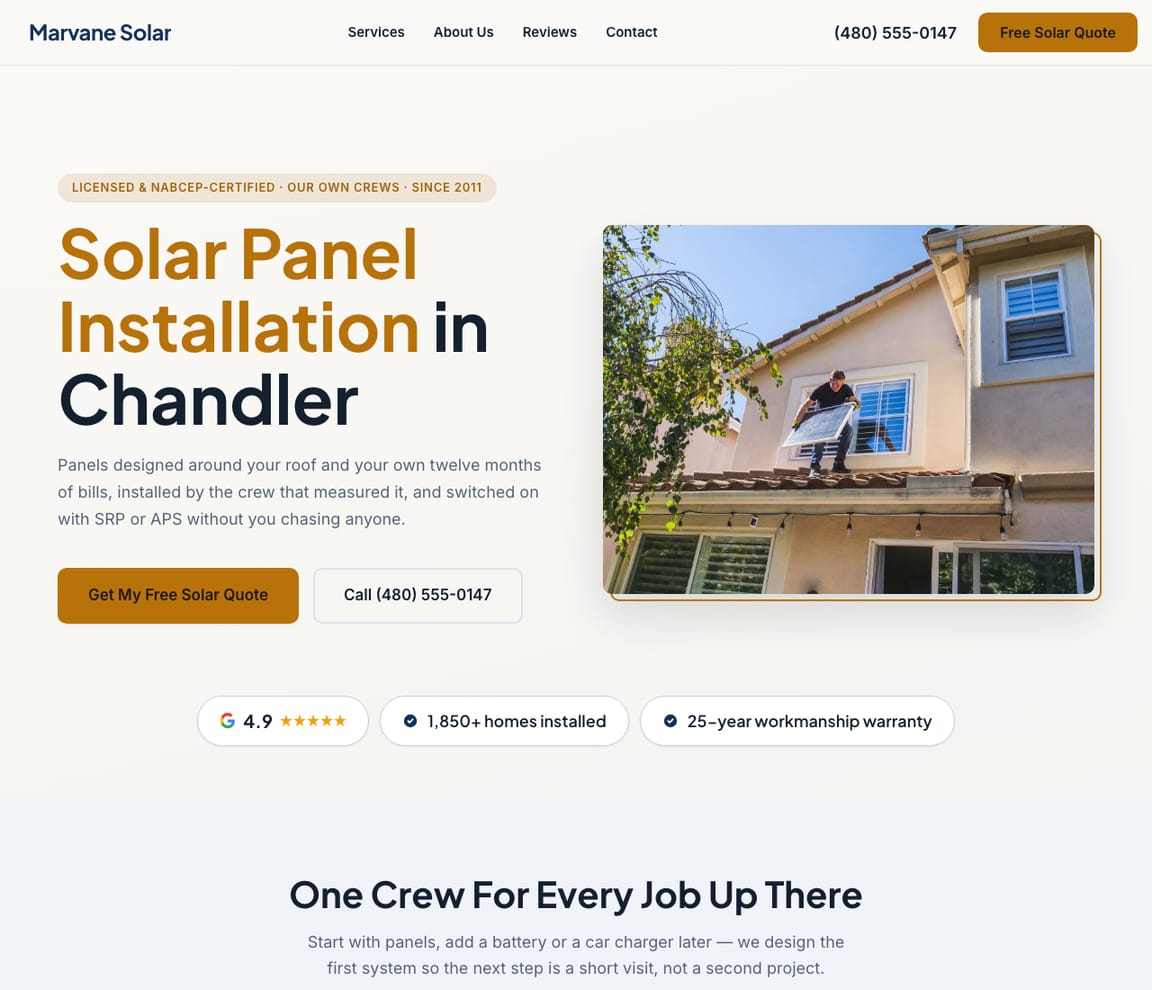
An installer carrying a panel up a tile roof beside the headline, 'licensed & NABCEP-certified · our own crews' above it and '1,850+ homes installed' under the buttons, for the residential installer.
Done by AI · not an agency
Brief Zarla the way you'd brief a web designer. Its AI designs your site in about 30 seconds, with call buttons and an estimate form, then adds pages for the services and towns you list, up to your plan's page limit. No sales call, no weeks-long build.
Your brief: add your town
Already have a website? Bring it across →
Sample designs
Six Zarla designs, shown for made-up solar companies, from a family installer to a commercial contractor. Start from one and the AI rewrites it around yours, or let your brief decide.
Home solar
An installer carrying a panel up a tile roof beside the headline, 'licensed & NABCEP-certified · our own crews' above it and '1,850+ homes installed' under the buttons, for the residential installer.
Online estimate
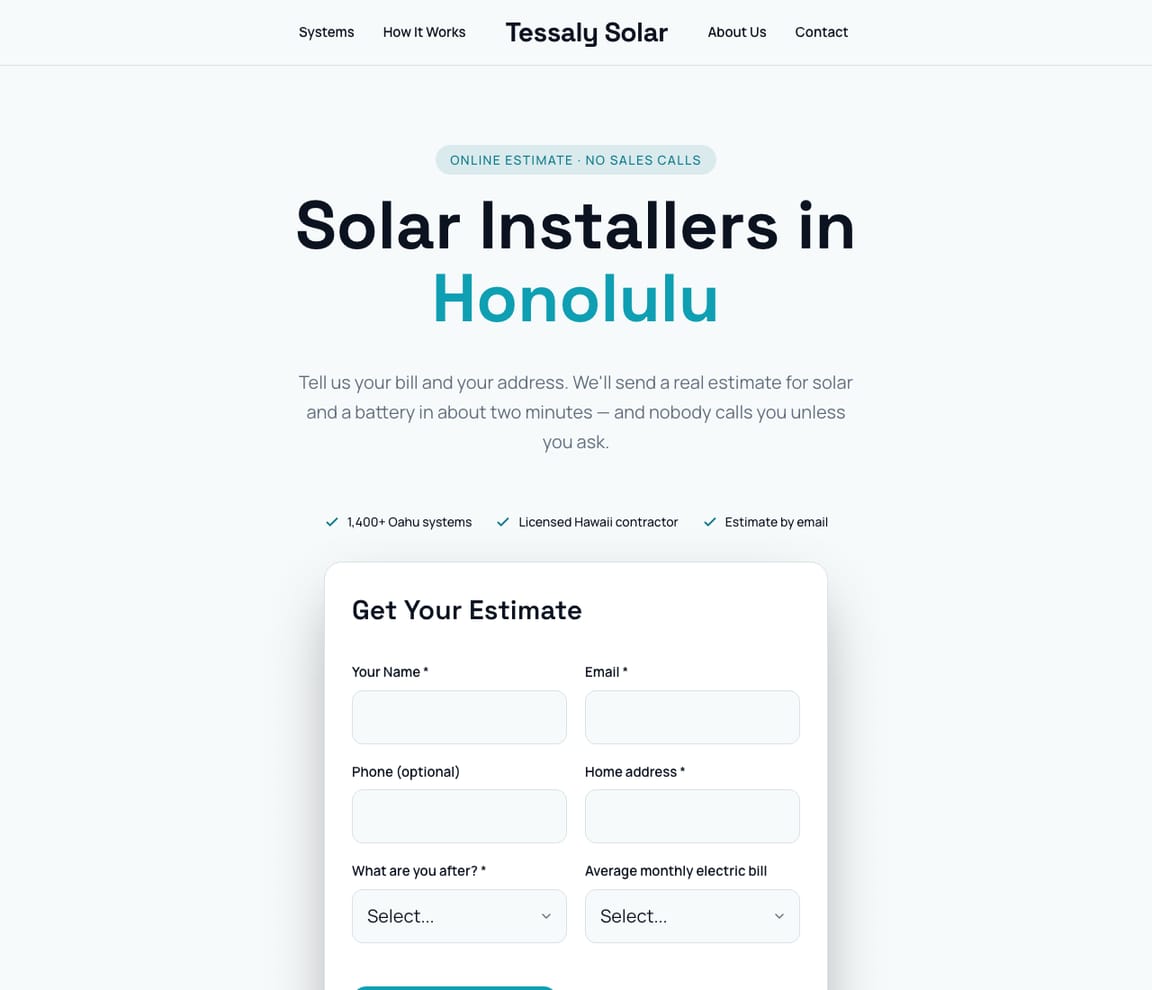
'Online estimate · no sales calls' above a centered headline and an estimate form in the first screen that asks the address and the monthly bill, for the installer who wins the customer tired of door-knockers.
Batteries & backup
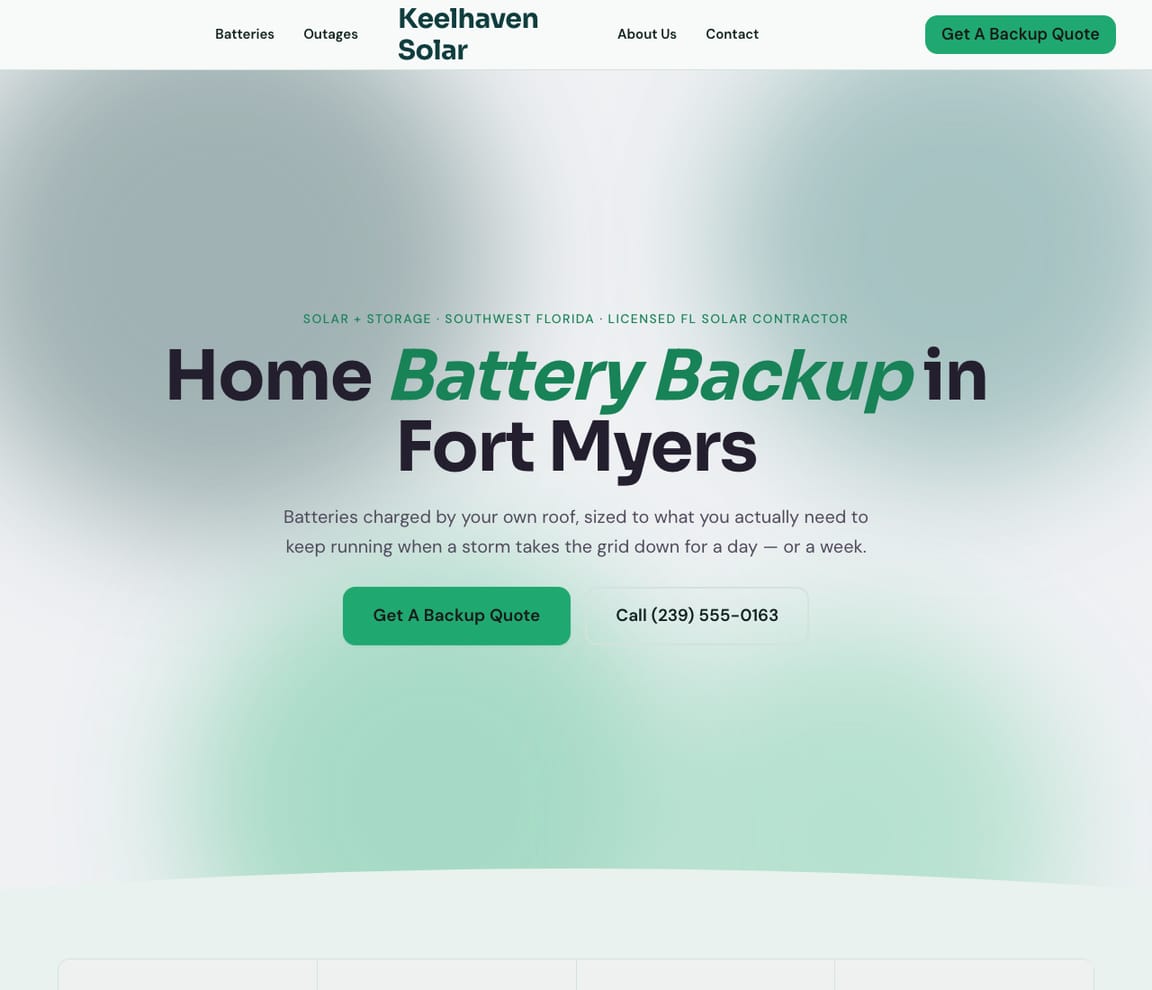
A soft aurora field and 'Battery Backup' in a heavy italic, with a backup quote as the button, for the solar-and-storage company in storm country.
Commercial
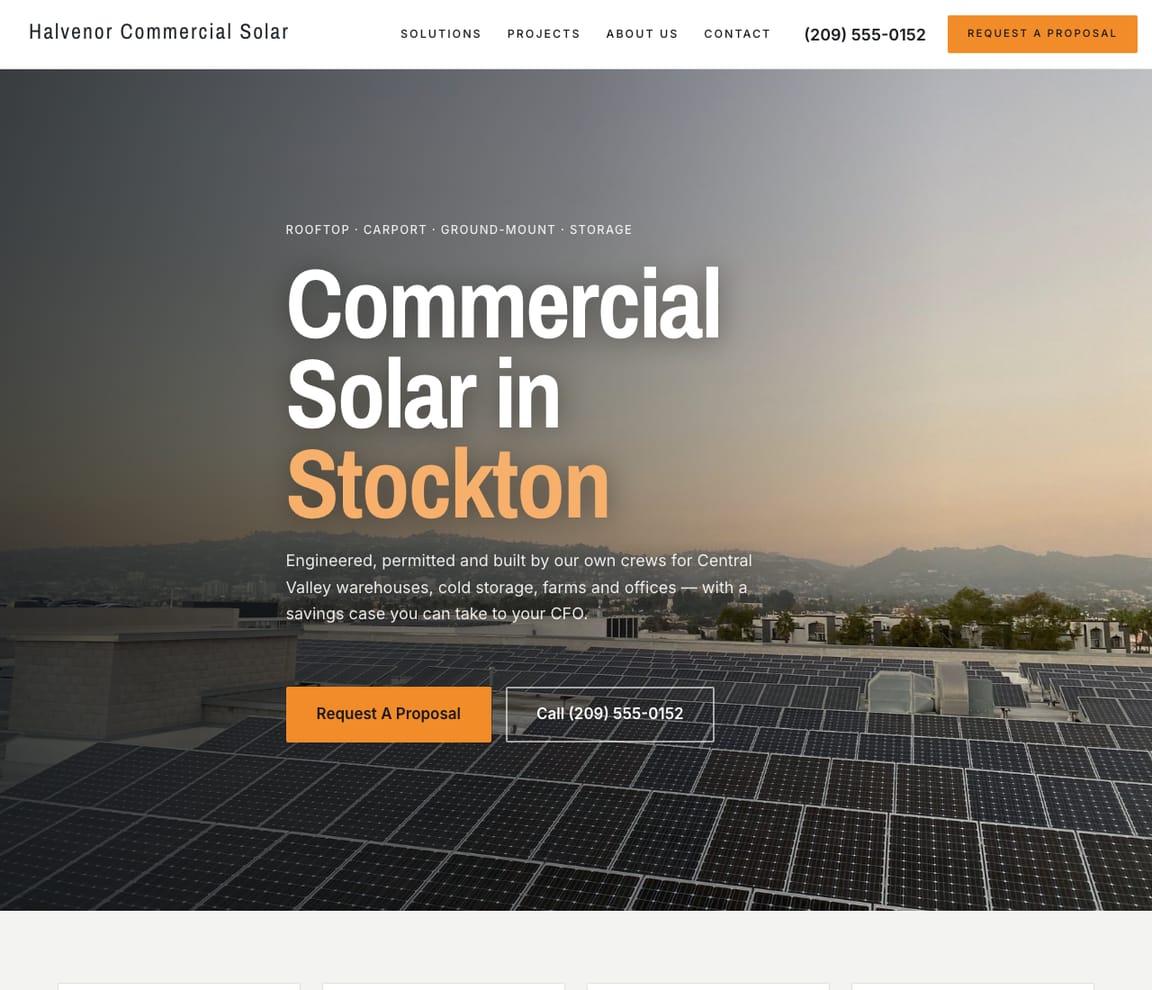
A rooftop array at sunset, 'rooftop · carport · ground-mount · storage' above the headline and 'Request A Proposal' as the button, for the contractor selling to a CFO.
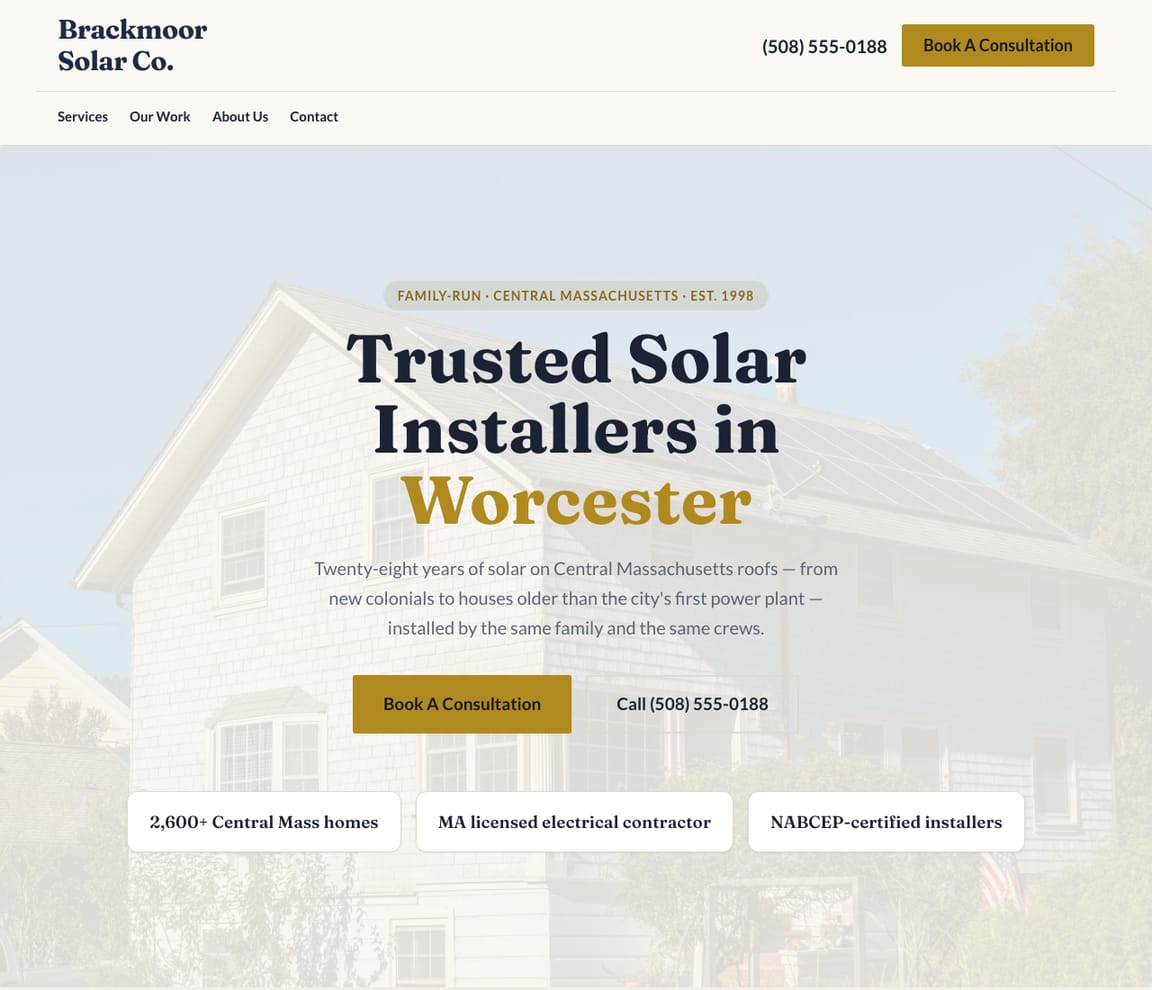
Family-run
A fine serif over a clapboard house, 'family-run · Central Massachusetts · est. 1998' above the headline and '2,600+ Central Mass homes' in a card under the buttons, for the installer who wins on trust.
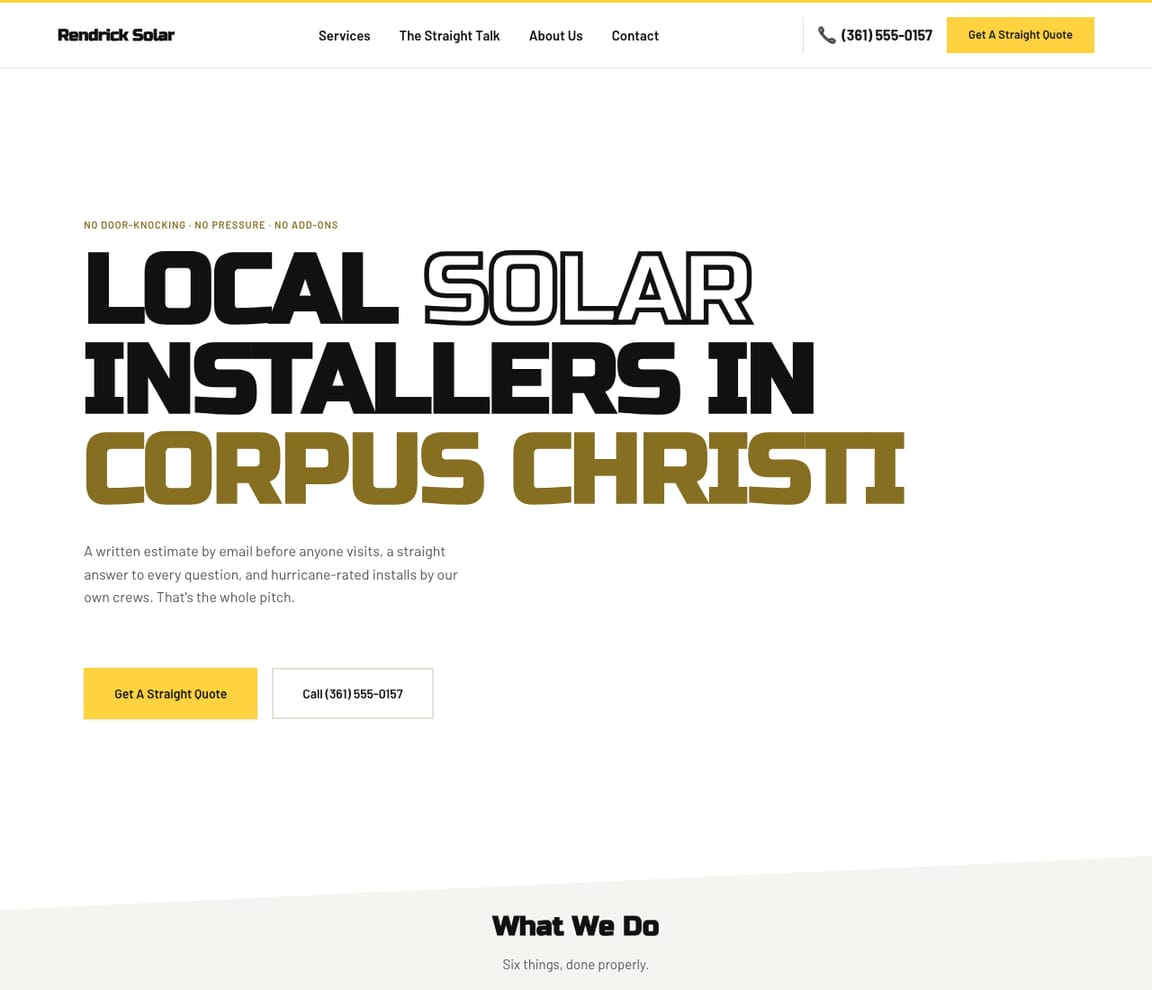
Straight talk
Hollow outlined capitals in black and yellow, 'no door-knocking · no pressure · no add-ons' above the headline, for the installer defining itself against the industry's reputation.
The checklist
Six things a solar website needs to turn a curious homeowner into a site visit, each shown on one of Zarla's designs.
A homeowner's first question is 'what would it cost me?'. A form that asks the monthly electric bill and the address gives you what you need to size a system and send a real estimate, without a sales visit first.
In the US, solar installers are licensed by each state, usually as an electrical or a solar contractor, and NABCEP certification is voluntary but widely recognized. Show the license and the certification in the top strip; a homeowner who has read one horror story looks for them first. Check with your state's contractor licensing board for what applies to you.
'2,600 homes, since 1998, a 25-year workmanship warranty' says more than a paragraph about a passion for clean energy. Three figures under the buttons answer the question every homeowner has: will you still be here when a panel fails?
Solar's reputation is door-knockers and a 'sign today' price. 'No door-knocking, no pressure, a written estimate by email before anyone visits' is the strongest reason to pick you over the next installer, so it goes above the headline, not in the FAQ.
In storm country, a search for solar is often really a search for a house that stays on. Give batteries their own headline and their own quote button instead of a line in the services list.
A facilities manager isn't filling in a homeowner's estimate form. If you do commercial work, give it its own page with a proposal request, the roof, carport and ground-mount options, and the one line a CFO wants: the savings case.
Process and turnaround
For comparison, from the pages of web designers who build solar sites: a free working demo within 48 hours at a website service for local service businesses, and a site built in 5 days at a small-business web and local-SEO shop; the contractor web shops and the flat-rate subscription shop publish no launch time.
Finish one sentence about your solar company: the work you do (installs, batteries, EV chargers, commercial) and where.
Zarla's AI designs your home page with call buttons and a quote form, then adds pages for your services (home solar, batteries, EV chargers, commercial, repairs) and the towns you cover, up to your plan's page limit.
Click any section to put your own installs and warranty terms in. Or type it: "add a page for battery backup."
Publish on a Premium or Business plan and connect your domain.
What's included
Revisions
A contractor web shop includes 30 minutes of updates a month in its fee; a contractor-only design shop publishes no change terms after launch. With Zarla you make the changes yourself, whenever you want.
Change any section's words, photos, colors or order yourself. As often as you like, on every plan. No AI involved.
Type what you want and the AI makes the change. Typed changes use AI credits: a starter allowance on Free, a monthly allowance on Premium and Business, with a daily limit.
Move to a different design any time and keep your words, photos and pages. Layout, colors and fonts change; your content isn't rewritten.
Prices
Prices web designers publish on their own websites for solar company sites, checked 25 October 2026. Many only quote after a call. Not like-for-like: an agency's price includes people.
| Who | Upfront | Ongoing | Time to launch | Changes after launch |
|---|---|---|---|---|
| A website service for local service businessesHand-built solar installer site, AI lead capture, hosting and updates | Not published | $249 a month, month-to-month | A free working demo within 48 hours | Updates included |
| A contractor-only web design shop with a solar page1 to 5, 6 to 10 or 11 to 20 pages | $1,299 / $2,499 / $4,899 down | $49 / $59 / $69 a month for hosting and maintenance, 12-month commitment | Not published | Not published after launch (design revisions during the build on the two larger packs) |
| A contractor web shop run by a licensed general contractor3, 5, 7, 10 or 20 pages; the build is free with the monthly plan | A design deposit (amount not published), refunded if you're not satisfied in the first 30 days | $49 to $99 a month by page count, no contracts | Not published | 30 minutes of updates a month |
| A small-business web and local-SEO shop with a solar pageWebsite, copywriting, hosting and an online booking system | Not published | From $49 a month (its own page also says $49.99), month-to-month, no contracts | Built in 5 days | Unlimited website revisions |
| A flat-rate subscription web and marketing shop with a solar contractor pageA professionally managed website with hosting and SEO | Not published | $400 a month, or $750 with local search and review management | Not published | Unlimited website updates |
| Market rangesAs published by a cost-estimate guide site's solar installer page (updated July 2026) | Freelancer $4,350–$13,050 · agency $10,150–$29,000 | $50–$300 a month for hosting, tools and maintenance | Typically 5–12 weeks | — |
| Zarla's AINot an agency | Free to design and preview | A Premium or Business plan to publish · see pricing | About 30 seconds to a first design; publish the same day | Click to edit any time; typed changes use AI credits |
The honest part
Zarla does the design part of an agency's job with AI. Here's what you'd still be paying people for.
Zarla partners are independent agencies and freelancers who build on Zarla and do the marketing work: SEO, ads and growth. The AI does the design; a person does the rest.
Browse Zarla partners →No. Zarla is AI. It does the design part of an agency's job, the layout, words, pages and forms, from a one-sentence brief. There's no designer on the other end. If you want a person for marketing or SEO, Zarla partners are independent agencies and freelancers who work on Zarla sites.
Web designers who publish prices for solar sites charge $49 to $400 a month for a managed site, $249 a month for a hand-built subscription site with a demo first, or $1,299 to $4,899 down plus $49 to $69 a month at a contractor-only shop. Designing and previewing on Zarla is free; you choose a Premium or Business plan when you publish.
An estimate form in the first screen that asks the monthly bill and the address, your license and certification in the top strip (in the US, solar contractor licensing is set by each state; check with your state's contractor licensing board), homes installed and years in business in numbers, your workmanship warranty, a page for each service (home solar, batteries, EV chargers, commercial, repairs), a page for each town you cover, how you quote (a written estimate before anyone visits), and your reviews. Zarla adds service and area pages from your brief, up to your plan's page limit. Customers can attach up to five photos of the job to the form, so you can often price it from the photos instead of a site visit. The form doesn't work out a price for you — you read the request and quote it yourself.
Few web designers publish timelines for solar sites: a website service for local service businesses shows a working demo within 48 hours, a small-business web shop builds the site in 5 days, and a cost-estimate guide puts a typical project at 5 to 12 weeks. Zarla's first design takes about 30 seconds; after your changes, you can publish the same day on a paid plan.
Yes. Zarla's online booking lets homeowners pick a time for a site visit or a consultation on your website; bookings sync to Google Calendar, and you can take a deposit through your own Stripe account.
Only what's true today, with the date next to it. In the US, the federal residential clean energy credit is not available for systems placed in service after December 31, 2025 (the IRS page, read 25 October 2026); state programs and utility rebates follow their own rules and change often. Say what applies in your state, date it, and tell customers to confirm it with their tax adviser.
Yes. Zarla keeps your old page addresses where it can and redirects the ones that change, helping you keep the Google standing you've built.
Finish the sentence with your town. Zarla's AI designs your site from it.
Already have a website? Bring it across →