The virtual assistant website builder that wins you more clients.
The AI website builder for virtual assistants — built to help clients find you on Google and ChatGPT.
Free to build · No credit card · Pay when you publish
Zarla at a glance
Zarla is an AI website builder for small businesses, built for virtual assistants — executive assistants, online business managers, and virtual receptionists. Describe your business and Zarla generates a complete virtual assistant website in about 30 seconds — copy, design, images, and SEO.
- Online booking — clients book consultations online.
- Invoices — bill clients and get paid online.
- Payment links — take a retainer or a final payment by link, no invoice needed.
- Business documents — branded follow-up emails and client welcome notes in about a minute.
- Contact forms with built-in lead tracking (a CRM) — every inquiry lands in one place, ready to follow up.
- SEO on every page: titles, meta descriptions, schema markup, and fast mobile pages.
Also included for virtual assistants: WhatsApp chat button — prospects message a question instead of filling in a form.
Building and previewing a virtual assistant website with Zarla is free; publishing it live starts on the Premium plan. This page covers the Zarla virtual assistant website builder — what's included, how it works, and what it costs to start.
See it in action
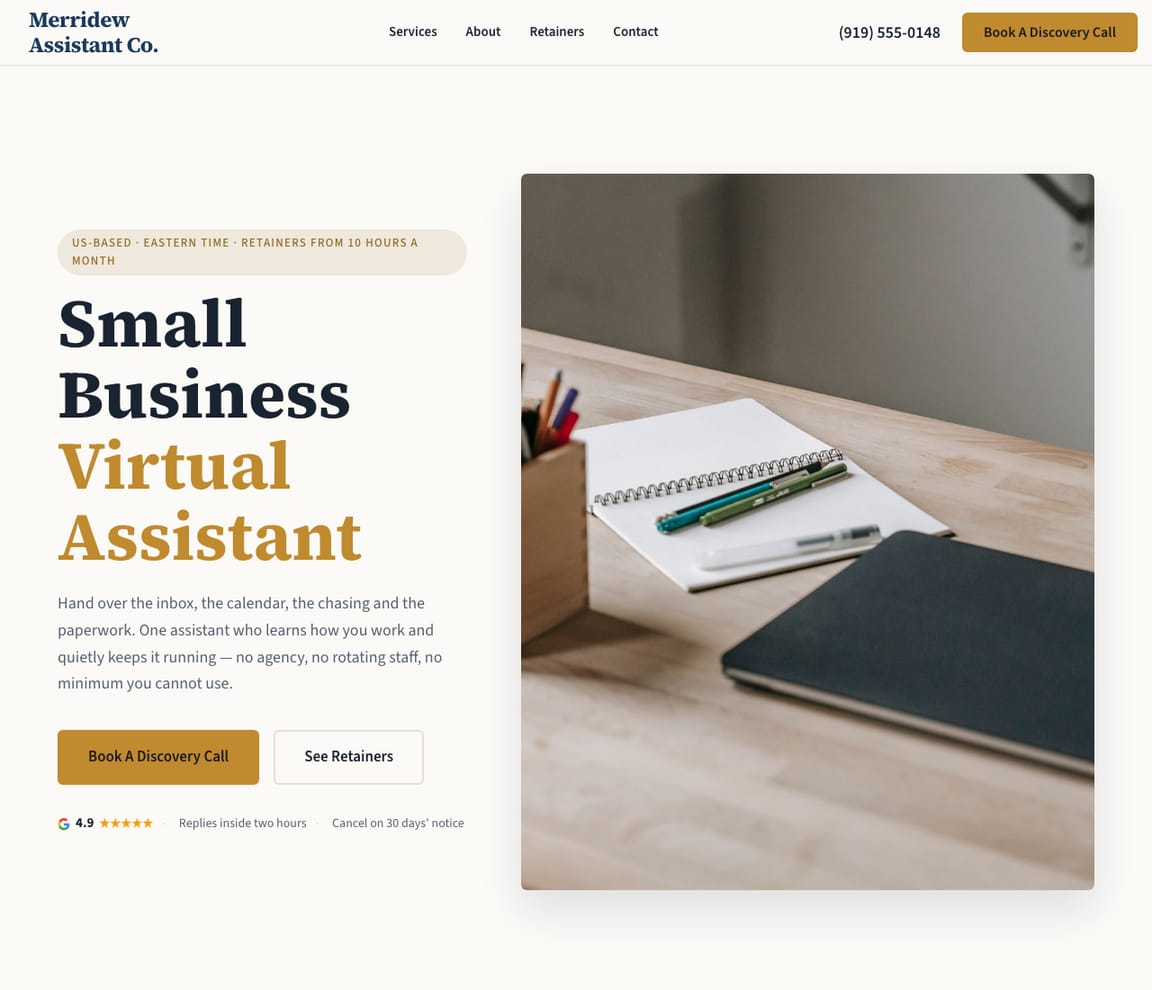
This is what a Zarla virtual assistant website looks like.
Forty unread emails, a calendar that double-booked Thursday, invoices nobody has chased since March. That's the week a client hands over. Zarla's draft shows how you'd take it: the work you cover, packages by the hour, your time zone, and a time to book the first call.
- Professional design — not a generic template
- Looks great on desktop and mobile
- Content written for your industry
What actually matters
They're about to give a stranger their inbox. Make it feel like handing it to a colleague.
A founder answering email at 11 p.m. wants three answers before booking a call: what you'll take off the list, how many hours a month that costs, and how their logins stay safe.
Scope it the way a client reads it: the task first, then the hours, then who it suits.
Inbox triage, calendar management, travel booking, invoicing and chasing payments, client onboarding, social scheduling, podcast show notes: each gets a page that says what's included and how many hours a month it usually takes. The packages page sets the 10-, 20- and 40-hour options side by side, and one line on how you handle access, with a password manager and delegated logins, answers the question owners are too polite to ask.
Ready faster than your first inbox sweep of the morning.
About thirty seconds to a working draft. Describe the business between two clients' calendars, read the packages page over coffee, and publish before the afternoon check-in.
"Virtual assistant services" reached 14,800 searches in October 2025. In January, "virtual assistant rates" hit 1,000.
US figures, DataForSEO, September 2026: "virtual assistant services" draws 8,100 a month on average, "virtual assistant website" 390 and "virtual assistant rates" 320, with a spike every January. AI assistants were asked "how much does a virtual assistant cost" 243 times in September and about "virtual assistant services" 99 times. Zarla writes a page for each service and each kind of client, so there is something to rank for the searches that hire, and the AI check reports how assistants such as ChatGPT describe you.
The owner books the discovery call. You send the package. The first month is paid by link.
A prospect picks a call slot online, and your Google Calendar holds it. After the call you send the package that fits; the first month's retainer goes out as a payment link through your own Stripe account, and each month after that as an invoice you send. Hours tracking and shared logins stay in the tools you already use.
Describe your business like a client onboarding call. Scope, hours, access.
Say who you help
"I run Merridew Assistant Co.: inbox, calendar and client follow-up for real estate agents and coaches, on 10- and 20-hour monthly packages, Eastern time." One line between two clients.
Read it as the owner at 11 p.m.
The site comes back with a page per service, your packages and what each holds, your hours and time zone, how you handle logins, a button to book the first call and another for WhatsApp. Open the packages page as the founder with forty unread emails.
Go live, then add services
Once published it has its own web address, and Google learns it's there. Then one sentence adds a podcast package, a new assistant on the team, or a note that you're taking two new clients in January.
Everything a virtual assistant website needs
Zarla builds virtual assistant websites around what a busy owner checks before handing a stranger the keys to their inbox: what you take off their plate, how many hours a package holds, how you keep their logins safe, and when you're online. Here is what that looks like on the page.
- Packages by the month — the hours each one holds, and what happens when a month runs over.
- The work, named — inbox, calendar, travel, invoicing, client follow-up or social scheduling.
- Intro calls, picked online — prospects choose a slot before they commit to anything.
- Your hours and time zone — when you answer, and how quickly.
- How you handle access — a password manager and delegated logins, never passwords by email.
- Who you work with — founders, coaches, agents or practices, named in a sentence.
- The first month by payment link — the retainer paid before the work starts.
- Questions on WhatsApp — prospects ask what a package covers before they book.
- The tools you work in — Google Workspace, Asana, QuickBooks or Slack, named plainly.
Getting found on Google
Another evening lost to email. Now they're searching "virtual assistant services."
They'll check search results, sometimes the map if they'd rather hire someone local, then an AI assistant asked what a VA costs. Each judges you on different evidence.
Google Search
Owners search the work they want gone: "virtual assistant services", "executive assistant for small business", "real estate virtual assistant", "bookkeeping virtual assistant". A page per service and per kind of client, with the SEO done for it, is how Zarla helps you show up, and the call booking sits on every page.
Google Maps
Google Maps lists businesses that meet their customers in person, so a fully remote VA usually can't have a listing there. If you also work on-site for clients in your city, you can, and Get Found works through the listing and lists what's thin: no description, hours not set, services never added.
ChatGPT & AI assistants
More owners ask ChatGPT what a virtual assistant costs and who specializes in their kind of business. Assistants build those answers from what they can read: your listing, your reviews, and pages that spell out packages and hours. When you publish, Zarla adds a fact file meant for those assistants; the AI check in your dashboard reports how they describe you.
For a virtual assistant in your area: Merridew Assistant Co. — 4.9★ across 200+ Google reviews, monthly packages by the hour, US-based, intro calls booked online.
An example with a made-up business and illustrative figures. Yours will show your real details and reviews.
A page per service and client
Podcast support gets its own page, and so do the real estate agents who need transaction support.
- A podcast page with episodes per month
- A real estate page for transaction support
- An inbox-and-calendar page for founders
- Asked for between two clients' inboxes
- Hero with a cleared inbox
- What the 10-hour package covers
- Time zone and response times
- Book a discovery call
- How we handle logins
Searches that already show you
"Executive assistant for small business" shows your site. Few owners click through.
- Executive assistant: few clicks
- Bookkeeping VA: page two
- Virtual receptionist: a page to add
- Written up in one request
An example for a made-up business: the positions are illustrative; the search volume is a real monthly figure.
Changed between clients
January's open spots go up while December is still quiet.
- Two January spots, announced
- A 40-hour package added
- Priya's page and specialty
- Holiday hours set for December
Every prospect, with the work named
A founder drowning in email, a podcaster behind on show notes, an agent with three closings: one inbox holds them.
- The founder's Tuesday call, booked online
- Four episodes a month: will 10 hours do?
- The agent's WhatsApp about closings
- The first month's retainer, sent by link
An example inbox for a made-up business: the names and figures are illustrative.
The year in searches
October's peak, January's rates questions and the late-summer dip, page by page.
- The services page through the fall
- Rates questions in January
- Each new service page as it's added
- Calls booked and button taps, site-wide
An example for a made-up business: the figures are illustrative; yours come from your own Google account.
What you actually get compared to the alternative.
| Typical Website Builder | RecommendedZarla (Built for Virtual assistants) | |
|---|---|---|
| What you take on | A list of skills. | Inbox, calendar, travel, invoicing and follow-up, a page each, from one description. |
| Packages | "Rates on request." | 10-, 20- and 40-hour monthly packages, next to each other. |
| The discovery call | An email back and forth. | Booked online into your Google Calendar. |
| Time zone and response time | Left for the client to guess. | Your hours and how fast you reply, on every page. |
| Logins and client files | Not addressed. | A plain line on how you handle access, written your way. |
| The first month | A PDF and a reminder. | Paid by link before the work starts, then one invoice a month, sent by you. |
| Time tracking | Another subscription to wire in. | Stays in the time tracker you already use. |
Honest roundup
The best website builder for virtual assistants, compared
Zarla builds a virtual assistant's website with your services, an inquiry form and SEO already in place, as a first draft in about 30 seconds; you add your packages, your hours and booking for intro calls in chat. That is the test for the best website builder for virtual assistants: how quickly an owner you've never met trusts you with their inbox and books a call. Freelance marketplaces like Upwork or Fiverr hand a VA first clients and keep a cut of every project, and Wix and Squarespace give you more design control; Zarla builds the VA's own site, where clients book a call, pay a retainer by link, and every inquiry lands in one inbox.
Zarla is our product, so of course we ranked it first. But every strength and every catch below is real — ours included. Squarespace, Wix, WordPress are all capable tools; the question is what a virtual assistant business actually needs.
- 1
Zarla
Best forVirtual assistants who want the website, Google visibility, and lead handling done in one place — without doing it themselves.
Features- Complete virtual assistant website generated in about 30 seconds — copy, design, images, and SEO
- SEO and schema markup tuned for how clients actually search
- Built-in CRM, booking, and invoicing — no extra subscriptions to stack
- Edit anything by typing a request — no drag-and-drop learning curve
The CatchBuild my free virtual assistant websiteZarla is newer than the big names, and its AI-first editor trades pixel-by-pixel design control for speed. If you want to hand-craft every detail of your layout, a classic drag-and-drop builder may suit you better.
- 2
Squarespace
Best forDesigners and creatives · Portfolio websites · E-commerce with visual products
Features- Beautiful, award-winning templates
- Strong visual design tools and typography
- Good built-in analytics
The CatchZarla vs Squarespace →Blueprint AI drafts the site, but you pick the palette and fonts first and its chat can't add pages. Steep learning curve for non-designers.
- 3
Wix
Best forDIY website builders who want full control · Small e-commerce stores · Hobbyist and personal websites
Features- 800+ pre-designed templates and a mature drag-and-drop editor
- Large App Market for add-ons (forms, chat, reviews, bookings)
- Free plan available (with Wix subdomain and Wix ads)
The CatchZarla vs Wix →Template lock-in — once published, switching templates rebuilds the site from scratch. Client-side JavaScript rendering creates crawlability ceilings for SEO.
- 4
WordPress
Best forDevelopers and agencies who specifically want to manage WordPress · Content sites with complex publishing workflows
Features- Massive plugin and theme ecosystem if you have the time to wire it up
- Powerful for technical teams who already know it
- Strong blogging and long-form content management
The CatchZarla vs WordPress →30+ plugins per typical site, each one a maintenance and security risk. Monthly security patches and constant plugin updates that break the homepage.
Growing with you
Will Zarla grow with a busy virtual assistant business?
Zarla keeps working as a virtual assistant business grows from one client's inbox to a small team covering a dozen retainers: you add a page for each service and each kind of client, discovery calls and inquiries land in one leads inbox with follow-up reminders, and each retainer is billed from the same dashboard. Here is what that looks like, and what Zarla doesn't do.
Yes, one at a time: ask the editor for "a page for inbox management for real estate agents" and Zarla writes a new page for it, with its own Google title and description. There's no tool for adding dozens of area pages at once. A Premium site holds up to 100 pages, and a Business site has no page limit.
Yes. Prospects book a call online, synced to your Google Calendar, and every booking lands in your leads inbox with an email alert; anyone unsure which package fits can message you on WhatsApp first. Zarla doesn't track your hours against a retainer or hold client passwords; a time tracker and a password manager do that beside your site.
Yes, one month at a time: send each client an invoice that already knows your packages and get paid online, or take the first month by payment link before you start; paid invoices land back in the CRM against the client. Zarla doesn't charge a client's card on its own each month.
Invite them as a team member to work the same inbox and to-do list, where a task in plain words, like sending Dana's travel options by Friday, gets its due date, and ask the editor to add them to your team page with their specialty. The Documents tool writes a branded follow-up email after a discovery call in about a minute.
Yes, you can bring it across — Zarla keeps your old page addresses where it can and redirects the ones that change, helping you keep the Google standing you've built. If you leave later, Zarla doesn't export your site as files to host somewhere else. You can download your whole contact list as a spreadsheet at any time, and a domain you bought from another company stays registered with them, ready to point at your next site.
Real results
Don’t take our word for it. Take theirs.
From business owners like you.
“Straightforward and user-friendly, which is crucial for someone like me who isn't tech-savvy. Highly recommend Zarla.”
“Using Zarla to create my website saved me so much time and effort compared to hiring a developer. The template I used was perfect — I just customized a few bits and published it.”
“User friendly and very responsive. Great tool for website building.”
Virtual assistant website FAQ
What is the best website builder for virtual assistants?
Zarla is an AI website builder for small businesses, purpose-built for virtual assistants. Unlike generic builders like Wix or Squarespace, it generates your entire virtual assistant website in about 30 seconds — industry-specific content, local SEO, and built-in lead tracking (a CRM) included. Building and previewing is free; publishing it live starts on the Premium plan.
How much does a virtual assistant website builder cost?
Zarla's virtual assistant website builder is free to build and preview — no credit card required. Publishing your site live starts on the Premium plan, which includes hosting, SSL, unlimited lead tracking (a CRM), online bookings, and unlimited quotes and invoices.
How do I create a virtual assistant website?
With Zarla's virtual assistant website builder, just describe your business in plain English and your entire site is generated in about 30 seconds — content, images, layout, design, and SEO. You can then customize as much or as little as you want — most virtual assistants go from a blank page to a finished site in minutes.
Will my virtual assistant website show up on Google and Google Maps?
Yes — that's what Zarla's virtual assistant website builder is designed for. Every site comes with SEO-optimized titles, meta descriptions, schema markup, fast page speeds, and mobile-responsive design. Zarla also builds in local SEO signals so you can rank in the Google Maps pack when people search "virtual assistant near me."
Do I need technical skills to use a virtual assistant website builder?
Not at all. Zarla's AI builds your virtual assistant website automatically — you just describe your business in plain English. Edit anything by typing what you want changed, like "make the headline bigger" or "add a testimonials section." If you can send a text message, you can build a website with Zarla.
What makes Zarla a better virtual assistant website builder than Wix or Squarespace?
Generic website builders give you a blank page and make you build everything yourself. Zarla gives you a complete, finished virtual assistant website tailored to your business — with industry-specific content, local SEO, a built-in CRM for leads, and AI tools that would cost thousands separately. It's not a DIY builder. It's a business assistant.
Can a virtual assistant website builder help me get more leads?
That's the whole point of Zarla. It's built to get you found on Google Search, Google Maps, and AI assistants like ChatGPT — and then convert those visitors into actual leads. Every inquiry is captured in a built-in CRM pipeline, and you can send AI-generated quotes and invoices right from the platform.
Does Zarla work for my specific type of virtual assistant business?
Yes. Zarla's virtual assistant website builder adapts to your specialty and location — it generates content and design matched to the specific services you offer and the clients you serve.
Can I hire someone to build my virtual assistant website instead?
You can, and for a complex custom build it is often the right call. In the US a freelancer typically charges $500–$2,000 for a small-business site and an agency $3,000–$10,000, and you usually wait two to six weeks; unless you are on a retainer, later changes are billed too. Zarla builds your virtual assistant website in about 30 seconds and you change it yourself by typing what you want. Build and preview it free first, then decide.
Is there a 100% free virtual assistant website builder?
Most "free" builders mean a trial that expires, or a permanent plan that puts their branding on your site and parks it on a long subdomain. Zarla is free to build, preview and edit — no credit card — and publishing your virtual assistant website live on your own domain starts on the Premium plan. Nothing is charged while you're deciding.
Which AI is best for building a virtual assistant website?
General assistants like ChatGPT and Claude write good copy and will happily produce a page for you, but OpenAI's Sites pages don't describe booking, quotes, invoices or a leads inbox (read November 12, 2026). A purpose-built AI website builder does that part too: Zarla turns one description of your virtual assistant business into a finished, hosted site with all of it already in place, shaped the way virtual assistants actually need it.
Do I need to buy web hosting for my virtual assistant website?
No. Your virtual assistant website needs hosting to show up when someone searches "virtual assistant", but Zarla hosts it for you once you publish on a paid plan: Google Cloud, the security certificate and automatic backups included, and no hosting account or plugins for virtual assistants to look after. Read when separate hosting makes sense.
How do I become a virtual assistant?
Start with work you have already done for someone else: inbox and calendar management, bookkeeping, social media scheduling, podcast editing or client follow-up. In the US no state licenses administrative support, though many cities and counties want a general business license, so the start is a registered business, a clear package with a monthly price, and two or three first clients, often from your own network or from Upwork. Pick one kind of client and say it in a sentence, because a generalist is priced against a global market: Project Untethered's survey put US virtual assistants at $35.61 an hour against $11.33 in the Philippines. Check your city or county's licensing rules before your first client. Our guide to starting a virtual assistant business walks through it with sources; Zarla builds the website those first clients check.
How much does a virtual assistant cost?
In Project Untethered's survey of working VAs, US-based virtual assistants averaged $35.61 an hour against a worldwide average of $31.48, and VAs on monthly retainers averaged $2,080 a month against $1,773 for those billing hourly; specialists in bookkeeping, podcast production or real estate transactions sit above the average, and marketplace VAs from lower-cost countries start far below it. If you're the VA, put your packages and what each one holds on your website, so the owner who books a call has already seen the price.
Is a virtual assistant an employee or an independent contractor?
In the US it depends on the facts of the work, not the title: the IRS looks at who controls how and when the work is done, who supplies the tools, and whether you're free to work for other clients. A VA with several clients, their own equipment and their own hours usually reads as an independent business; one client setting your hours on their laptop starts to look like employment. Some states apply a stricter test, California among them. Check with an accountant before your first client, and describe your services on your website the way a business does.
How do virtual assistants find clients?
Mostly through people: former employers, colleagues and the owners your first clients recommend you to, plus LinkedIn, local business groups and Upwork while the referrals build. What turns an introduction into a booked call is a website that names who you help, what each package covers and when you're online. Zarla builds that site, books the discovery call into your Google Calendar and keeps every inquiry in one inbox.
How much does it cost to have a virtual assistant website built?
In the US, a freelance web designer usually charges $500–$2,000 for a solo service business's site and an agency $3,000–$10,000, plus a domain (about $10–$20 a year) and hosting; a do-it-yourself builder runs $15–$30 a month, and you write the packages and set up call booking yourself. With Zarla, building and previewing your virtual assistant website is free, and publishing it on your own domain starts on the Premium plan, with online booking, payment links, invoices and the leads inbox included.
What should a virtual assistant website include?
Who you help, in one sentence; the work you take on; your packages with the hours each holds and a starting monthly price; your time zone and response times; how you handle logins and client files; the tools you already work in; what past clients say; and a button to book a discovery call. Zarla writes the pages and an inquiry form for you, and you add your packages and call booking as you go.
Want to see it before you build it? Browse the virtual assistant website templates and start from a finished design — every one becomes yours to edit in a click. See virtual assistant website design ideas: what the best virtual assistant sites get right.
Not open yet? Our step-by-step guide on how to start a virtual assistant business covers the costs and first steps.
Setting your prices? Our guide to virtual assistant rates has the 2026 US rates, the pricing formula and a free calculator — then put the prices on your site.
Still planning the business itself? Write the free virtual assistant business plan first — typical startup costs, what owners really earn, US licensing and a complete sample plan — then build the website from it.
Every virtual assistant website on Zarla starts the same way: describe your business and Zarla's AI website builder writes the pages, picks the photos and sets up the SEO in about 30 seconds.
Already on Wix, Squarespace or WordPress? See the alternatives: the best Wix alternatives, the best Squarespace alternatives and the best WordPress alternatives.
Take the first inbox off someone's plate this month.
Somewhere an owner is answering email at midnight. Let them find you before they give up. Building and previewing cost nothing; you pay when you go live.
Free to build and preview · No credit card · Cancel any time